
The little peasant
Oil on canvas, 1918
Identification
- Published titles
- English: The little peasant; The young farmer; The peasant boy.
French: Le petit paysan. - Date
- c. 1918 (Tate, inv. N05269, 100 × 64.5 cm, oil on canvas). Ceroni, Patani, Parisot and MR date the canvas 1918. Pfannstiel dates it 1917; Lanthemann dates it Nice 1919.
- Medium
- Oil on canvas. This investigation notes possible traces of tempera.
- Dimensions
- 100 × 64.5 cm (1963 exhibition: 100 × 65 cm).
- Signature
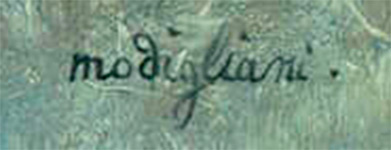
- Signed modigliani. at top right. The words le petit paysan are painted at bottom right.
- Present location
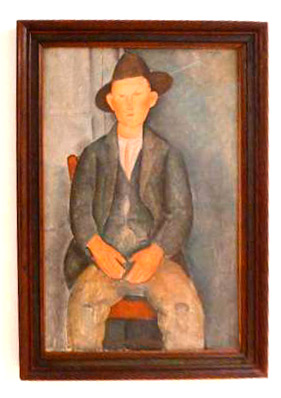
- Tate, United Kingdom (inv. N05269). Presented by Miss Jenny Blaker in memory of Hugh Blaker, 1941. The museum dates the canvas c. 1918 and gives 100 × 64.5 cm, which matches this file.
Catalogue numbers
| Compiler | Number |
|---|---|
| Arthur Pfannstiel | no. 121 |
| Joseph Lanthemann | no. 373 |
| Ambrogio Ceroni | no. 257 |
| Jeanne Modigliani | YES |
| Christian Parisot | no. 39/1918 |
| Osvaldo Patani | no. 270 |
| Modigliani Project | YES |
| MR | YES |
| Modigliani Initiative | ? |
Legal note on MR: This investigation has not had access to MR’s catalogue raisonné; all research here is based on open sources, publications and exhibitions. By no means has that catalogue been copied at any point. Modigliani Project and Modigliani Initiative are marked YES when the work is published or otherwise recorded by those projects, even if no catalogue number is assigned; otherwise the field is marked ?.
Provenance
- Léopold Zborowski, Paris.
- Mansard Gallery, London.
- Hugh Blaker Collection, Isleworth-on-Thames (purchased through Zborowski at the Mansard Gallery or during Zborowski’s London visit in 1919).
- Jenny Blaker Collection, Isleworth-on-Thames, 1936 (by descent).
- Tate (inv. N05269), gift of Jenny Blaker in memory of Hugh Blaker, 1941.
The sequence follows the published museum, sale, and catalogue record in this investigation. Gaps and uncertain transfers are marked as such.
Selected bibliography
Book-length publications are marked with a footnote giving a full citation. Exhibition catalogues appear in both this list and the exhibition list when this investigation recorded them in both places. Where this investigation listed a long run of secondary mentions, only the principal catalogues and museum or sale references are retained here.
- The Burlington Magazine 35 (1919), p. 121.
- Colour 11 (December 1919), p. 94.
- Arthur Pfannstiel, 1929 presumed catalogue, pp. 30, colour pl. 18.1
- Arthur Pfannstiel, 1956, no. 121, dated 1917.2
- Joseph Lanthemann, 1970, no. 373, dated Nice 1919.3
- Ambrogio Ceroni and Leone Piccioni, 1970, no. 257, dated 1918.4
- Ronald Alley, Tate catalogue, 1981, pp. 529–31.5
- Christian Parisot, 1991, no. 39/1918.6
- Osvaldo Patani, 1991–94, no. 270.7
- Kenneth Wayne, 2002, no. 34.8
- King et al., The Burlington Magazine 160 (May 2018), pp. 394–399.9
Exhibitions
- London, Mansard Gallery, French Art 1914–19, 1919, no. 41, as Little peasant.
- Dublin, Mills’ Hall, Pictures by Modern Artists, 1922.
- On loan to the Tate Gallery, 1927–39.
- London, Storran Gallery, 1937, no. 8.
- London, Tate Gallery, Modern Italian Art, 1950.
- Boston, Museum of Fine Arts, and Los Angeles County Museum, 1961, no. 15, dated c. 1917.
- Edinburgh, Royal Scottish Academy, and London, Tate Gallery, 1963, no. 39.
- Düsseldorf and Zurich, 1991, no. 73.
- Buffalo, Fort Worth and Los Angeles, 2002–03, no. 34.
- New York, Toronto and Washington, Modigliani: Beyond the Myth, 2004–05.
- London, Royal Academy, 2006, no. 33.
- Moscow, Pushkin Museum, 2007.
- Madrid, Museo Nacional Thyssen-Bornemisza, 2008.
- London, Tate Modern, 2017–18.
Notes
D’Atri papers no. 326, as The little peasant, dated 1917, Paris, 100 × 65 cm; provenance Zborowski > Netter > Blaker 1929 > National Gallery, London. The Netter step is not supported by Blaker’s own record.
Hugh Blaker wrote in his diary on 31 March 1932, after Zborowski’s death, that in 1919 Zborowski brought canvases to London rolled, without stretchers, and that Blaker bought four of them. The purchase is the documented first English ownership. Pictures from the same visit were also bought by Arnold Bennett and by Osbert and Sacheverell Sitwell.
Holes are visible at the four corners.
The canvas was examined in the Modigliani technical research study published in The Burlington Magazine 160 (May 2018), pp. 394–399. The published extract describes a limited, consistent palette and a thin paint layer associated with the southern French period. Pigments published for this canvas: zinc chromate yellow; lead and zinc white; vermilion; ochre; organic red lake; bone black; viridian; Prussian blue (with synthetic ultramarine noted).
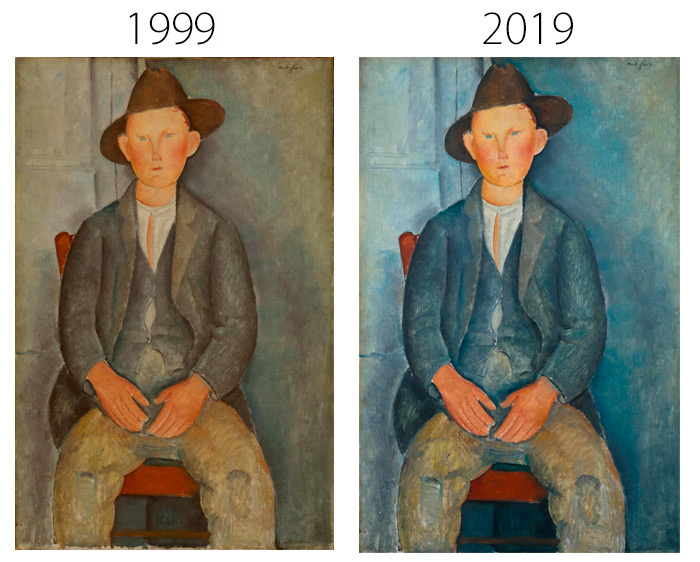
A later cleaning is recorded in this investigation; no conservation report is cited here.
The same sitter appears in a companion peasant portrait (the Orangerie apprentice, 1918-w-117).
This investigation marked several fields as still being checked. The facts above are those already published; where sources disagree, both readings are given.



Footnotes
- Arthur Pfannstiel, Modigliani. L’Art et la Vie, preface by Louis Latourette, Paris, Seheur, 1929 (presumed catalogue).
- Arthur Pfannstiel, Modigliani et son œuvre, étude critique et catalogue raisonné, Paris, Bibliothèque des Arts, 1956.
- Joseph Lanthemann, Modigliani, catalogue raisonné: sa vie, son œuvre, son art, Barcelona, G. Condal, 1970.
- Ambrogio Ceroni and Leone Piccioni, I dipinti di Modigliani, Milan, Rizzoli, 1970.
- Ronald Alley, Catalogue of the Tate Gallery’s Collection of Modern Art other than Works by British Artists, London, Tate Gallery and Sotheby Parke-Bernet, 1981.
- Christian Parisot, Catalogue raisonné Modigliani, Livorno, Graphis Arte, 1991.
- Osvaldo Patani, Modigliani. Catalogo generale, Milan, Leonardo, 1991–94.
- Kenneth Wayne, Modigliani and the Artists of Montparnasse, New York, Abrams / Albright-Knox Art Gallery, 2002.
- Annette King, Silvia A. Centeno, Isabelle Duvernois, J. Paul Getty / LACMA / Tate collaborators, “The Modigliani Technical Research Study: Modigliani in the South of France,” The Burlington Magazine 160 (May 2018), pp. 394–399.