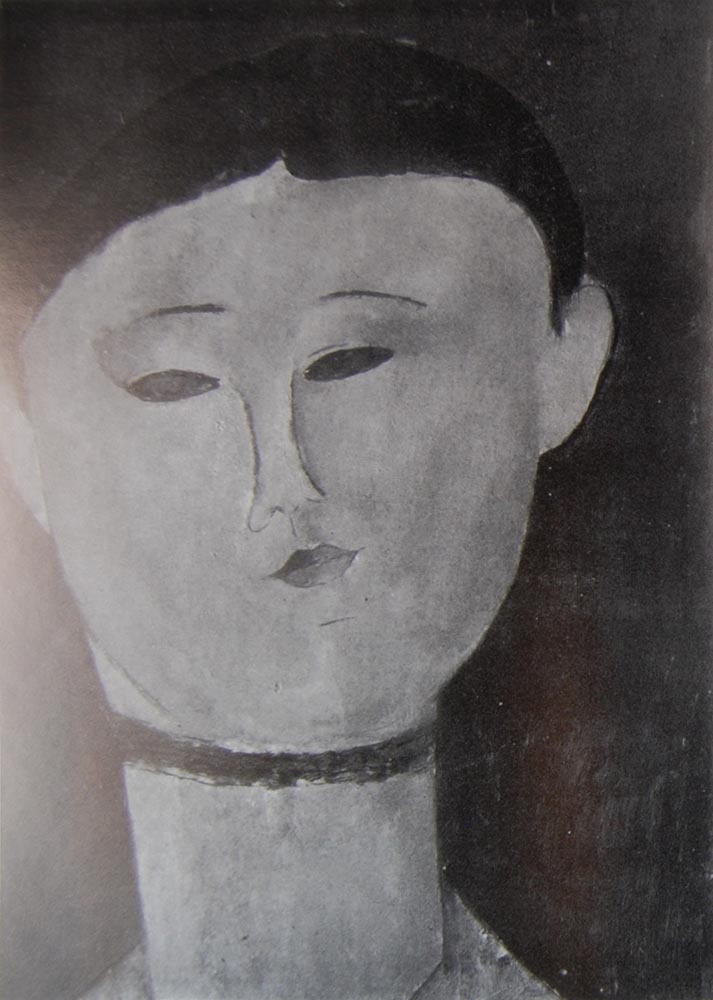
Young woman head with velvet lace
Oil on canvas? — 1915 ?
Identification
- Title
- English: Young woman head with velvet lace.
Notes: Young woman head with velvet lace; Testa di donna con nastro al collo (Ceroni) - Date
- 1915?
Notes: 1915 ?" 1912–1913 (Jeanne Modigliani); 1915–1916 (Pfannstiel) - Medium
- Oil on canvas?
- Dimensions
- Unknown?
Notes: 55 × 46 cm (Ceroni and Parisot); 46 × 38 cm (Pfannstiel); about 38 × 28 cm at most, estimated from a photograph. - Signature
- Unsigned?
Notes: signed "modigliani" upper right (Parisot and Pfannstiel) - Present location
- Unknown
Notes: Paris, private collection (Ceroni)
Catalogue numbers
| Compiler | Number |
|---|---|
| Arthur Pfannstiel | no. 58 - 196 |
| Joseph Lanthemann | no. 82 |
| Ambrogio Ceroni | no. 75 |
| Jeanne Modigliani | YES |
| Christian Parisot | 24/1915 or 246/1915? |
| Osvaldo Patani | NO |
| Modigliani Project | ? |
| MR | ? |
| Modigliani Initiative/AMDC | ? |
Legal note on MR: This investigation has not had access to MR’s catalogue raisonné; all research here is based on open sources, publications and exhibitions. By no means has that catalogue been copied at any point. Modigliani Project and Modigliani Initiative are marked YES when the work is published or otherwise recorded by those projects, even if no catalogue number is assigned; otherwise the field is marked ?.
Provenance
- Paul Guillaume, Paris
- Coll. Mademoiselle M. Brussels?
- Dutilleul Collection, Paris
- Private Collection USA (Pfannstiel 1956)?
- Private Collection Paris ( Ceroni 1970) ?
- Unknown location
The sequence follows the published museum, sale, and catalogue record in this investigation. Gaps and uncertain transfers are marked as such.
Selected bibliography
Book-length publications are marked with a footnote giving a full citation. Exhibition catalogues appear in both this list and the exhibition list when this investigation recorded them in both places.
- Pfannstiel, "catalogue presume" Modigliani. L'Art et la Vie. Preface de Louis Latourrettes, Seheur, Paris, 1929, p. 9 - no. VI also repeated in p. 321
- Modigliani J., Modigliani sans légende, Gruend, Paris, 1961 pl. 27 (Dated in 1912-1913)2
- Pfannstiel, Modigliani et son oeuvre, etude critique et catalogue raisonne, bibliotheque des arts, Paris, 1956, no. 58 also repeated in no. 1963
- Ceroni, Amedeo Modigliani: Peintre; Suivi des Souvenirs de Lunia Czechowska, Edizioni del Milione, 1958 - p. 1644
- Lanthemann, Modigliani, catalogue raisonné: sa vie, son oeuvre, son art, G. Condal, Barcelona, 1970 - no. 825
- Ceroni & Piccioni, Il dipinti di Modigliani, Rizzoli, Milano, 1970 - no. 756
- Parisot, Catalogue Raisonee Modigliani, Graphis Arte, 1991 no. 246/19157
- Soto Caba, Modigliani, The timeless face, Libsa, Madrid, 20078
Exhibitions
- Paris, Bernheim Jeune, May-June 1929, p. 145 ???
Notes
This work is repeated in Pfannstiel, also in the number 196 dated in 1917 as "Le Liseré noir - size 54 x 45 signed top right with the next bibliography lines:
1.Waldemar, La grande peinture contemporaine dans la collection Guillaume, exp. Bernheim Jeune, Paris 1929, p. 145.
2.- Pfannstiel, "catalogue presume" Modigliani. L'Art et la Vie. Preface de Louis Latourrettes, Seheur, Paris, 1929, p. 32 - no. VI.
With a location in Coll. Mlle. M., Bruxelles.
Have never seen this painting live or at a color photo. only in Black and White old photos, this investigation cannot find any exhibition reference.
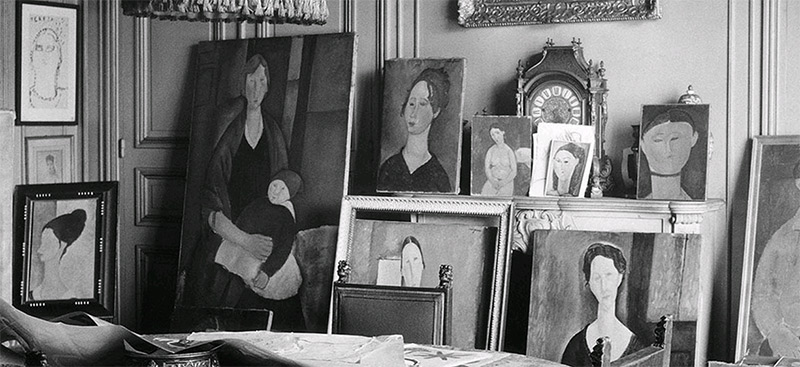
There is an image of the Dutilleul house where this painting is on display and a simple look at the image reveals that the size must be much more smaller than Parisot, Ceroni or even Pfannstiel (he usually is much more near than the others) say, so this may mean none of them really saw the painting live, another example of their lack of quality in the work, they just accepted it because of what?
Another interesting fact is that they don't even mention the provenance in Dutilleul, so what kind of research they made?
1.- J. Hebuterne in lower left side size is 46 x 29 cm and moving the image and taking in control the possible distort of perspective, this painting is smaller in both sides to Hébuterne portrait..
2.- The Burgundian woman in the center has a size 55 x 38 and is clearly bigger than the painting of the woman with velvet lace in both sides.
So none of the sizes provided by the experts can match the real size of the painting (approx. size 38 x 28 cm as maximum?, R say 35 x 24 and it could match...) same with the support that presents in the image no canvas sides, just a thin small frame, probably the real support is cardboard.
Where sources disagree, both readings are given. This is a working research page, not a catalogue raisonné.
Introduction
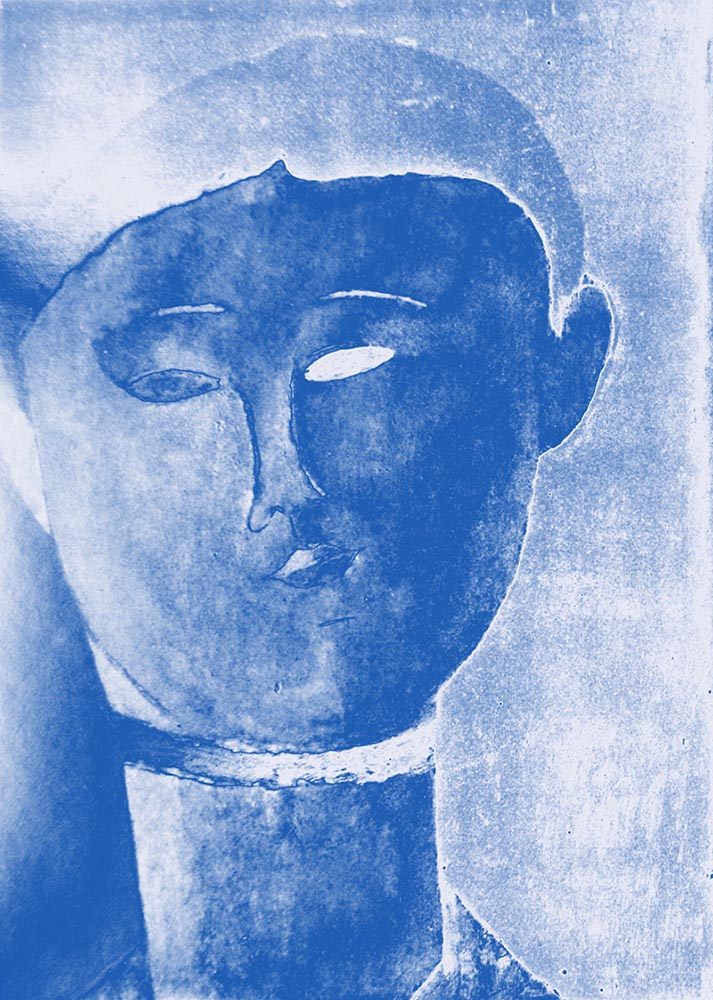
The painting is known only from black-and-white photographs. They show the head of a young woman with a large pale face, a dark cap of hair and a long cylindrical neck encircled by a dark ribbon. The eyes are dark almond shapes, the nose long and thin, the lips small. The background is dark. The image is spare, almost diagrammatic, and the face, with its broad smooth surface and its few lines, recalls the stone heads that Modigliani carved before 1915.
Ceroni catalogued it as no. 75, Testa di donna con nastro al collo (Head of a Woman with a Ribbon at the Neck), with a size of 55 × 46 cm and a private owner in Paris. The Secret Modigliani page on the work, however, describes its size, support, signature and present location as unknown or doubtful. The page also reproduces a photograph of the apartment of the collector Roger Dutilleul in which the painting appears, a provenance that the catalogues do not mention.
This essay describes the painting from the photographs, examines the evidence for its size, and argues, as my own inference, that part of the documentation given on the Secret Modigliani page belongs to another painting, Femme au ruban de velours in the Musée de l'Orangerie, which is Ceroni no. 63.
Composition and format
The reproduction on the Secret Modigliani page measures 713 × 1000 pixels, a proportion of 1.40. The Ceroni plate has a proportion of 1.36. Neither agrees with Ceroni’s size of 55 × 46 cm or with Pfannstiel's 46 × 38 cm, both of which have proportions of about 1.20. In my measurement, the photographs agree better with the size estimated on the Secret Modigliani page, about 38 × 28 cm, a proportion of 1.36, or with the 35 × 24 cm that the page attributes to a source it abbreviates as R, a proportion of 1.46. The photographs may, of course, be cropped.
The composition is centred and vertical. The face fills the upper two-thirds of the picture, slightly to the left of centre, and the top of the hair nearly touches the upper edge. The neck descends from the chin to the lower edge, where the shoulders are barely indicated at the corners. The ribbon crosses the neck just below the chin, forming a strong horizontal that divides the head from the neck.
In the Dutilleul photograph the painting stands on the mantelpiece, to the right of a clock, in a narrow frame. The Secret Modigliani page compares it there with a portrait of Jeanne Hébuterne, which it gives as 46 × 29 cm, and with a portrait of a woman from Burgundy, 55 × 38 cm, and concludes that the present painting is smaller than both.
Line
The drawing is reduced to a few lines. The eyebrows are thin curved strokes, set high above the eyes. A single line descends from the left eyebrow to form the side of the nose, ending in a small curve for the nostril. The eyes are almond shapes filled with dark tone, without visible pupils. The mouth is small, with a pronounced bow to the upper lip and a dark line between the lips. A short line at the right of the mouth may indicate the corner of the cheek.
The contour of the face is soft on the left, where the face merges with a lighter area of the background, and firmer on the right, where it is set against the dark. The ear at the right is drawn as a simple curve. The hair forms a dark cap with a small point at the centre of the forehead.
Colour
The colour cannot be described from the sources opened, since only black-and-white photographs are reproduced. In the photographs, the face and neck are very light, the hair and ribbon very dark, and the background dark, lighter at the left edge. The face has a slightly darker area on its right half, which may correspond to a change of colour or of tone.
Facture
In the reproduction, the face appears to be painted in a thin, even layer, with some granular texture in its lighter parts. The ribbon is painted with a broader, rougher stroke. The background appears loosely brushed. Beyond this, the photographs do not allow a description of the paint surface.
Figure and space
The figure is close to the picture plane, and the space is undefined. The face is modelled only by the slight darkening of its right side, and the neck is an almost flat pale column. The head is very large in relation to the neck, and the neck very long. The ribbon, in my reading, functions as a joint between two simple volumes, the oval of the head and the cylinder of the neck, in a way that recalls the separation of head and neck in Modigliani’s carved heads.
Iconography and sitter
The sitter is not identified. The ribbon at the neck is the only attribute. The title used on the Secret Modigliani page, Young woman head with velvet lace, implies a velvet ribbon similar to the one in the Orangerie portrait.
The date is uncertain. Jeanne Modigliani dated the painting to 1912–1913, which would place it in the years of sculpture, while Pfannstiel dated it to 1915–1916. In my reading, the sculptural simplicity of the head is consistent with either date, and would be consistent with Jeanne Modigliani’s earlier date in particular.
Comparisons
Femme au ruban de velours. The Orangerie portrait, Ceroni no. 63, shows a woman with a velvet ribbon around her neck. The Orangerie gives its size as 54 × 45.5 cm and its medium as oil on paper laid down on cardboard. As described in the essay on Ceroni no. 63, the Orangerie portrait shows a pale, elongated face with slit-like blue eyes, dark hair drawn back into a chignon, a broad light collar and a background of trees and foliage. The present head, with its short cap of hair, its dark background and its lack of a collar, is a different composition. The two works are therefore distinct, even if their subjects are similar and their documentation has been confused. The similarity of subject, a woman with a dark ribbon at the neck, is probably what allowed the confusion: a title such as Le liseré noir (The Black Border) could describe either painting.
Young woman head (Geneva). The Secret Modigliani page on the work 15-44 shows another simplified head of 1915 with a long neck. That page also claims the Ceroni number 75 in its table, though its own bibliography gives Ceroni and Piccioni no. 83. The present painting, with its size of 55 × 46 cm in Ceroni and its owner in Paris, is the work that agrees with Ceroni’s no. 75.
L'Enfant gras. Ceroni no. 74 has the same blank almond eyes and the same long nose drawn from the brow, but it is painted in strong colour and with much more developed hair.
Provenance and exhibitions
Provenance as Paul Guillaume, Paris; Collection Mademoiselle M., Brussels?; the Dutilleul collection, Paris; a private collection in the United States (Pfannstiel 1956)?; a private collection in Paris (Ceroni 1970)?; and an unknown location. It lists one exhibition with three question marks: Paris, Bernheim-Jeune, May–June 1929, p. 145.
The page also states that the painting is repeated in Pfannstiel as no. 196, dated 1917, as "Le Liseré noir - size 54 x 45 signed top right", with references to Waldemar George's catalogue of the Bernheim-Jeune exhibition of the Guillaume collection in 1929, p. 145, and to Pfannstiel's catalogue of 1929, p. 32, and with a location in the collection of Mlle M. in Brussels.
Discrepancies
- Pfannstiel no. 196 and the Orangerie painting. The Musée de l'Orangerie cites the same references for its own Femme au ruban de velours. Its bibliography gives Waldemar George, 1929, repr. p. 145, as "Le liseré noir"; Pfannstiel, 1929, p. 32, as "Le Liseré noir"; and Pfannstiel, 1956, no. 196, as "Le Liseré noir", in the collection of Mlle M. in Brussels. Its early album gives "Le liseré noir 0m54 x 0m45". The Secret Modigliani page on the Orangerie work also gives the title Le liseré noir for the Galerie Bernheim-Jeune exhibition of 1922, no. 5. The size of 54 × 45 cm matches the Orangerie painting. In my inference, the references to Brussels, Pfannstiel no. 196, Pfannstiel 1929 p. 32 and the Bernheim-Jeune exhibition of 1929 belong to the Orangerie painting and not to the present work.
- Size. Ceroni and Parisot give 55 × 46 cm, Pfannstiel 46 × 38 cm. The proportions of the photographs do not match either, and the Secret Modigliani page estimates the size at about 38 × 28 cm at most from the Dutilleul photograph.
- Parisot number. The table on the Secret Modigliani page gives Parisot 24/1915, while its bibliography gives Parisot 1991, no. 246/1915.
- Ceroni 1958. The Secret Modigliani page cites Ceroni’s catalogue of 1958, p. 164, for this work. The Orangerie cites Ceroni 1958, no. 41, p. 47, for its own painting, as Tête de femme (au ruban noir). The two citations should be checked against the book.
- Signature. Parisot and Pfannstiel give a signature at the top right, but the Secret Modigliani page reports that a gradient filter applied to the black-and-white photograph reveals no signature on the front.
- Date. Jeanne Modigliani gives 1912–1913, Pfannstiel 1915–1916.
- Dutilleul provenance. The Dutilleul ownership, shown by the photograph, is not mentioned in the catalogues.
The history that can be reconstructed with some confidence is therefore short. The painting belonged to Roger Dutilleul, as the photograph shows, and it may earlier have belonged to Paul Guillaume, though no source opened documents this. Pfannstiel's no. 58, the American private collection he gives in 1956, and Ceroni’s Parisian private collection of 1970 may refer to later owners, but none of them is named, and none of the sources opened links them with certainty to this painting.
Technical analysis
No technical examination of the painting is known, and its present location is unknown. The following remarks are based on the photographs and on comparative literature.
Support. The Secret Modigliani page suggests that the support is probably cardboard, because in the Dutilleul photograph the painting shows no canvas sides, only a thin narrow frame. Tate Papers, no. 35, by Anaïs Genty-Vincent et al., notes that "During the early years of his career, Modigliani painted on various kinds of support, from cardboard to canvas". A small cardboard support would be consistent with the photograph and with the smaller estimated size.
Drawing. The few fine lines of the face suggest a brush drawing. The Burlington Magazine article by Annette King, Nancy Ireson, Simonetta Fraquelli and Joyce H. Townsend, vol. 160, no. 1380 (March 2018), reports that drawing in the works studied "varied from clean graphite lines to ones made with thin brushes in paint of varying colours".
Surface. Tate Papers, no. 35, by Anaïs Genty-Vincent et al., describes works by Modigliani with earlier paintings beneath the visible surface. Nothing can be said about such layers in a painting known only from photographs. These observations are comparative.
Conclusion
Head of a Young Woman with a Neck Ribbon is a lost or untraced painting, known from black-and-white photographs. They show a simplified, sculptural head with a pale face, a dark cap of hair and a ribbon at the neck. Its Dutilleul provenance is documented by a photograph, and its size was, it appears, much smaller than the catalogues say.
The documentation given for it on the page combines evidence from at least two paintings. The Orangerie's own bibliography for Femme au ruban de velours claims the title Le liseré noir, Pfannstiel no. 196, the Brussels location and the publication of 1929, and these references, in my inference, should be removed from the history of the present work. What remains is a small head, probably on cardboard, owned by Roger Dutilleul, whose present location is unknown.
Museum, auction and exhibition sources
- Musée de l'Orangerie, Femme au ruban de velours, https://www.musee-orangerie.fr/en/artworks/femme-au-ruban-de-velours-196296
Technical literature (comparative)
- Annette King, Nancy Ireson, Simonetta Fraquelli and Joyce H. Townsend, "The Modigliani Technical Research Study. An introduction to Modigliani’s materials and techniques", The Burlington Magazine, vol. 160, no. 1380 (March 2018) (comparative)
- Anaïs Genty-Vincent et al., "Works by Modigliani that have Paintings beneath the Visible Surface", Tate Papers, no. 35, https://www.tate.org.uk/research/tate-papers/35/works-by-modigliani-that-have-paintings-beneath-the-visible-surface (comparative)
Sources that could not be opened
The painting itself, whose location is unknown; Waldemar George's catalogue of the Bernheim-Jeune exhibition of 1929; the album and binder cited by the Orangerie; Ceroni’s catalogues beyond the online caption and plate.
Cited but not independently consulted
Pfannstiel, catalogue presume Modigliani. L'Art et la Vie. Preface de Louis Latourrettes, Seheur, Paris, 1929, p. 9 - no. VI also repeated in p. 32; Modigliani J., Modigliani sans légende, Gruend, Paris, 1961 pl. 27; Pfannstiel, Modigliani et son oeuvre, etude critique et catalogue raisonne, bibliotheque des arts, Paris, 1956, no. 58 also repeated in no. 196; Ceroni, Amedeo Modigliani: Peintre; Suivi des Souvenirs de Lunia Czechowska, Edizioni del Milione, 1958 - p. 164; Lanthemann, Modigliani, catalogue raisonné: sa vie, son oeuvre, son art, G. Condal, Barcelona, 1970 - no. 82; Ceroni & Piccioni, Il dipinti di Modigliani, Rizzoli, Milano, 1970 - no. 75; Parisot, Catalogue Raisonee Modigliani, Graphis Arte, 1991 no. 246/1915; Soto Caba, Modigliani, The timeless face, Libsa, Madrid, 2007. Titles are given as the page gives them, without the footnote digits it attaches to them.Footnotes
- Arthur Pfannstiel, Modigliani. L’Art et la Vie, preface by Louis Latourette, Paris, Seheur, 1929 (presumed catalogue).
- Jeanne Modigliani, Modigliani sans légende, Paris, Gründ, 1961.
- Arthur Pfannstiel, Modigliani et son œuvre, étude critique et catalogue raisonné, Paris, Bibliothèque des Arts, 1956.
- Ambrogio Ceroni, Amedeo Modigliani: Peintre; suivi des souvenirs de Lunia Czechowska, Milan, Edizioni del Milione, 1958.
- Joseph Lanthemann, Modigliani, catalogue raisonné: sa vie, son œuvre, son art, Barcelona, G. Condal, 1970.
- Ambrogio Ceroni and Leone Piccioni, I dipinti di Modigliani, Milan, Rizzoli, 1970.
- Christian Parisot, Catalogue raisonné Modigliani, Livorno, Graphis Arte, 1991.
- Victoria Soto Caba, Modigliani: The Timeless Face, Madrid, Libsa, 2007.