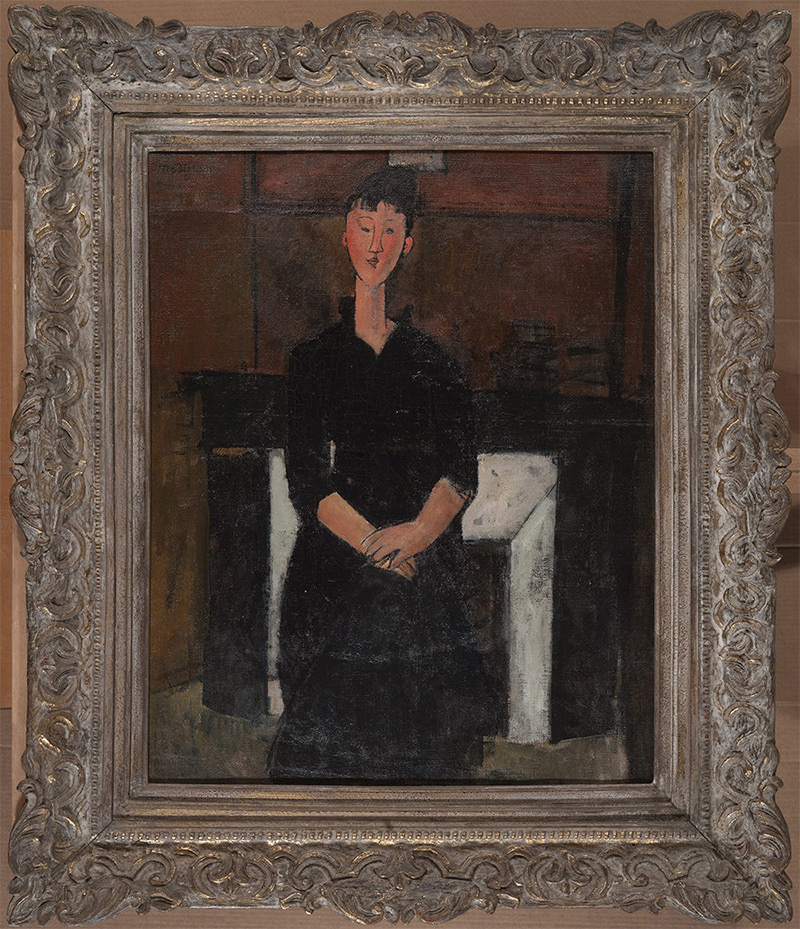
Beatrice Hastings seated in front of the fireplace
Oil on canvas - dated 1915

Identification
- Title
- English: Beatrice Hastings seated in front of the fireplace .
Notes: donna davanti a un caminetto (Ceroni); Woman Seated in Front of a Fireplace (Beatrice Hastings) (Tate Papers, no. 35). - Date
- 1915
- Medium
- Oil on canvas.
- Dimensions
- 80.5 × 64.5 cm.
Notes: 80.5 x 64.5 cm ? ( Klein); 81 x 65 cm (MR); 80. 5 x 64.5 mm (Tate Papers, no. 35) - Signature
- Signed "Modigliani" upper left.
- Present location
- VAC Foundation, Moscow, unconfirmed.
Notes: "Private collection" (Tate Papers, no. 35); "New York, proprietà Perls Galleries" (Ceroni).
Catalogue numbers
| Compiler | Number |
|---|---|
| Arthur Pfannstiel | no. 102 |
| Joseph Lanthemann | no. 77 |
| Ambrogio Ceroni | no. 58 |
| Jeanne Modigliani | YES |
| Christian Parisot | ? |
| Osvaldo Patani | no. 63 |
| Modigliani Project | ? |
| MR | YES |
| Modigliani Initiative/AMDC | ? |
Legal note on MR: This investigation has not had access to MR’s catalogue raisonné; all research here is based on open sources, publications and exhibitions. By no means has that catalogue been copied at any point. Modigliani Project and Modigliani Initiative are marked YES when the work is published or otherwise recorded by those projects, even if no catalogue number is assigned; otherwise the field is marked ?.
Provenance
- Paul Guillaume, Paris (unconfirmed).
- Georges Chéron, Paris (unconfirmed).
- M. Louis Libaude Collection, Paris.
- Hôtel Drouot, Paris, Libaude Collection, 19 May 1920, lot 64.
- Netter Collection, Paris (by 1956, unconfirmed).
- Perls Galleries, New York.
- Private collection (by 1972).
- Christie’s, New York, Impressionist and Modern Paintings and Sculpture, Part I, 7 November 1995, sale 8306, lot 33 (estimate USD 900,000–1,200,000; sold USD 1,487,500).
- Helly Nahmad Collection / private collection (unconfirmed).
- VAC Foundation, Moscow.
The sequence follows the published museum, sale, and catalogue record in this investigation. Gaps and uncertain transfers are marked as such.
Selected bibliography
Book-length publications are marked with a footnote giving a full citation. Exhibition catalogues appear in both this list and the exhibition list when this investigation recorded them in both places. Where this investigation listed a long run of secondary mentions, only the principal catalogues and museum or sale references are retained here.
- Arthur Pfannstiel, 1929, presumed catalogue, p. 16.1
- Arthur Pfannstiel, 1956, no. 102.2
- Joseph Lanthemann, 1970, no. 77.3
- Ambrogio Ceroni and Leone Piccioni, 1970, no. 58.4
- Osvaldo Patani, 1991, no. 63.5
- Raffaele Monti, ed. R. Chiappini, Amedeo Modigliani, Lugano, Skira, 1999.6
- Mason Klein, Modigliani: Beyond the Myth, The Jewish Museum, 2004, p. 84, pl. 8 (courtesy of Helly Nahmad).7
- Simonetta Fraquelli et al., Modigliani and His Models, Royal Academy of Arts, London, 2006, p. 84, no. 8.8
- Victoria Soto Caba, 2007.9
Exhibitions
- New York, Acquavella Galleries, Amedeo Modigliani, 1971, no. 11.
- Lugano, Museo d’Arte Moderna, Amedeo Modigliani, 1999, no. 20.
- New York, The Jewish Museum, Modigliani: Beyond the Myth, 2004–2005, no. 8.
- Toronto, Art Gallery of Ontario, Modigliani: Beyond the Myth, 2004–2005, no. 8.
- Washington, D.C., The Phillips Collection, Modigliani: Beyond the Myth, 2005, no. 8.
- London, Royal Academy of Arts, Modigliani and His Models, 2006, no. 8 (private collection, courtesy of Helly Nahmad).
- Moscow, Museum of Modern Art, General Rehearsal, VAC Collection, 2018.
Notes
This investigation marks the D’Atri papers entry unconfirmed.
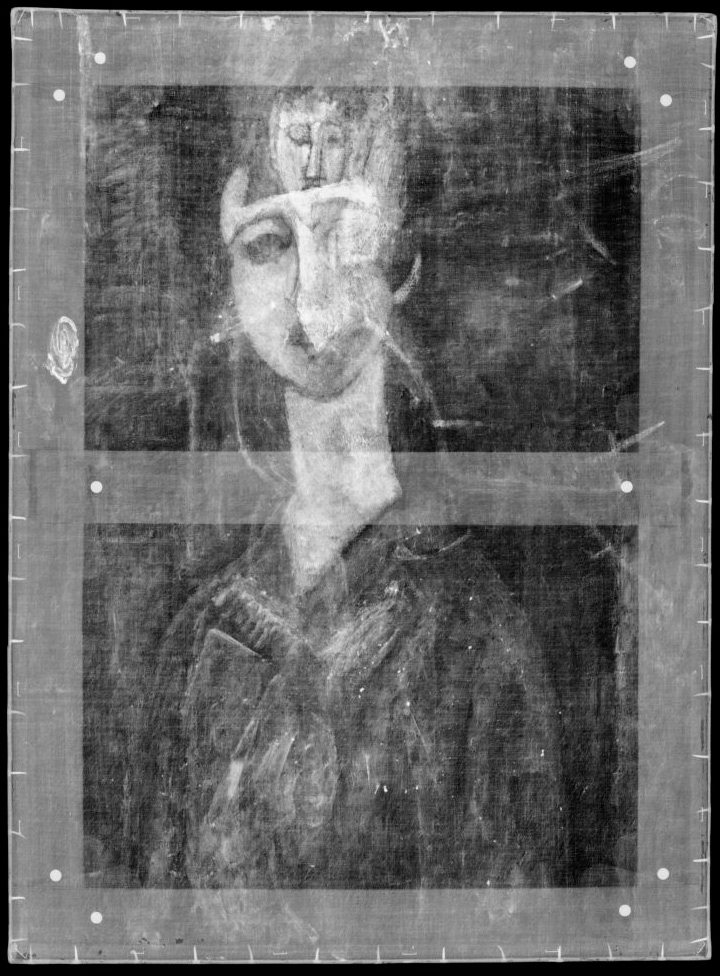
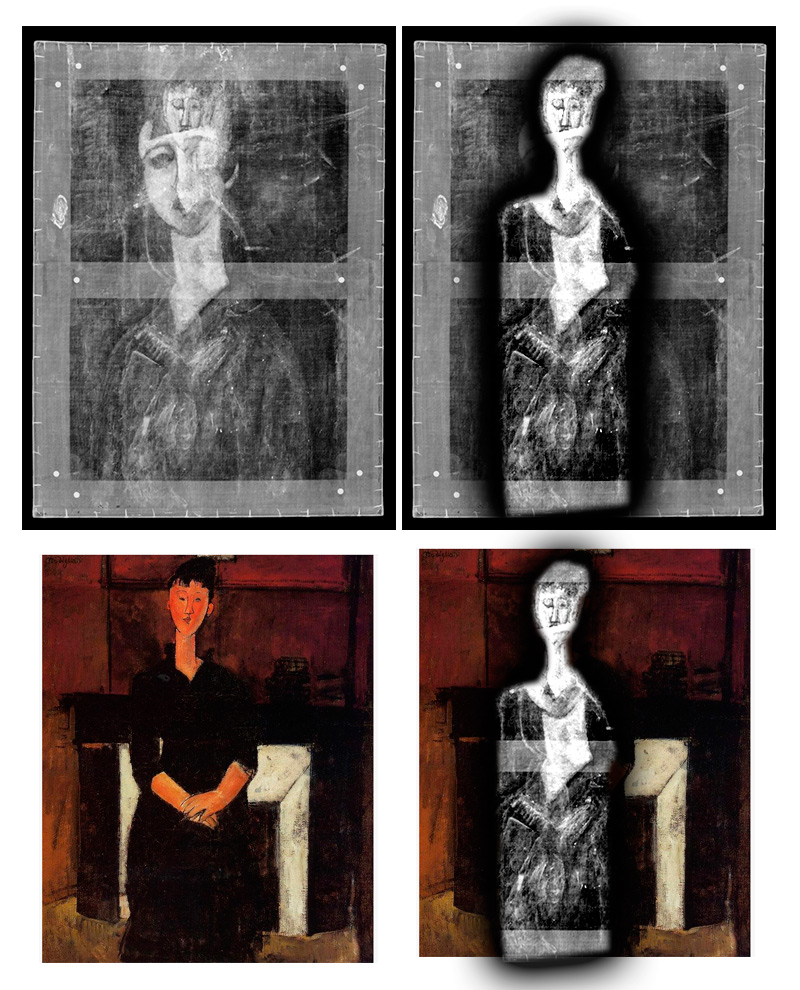
This investigation records that technical study of the Tate Gallery painting known as Victoria showed, in X-ray, another composition beneath the present surface, described as almost identical in pose, scale and perspective to this 1915 Beatrice Hastings before the fireplace. The observation is given as published in the documentation assembled for this investigation.
The original page of this investigation marked several fields as still being checked. The facts above are those already published; where sources disagree, both readings are given.

Introduction
Most of Modigliani’s portraits of 1915 are busts or heads set before abstract or barely suggested backgrounds. The portrait of a woman seated before a fireplace is an exception. It shows a full interior: a red wall, a black mantelpiece with a stack of books, white marble jambs, and a floor. In front of this setting a slender woman in a black dress sits upright, her hands clasped in her lap. The sitter is traditionally identified as Beatrice Hastings, the English writer who, according to Tate Papers, no. 35, was "Modigliani’s partner from mid-1914 to mid-1916".
The picture has gained a new importance through the technical study of Tate's Portrait of a Girl, which revealed beneath that painting a seated woman resembling the sitter here. The Secret Modigliani page on the work goes further and claims that the underlying image is "another version" of this composition. This essay analyses the painting itself and then weighs that claim against the published technical evidence.
Composition and format
The canvas is an upright of about 80.5 × 64.5 cm, a ratio of about 0.80. The Secret Modigliani reproduction has a ratio of 0.807, and the Ceroni plate as reproduced 0.795. The composition is built on a strong horizontal division. A black mantelpiece crosses the whole width of the picture a little above its middle; above it is the red wall, below it the white jambs of the fireplace and the dark opening of the hearth. The seated figure, placed on the vertical axis, overlaps the mantelpiece and the hearth, so that her black dress joins the black of the mantel shelf and the dark of the fireplace opening.
The figure is three-quarter length. Her head is near the top of the picture, a little below a horizontal moulding that runs across the wall; her skirt is cut by the lower edge, and her clasped hands are at about two-thirds of the height. The head is small in relation to the body, and the long neck and narrow shoulders exaggerate the slenderness of the figure. On either side of her, the white jambs of the fireplace form two pale vertical bands, the one at the right broader and more brightly lit. At the upper right, on the mantelpiece, stands a stack of books. At the extreme left, a brownish-ochre area may represent a door or the side wall of the room, and at the bottom an ochre floor appears on both sides of the skirt. At the top of the picture, just right of centre, a pale rectangle is cut by the upper edge; it might be a picture or a card hanging on the wall.
The signature, "Modigliani", is at the top left, on the red wall. The figure is thus framed by strong rectangular forms: the wall above, the mantelpiece and the jambs below. The composition is symmetrical in its main lines but varied in its details, for the books at the right have no counterpart at the left, and the left jamb is narrower and partly hidden by the figure.
Line
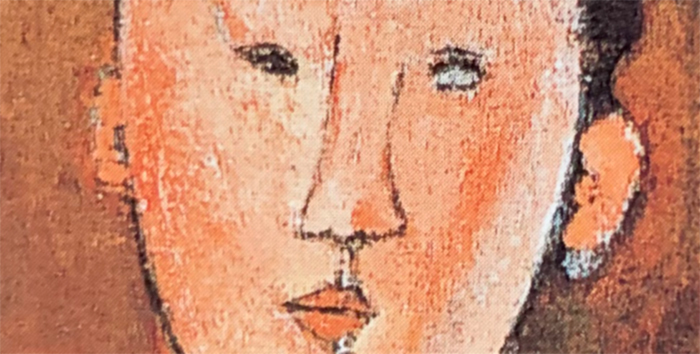
Line plays a more descriptive role here than in Raymond or Madam Pompadour (Ceroni nos. 56–57). The face is drawn with fine lines: thin, arched brows, almond-shaped eyes, a long, straight nose, a small mouth. The jaw is a gentle curve, and the chin is pointed. The hair is piled on top of the head, with a jagged fringe across the forehead. The black dress is outlined with a firm contour, and the collar, at the neck, has a ruffled edge, drawn with small, irregular strokes.
The hands are drawn with care. The fingers of the two hands interlace in the lap, their contours defined with thin dark lines on a pale flesh tone. The forearms emerge from the sleeves of the dress, which end just below the elbows. The architecture of the fireplace is drawn with straight lines that are not quite ruled, and the vertical lines that divide the red wall are slightly irregular, giving the setting a hand-made quality.
The Secret Modigliani page on the work describes a detail of the ears as "made full of details and color, drawing with colors and black detail is visible and is painted over the color (on top of the color)". It also translates an extract from a report by "R", which says that in female portraits Modigliani’s ears are rarely exposed and "not detailed", but that here "the ears are full in details, painted with color gradation as detailed as the eyes or the hair or clothes". The report concludes that "The ears in this painting are a total point of light". In the reproduction, the ear at the viewer's right is indeed visible as a pale form against the dark hair, with a small earring or highlight.
Colour
The colour is dominated by three elements: the red of the wall, the black of the dress and mantelpiece, and the white of the marble jambs. The red is warm and varied, from an orange-red at the top to a darker red-brown near the mantel, and it is laid in with visible strokes that let other tones show through. The black is dense in the dress, slightly lighter in the mantelpiece, and greyish in the hearth. The white of the jambs is a cool, bluish white, especially on the right, where it is the brightest area in the picture.
The flesh tones are pale: the face and neck are a light pink, and the hands and forearms a slightly warmer pink. The eyes are pale, grey-blue, and appear to lack pupils. The lips are a small touch of red, echoing the wall. The books on the mantelpiece are painted in browns, greys and ochres, and the floor is ochre. The overall effect is of a strong contrast between the warm red above and the cold black and white below, with the figure, in black, linking the two zones.
Facture
The paint is applied with varied density. In the red wall, the brushwork is broad and visible, with a rough, dragged texture in places. The mantelpiece and the dress are more uniformly covered with black. The white of the jambs is applied more thickly, especially on the right. In the reproduction, the black of the dress appears to show a fine network of cracks, which, if confirmed, would suggest that the black was applied over a layer that had dried, or in a medium-rich paint; I cannot verify this from the reproduction alone. The flesh is painted thinly and smoothly. The floor and the area at the extreme left are painted loosely, with the weave of the canvas visible in places.
Figure and space
The picture creates a real, if shallow, interior space. The mantelpiece, the jambs and the floor define a room, and the figure is placed in front of the fireplace, as if seated on a low chair before it. Yet the space is compressed. The mantelpiece is seen almost frontally, with little indication of its depth; the jambs are flat bands; the wall is a flat plane. The figure's body, seen frontally, is aligned with the plane of the picture, and her dress merges with the black of the mantelpiece and hearth.
The figure is immobile and self-contained. Her hands are clasped, her shoulders are drawn in, and her gaze is directed straight out at the viewer, but the pale, pupil-less eyes give it a detached quality. The impression is of composure and reserve, an impression very different from the irony of Madam Pompadour, though both pictures are associated with Hastings.
Iconography and sitter
The identification of the sitter as Hastings is traditional rather than documented. The plate title of Ceroni’s catalogue, as transcribed on modigliani1909.com, calls the picture simply "donna davanti a un caminetto", a woman before a fireplace, without naming her. Tate Papers, no. 35 uses the title Woman Seated in Front of a Fireplace (Beatrice Hastings) and describes the picture as "thought to be a portrait of the British writer, poet and journalist Beatrice Hastings". The Secret Modigliani page titles it Beatrice Hastings seated in front of the fireplace.
Tate Papers, no. 35 notes that Hastings "was born in England, raised in South Africa and, having returned to England, relocated to Paris in 1914 to become a correspondent for The New Age", and that she "had much in common with Modigliani: she was well read, well travelled, fiercely intellectual, artistic and a fellow foreigner in the bohemian avant-garde of Paris during the war". If she is the sitter, the books on the mantelpiece may allude to her literary profession. The domestic interior, unusual in Modigliani’s work, may be the setting of their life together, but no source I have consulted identifies the room.
Comparisons
The most important comparison is with the image beneath Tate's Portrait of a Girl (Ceroni no. 118). Tate Papers, no. 35 reports that the X-radiograph of that painting "reveals an earlier underlying image in the same orientation: a three-quarter length portrait of a woman, seated and slightly to the left of the centre of the canvas, her arms curved in front of her small-waisted body". The woman "bears a strong resemblance to the sitter in Woman Seated in Front of a Fireplace (Beatrice Hastings)". The authors list the "several striking similarities": "both sitters wear their dark hair piled on top of their head, with a jagged fringe; both have oval-shaped faces with narrow pointed chins, have long necks and wear a dark long-sleeved dress with a high v-shaped neckline".
The same study also lists differences. "The face in the X-radiograph is slimmer than that in the portrait of Hastings", though a secondary outline suggests a revised contour. "The figure seen in the X-radiograph is rather narrower at the waist than the figure of Hastings in Woman Seated in Front of a Fireplace, and the profile of the bust is more defined". The dress "has a slightly more formal appearance", the proper right sleeve has horizontal lines that may indicate brocade, embroidery or "ruched gloves", one hand "appears to be clutching a piece of fabric that cascades over the dress", and "The proper left arm is placed slightly higher in the lap" than in the present picture. The study concludes: "There is no way of knowing for certain whether the painting beneath Portrait of a Girl is of Beatrice Hastings, but stylistic similarities suggest that it was painted by Modigliani and likely dates to around 1915."
Other comparisons are with Madam Pompadour (Ceroni no. 57), also associated with Hastings and painted in the same year, which shows a very different, geometric treatment of the face; and with The Pretty Housewife (Ceroni no. 60), another three-quarter-length figure in an interior with recognisable furniture.
Provenance and exhibitions
Two versions of the Secret Modigliani page on the work exist, and they differ. The page under /works/ gives the provenance as "Guillaume Collection, Paris", "Georges Cheron, Paris?", "Netter Collection, Paris ( by 1956?)", "Perls Galleries, New York", "Private Collection (by 1972)", the Christie's sale in New York on 7 November 1995, sale 8306, lot 33 ("Estimate: 900.000 - 1.200.000 USD Sold: 1.487.500 USD"), "Helly Nahmad Collection?", "Private Collection?" and "VAC Foundation, Moscow". The second version, at the site's root, adds "M. Louis Libaude Collection, Paris" and "Hôtel Drouot, Paris, Libaude Collection, 19 May 1920, lot 64" after Chéron.
Both versions list the same exhibitions: Acquavella Galleries, New York, 1971, no. 11; Museo d'Arte Moderna, Lugano, 1999, no. 20; Modigliani: Beyond the Myth, Jewish Museum, New York, Art Gallery of Ontario, Toronto, and Phillips Collection, Washington, 2004–2005, no. 8; Modigliani and His Models, Royal Academy of Arts, London, 2006, no. 8 ("P.C. courtesy of Helly Nahmad"); and General Rehearsal, Museum of Modern Art Moscow, VAC Collection, 2018. The page under /works/ reproduces an installation photograph of the picture at the Moscow exhibition.
Discrepancies
- Two versions of the page. The root version of the Secret Modigliani page adds Libaude and the Drouot sale of 1920 to the provenance, and Fraquelli et al., Modigliani and His Models (2006), p. 84, no. 8, to the bibliography; the /works/ version does not. The root version describes the picture in its heading as "Oil on canvas, dated 1915", but gives "Date 1915?" in its identification section; the /works/ version describes only the signature, "Modigliani" in top left, and no date is visible in the reproduction.
- The X-radiograph claim. The /works/ page states that "the X ray showed another Modigliani painting under almost identical to the Hastings portrait" and that "the position, size and perspective fits perfect". Tate Papers, no. 35 speaks of a "strong resemblance", lists several differences, and says there is "no way of knowing for certain" whether the underlying figure is Hastings. Moreover, Portrait of a Girl measures "80.6 by 59.7 centimetres", about 5 cm narrower than this picture, and its canvas "was cut from a larger canvas that was already primed". The underlying figure, which is "slightly to the left of the centre of the canvas", cannot therefore occupy exactly the same position in a canvas of the same size. The site's overlay of the X-radiograph on the present picture has to adjust the two images to make them coincide.
Technical analysis
No technical study of this picture has been published in the sources I could consult. The only direct observations are those on the Secret Modigliani page: the description of the signature, painted "in black oil", and of the ears, painted "on top of the color".
The comparative evidence from Portrait of a Girl is, however, directly relevant to the picture’s context. Tate Papers, no. 35 reports that the underlying image beneath that painting was "dry when Modigliani chose to paint over it in 1916 or early 1917", and that the transmitted light image "suggests that the background is thinly painted in contrast to the figure, and raking light reveals little of this underlying image except for the curved arms". It is not known whether the underlying painting included a setting like the fireplace of the present picture; the thin background makes that difficult to determine. The study suggests that Modigliani might have been prompted to paint over the picture by a quarrel with Hastings in January 1917, or that he reused "whatever support was in his possession to avoid a purchase he could not afford".
The Secret Modigliani page draws a different conclusion from the same evidence. It argues that the reuse of a canvas in 1916 or 1917, when "some experts say" that Guillaume and Zborowski were supplying Modigliani with canvases, means that "we have to rethink all over many commonly accepted opinions". The Tate Papers authors, by contrast, raise the possibility that "Zborowski was not yet supplying him with canvases" at the time.
If the underlying image is indeed a version of the present composition, it would show that Modigliani painted the subject at least twice, and that he abandoned or rejected one version. The present picture, with its fully realised setting, would then be the version he kept. But the differences noted by Tate Papers, no. 35, in the waist, the bust, the dress, the hands and the position of the arms, suggest that the underlying image was a related but distinct composition, not a replica.
Conclusion
This portrait of a woman before a fireplace is unusual among Modigliani’s works of 1915 for its detailed interior and its relatively naturalistic treatment of the figure. Its composition, divided by the black mantelpiece into a red upper zone and a black and white lower zone, with the slender black-clad figure linking the two, is clear and powerful. The identification of the sitter as Beatrice Hastings is traditional and plausible, but not documented.
The technical study of Tate's Portrait of a Girl has shown that Modigliani painted a closely related figure, probably around 1915, which he later covered. The Secret Modigliani page’s claim that the underlying image is "another version" of the present picture, matching it in "position, size and perspective", goes further than the published evidence allows. Tate Papers, no. 35 finds a strong resemblance but also several differences, and the two canvases differ in width. The relationship between the two images remains an open question that only a direct technical comparison could settle.
Museum, auction and exhibition sources
No museum or auction source on this picture could be opened; see below.
Technical literature (comparative)
- Anaïs Genty-Vincent et al., "Works by Modigliani that have Paintings beneath the Visible Surface", Tate Papers, no. 35, https://www.tate.org.uk/research/tate-papers/35/works-by-modigliani-that-have-paintings-beneath-the-visible-surface (comparative; the section on Portrait of a Girl discusses this picture directly)
- Annette King, Nancy Ireson, Simonetta Fraquelli and Joyce H. Townsend, "The Modigliani Technical Research Study: An introduction to Modigliani’s materials and techniques", The Burlington Magazine, vol. 160, no. 1380 (March 2018) (comparative)
Sources that could not be opened
The Christie's New York sale catalogue of 7 November 1995 (sale 8306, lot 33); the VAC Foundation's own documentation of the 2018 exhibition; Klein, Modigliani: Beyond the Myth (2004); Fraquelli et al., Modigliani and His Models (2006); the Lugano catalogue (1999); the report by "R" quoted on the Secret Modigliani page; the D'Atri papers. No technical report on the picture itself was found.
Cited but not independently consulted
Pfannstiel, catalogue présumé, 1929, p. 16; Pfannstiel, Modigliani et son œuvre, 1956, no. 102; Lanthemann, 1970, no. 77; Ceroni and Piccioni, I dipinti di Modigliani, 1970, no. 58; Patani, 1991, no. 63; Monti, ed. Chiappini, Amedeo Modigliani, Lugano, 1999; Klein, Modigliani: Beyond the Myth, 2004–2005, p. 84, pl. 8; Fraquelli et al., Modigliani and His Models, 2006, p. 84, no. 8; Soto Caba, 2007. Page and catalogue numbers are given without the footnote digits the page attaches to them.Footnotes
- Arthur Pfannstiel, Modigliani. L’Art et la Vie, preface by Louis Latourette, Paris, Seheur, 1929 (presumed catalogue).
- Arthur Pfannstiel, Modigliani et son œuvre, étude critique et catalogue raisonné, Paris, Bibliothèque des Arts, 1956.
- Joseph Lanthemann, Modigliani, catalogue raisonné: sa vie, son œuvre, son art, Barcelona, G. Condal, 1970.
- Ambrogio Ceroni and Leone Piccioni, I dipinti di Modigliani, Milan, Rizzoli, 1970.
- Osvaldo Patani, Modigliani. Catalogo generale, Milan, Leonardo, 1991–94.
- Raffaele Monti, ed. R. Chiappini, Amedeo Modigliani, Lugano, Museo d’Arte Moderna / Skira, 1999.
- Mason Klein, Modigliani: Beyond the Myth, New York, The Jewish Museum / Yale University Press, 2004.
- Simonetta Fraquelli et al., Modigliani and His Models, London, Royal Academy of Arts, 2006.
- Victoria Soto Caba, Modigliani: The Timeless Face, Madrid, Libsa, 2007.