Young woman with hat
Oil on cardboard — c. 1909–1911
Identification
- Title
- English: Young woman with hat.
Notes: Donna con cappello (Ceroni); Femme au chapeau, verso étude pour un paysage (Martigny 1990) - Date
- c. 1909–11?
Notes: 1909 (Ceroni); Lanthemann (1908); Charpentier (1910); Martigny (c.1910-11). - Medium
- Oil on cardboard. (Martigny)
Notes: Ceroni records oil on canvas. This investigation records a landscape sketch on the verso (not mentioned by Ceroni.) - Dimensions
- 35 × 27 cm.
- Signature
- Unsigned.
- Present location
- Hays Collection, Nashville. This investigation also records a future permanent loan to the Musée d’Orsay, Paris.
Catalogue numbers
| Compiler | Number |
|---|---|
| Arthur Pfannstiel | NO |
| Joseph Lanthemann | no. 15 |
| Ambrogio Ceroni | no. 26 |
| Jeanne Modigliani | YES |
| Christian Parisot | YES |
| Osvaldo Patani | no. 28 |
| Modigliani Project | ? |
| MR | YES |
| Modigliani Initiative/ AMDC | ? |
Legal note on MR: This investigation has not had access to MR’s catalogue raisonné; all research here is based on open sources, publications and exhibitions. By no means has that catalogue been copied at any point. Modigliani Project and Modigliani Initiative are marked YES when the work is published or otherwise recorded by those projects, even if no catalogue number is assigned; otherwise the field is marked ?.
Provenance
- Mme Denise Sasportas, Paris (recorded in 1958).
- Wildenstein & Co., New York.
- Edward G. Robinson Collection, Los Angeles.
- Hays Collection, Nashville.
- Future Loan to the Musée d’Orsay, Paris (recorded in this investigation).
The sequence follows the published museum, sale, and catalogue record in this investigation. Gaps and uncertain transfers are marked as such.
Selected bibliography
Book-length publications are marked with a footnote giving a full citation. Exhibition catalogues appear in both this list and the exhibition list when this investigation recorded them in both places. Where this investigation listed a long run of secondary mentions, only the principal catalogues and museum or sale references are retained here.
- Cent tableaux de Modigliani, Galerie Charpentier, Paris, 1958, no. 10.
- Joseph Lanthemann, 1970, no. 15 (dated 1908).1
- Ambrogio Ceroni and Leone Piccioni, 1970, no. 26 (dated 1909).2
- Osvaldo Patani, 1991–94, no. 28.3
- Victoria Soto Caba, 2007.4
Exhibitions
- Paris, Galerie Charpentier, Cent tableaux de Modigliani, 1958, no. 10.
- Tokyo, Grand Magasin Seibu, Modigliani, 1968, no. 5.
- Kyoto, The National Museum of Modern Art, Modigliani, 1968, no. 5.
- Tokyo, National Museum of Modern Art, Modigliani, 1985, no. 19.
- Aichi, Aichi Prefectural Art Gallery, Modigliani, 1985, no. 19.
- Martigny, Fondation Pierre Gianadda, Modigliani, 1990, no. 11.
- Paris, Musée d’Orsay, The Collection of Marlene and Spencer Hays. A Passion for France, 2013.
Notes
This investigation records a landscape sketch on the verso that is not mentioned in Ceroni.
This investigation publishes installation photographs from the 2013 Musée d’Orsay exhibition and views of the work in the Hays residences.
The original page of this investigation marked several fields as still being checked. The facts above are those already published; where sources disagree, both readings are given.

Introduction
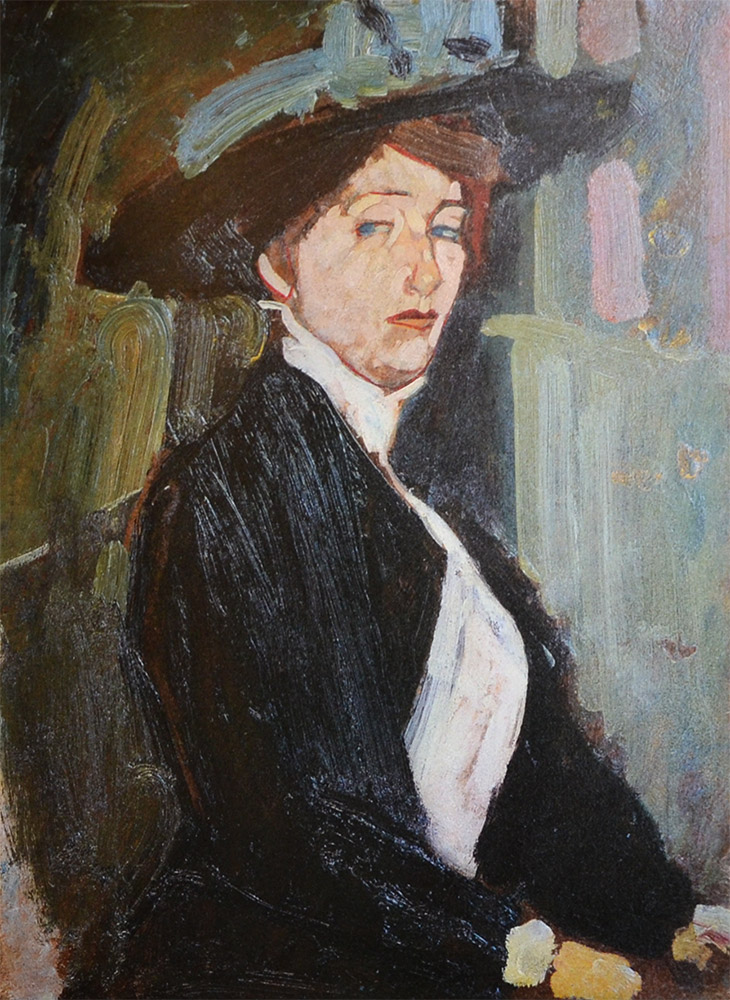
A woman in a great black hat sits half-length in an armchair, her body turned to the right and her head brought back towards the viewer. Her look is sidelong and cool. Above her face, a band of pale blue-green paint, threaded with dark knots, crowns the brim. Below, a stiff white collar rises to her jaw, and a white blouse shows between the lapels of a black jacket that fills almost the whole lower half of the picture. Behind her, at the left, the curved back of an olive-green chair catches yellow light. At the right, the wall breaks up into pale blue-grey and pink vertical strokes.
This is the small painting Ceroni catalogued as no. 26, Donna con cappello. Among the works of the Alexandre years it is unusual in four ways. It is on cardboard, not canvas. It is unsigned. It has no known connection with Paul Alexandre's collection. And it shows a woman who is clothed, hatted and fashionable, not a model, a nude or a bohemian friend. Its date is also unsettled: the published catalogues place it anywhere between 1908 and 1911. This essay examines the work's surface and design, then its place among Modigliani's early portraits of women, and then the points on which the documentation disagrees.
Composition and format
The format is small and upright, 35 by 27 centimetres. Those dimensions match the French standard size 5 figure (my own identification; the Secret Modigliani page on the work does not mention it). Commercial boards were also sold in the standard canvas sizes, so the match does not prove a canvas origin. The Burlington Magazine introduction to the Modigliani Technical Research Study (2018) notes that standard French sizes were still sold in distinct formats in the early twentieth century, and that Modigliani often turned paysage and marine strainers on their short edges to gain height. Here he does not need to. The figure proportion is the conventional portrait shape, and the composition uses it conventionally.
The design is built on a diagonal. The black hat runs across the top of the picture from upper left to right, cut by the right edge. The black body runs from the hat down to the lower right corner. Between them, the face is placed slightly right of centre and above the midline, so that it is the meeting point of two dark masses. The white collar and blouse run as a narrow vertical down the middle of the black jacket, and they lead the eye from the face to the lower edge. At the bottom, near the right corner, a few pale yellow and cream touches may describe gloved hands or something held in the lap. The reproduction is not clear enough to say which.
The figure's pose has a slight torsion. The shoulders face right, but the head turns back towards the picture plane. This is the standard three-quarter pose of nineteenth-century society portraiture, and Modigliani handles it with ease. It gives the image an air of interruption, as if the sitter had turned to look at the painter.
Line
Line in this work is not yet the closed contour of Modigliani's later portraits. It is the edge of a brushstroke. The face is shaped by a reddish-brown line along the right cheek and jaw, by dark strokes for the brows and eyelids, and by a sharp red accent at the mouth. The nose is a long, narrow plane, lit on its left and shadowed on its right. The eyes are fully drawn, with blue irises and dark lids. These are the eyes of a particular person, not the blank almonds of the work after 1911.
Elsewhere line gives way to the brush. The black jacket is made of long strokes laid side by side, and they curve with the arm and shoulder. The chair back is drawn in thick, rounded strokes of olive and yellow, and its curves echo the curve of the hat brim. The background at the right is a set of vertical bands, some pink, some blue-grey, some pale, which read as panelling, curtains or the reflections of a window. Ceroni's transcribed note says nothing about the setting. The page on the work says nothing about it either.
Colour
The colour scheme is narrow and carefully balanced. Black and white dominate the figure: the hat, the jacket, the collar and the blouse. The flesh is pale, almost chalky, warmed by pink on the cheeks and lips and by red-brown in the shadows. The auburn hair forms a warm band between the black hat and the pale face. Around the figure, the colour is cooler and more varied: olive green, yellow-green and ochre in the chair at the left, and blue-grey, pale green and pink in the wall at the right.
Two accents carry the design. The first is the pale blue-green ribbon on the hat. It is the brightest cool colour in the picture, and its blue is picked up in the sitter's eyes. The second is the red of the lips. It is the only saturated warm colour, and it lies exactly on the axis of the white collar below. Small accents of this kind, placed with care, show how far Modigliani had moved by this date from the earth-coloured palette of his student work in Livorno and Venice.
Facture
The paint is handled freely and with evident speed. The jacket shows the drag of a loaded brush over a smooth support, and the strokes are broken where the paint thins. The hat brim is laid in with broad, flat strokes, and the ribbon on top is built up with thicker touches of light colour over the black. The face is more closely worked, with small strokes that follow the planes of the cheek and forehead. The background at the right is thin and scrubbed, and it may let the support show through in places, although the reproduction does not allow certainty.
The smoothness of the strokes, especially in the black, is consistent with a board support. On canvas, a quick stroke of this kind would usually show the weave. The Secret Modigliani page on the work gives the medium as "Oil on Cardboard (Ceroni: oil on canvas)", and the Martigny catalogue of 1990, as listed on the Secret Modigliani site, gives "Huile sur carton". Without having seen the object, I can say only that the visible handling does not contradict a board support.
Figure and space
The space is shallow but readable. The chair back at the left and the panelled wall at the right place the figure in a room, and the chair's curve wraps around her shoulder and pushes her forward. Nothing is shown of the floor or the depth of the room. The hat, cut by the top and right edges, presses the figure towards the viewer. The result is a close, nearly intimate view, which suits the small format and the sitter's sidelong glance.
This is a more conventional space than that of the Alexandre portraits of 1909, which often set the sitter against an unfinished canvas or a patterned ground. It is closer to the interiors of Toulouse-Lautrec and the Nabis, in which a figure sits in a café or a drawing room and the furniture is described in a few strokes. The Tate Papers study of Modigliani's reused canvases notes the impact of Toulouse-Lautrec on a nude of 1908, and the Tate's large-print guide to the 2017 exhibition connects the Lille Bust of a Young Woman of 1908 to Kees van Dongen and the nightlife of Montmartre. The present work belongs to the same field of reference, but in a quieter key.
The sitter and the hat
No name is attached to the sitter. Ceroni's caption, as transcribed by modigliani1909.com, gives only Donna con cappello, "Woman with hat", with the owner as Denise Sasportas, Paris. The Secret Modigliani page adds no identification. This is unusual among Modigliani's early women: La Juive, La petite Jeanne, Maud Abrantes and the "Amazon" (Baroness Marguerite de Hasse de Villers) all carry names or nicknames that come from Paul Alexandre. The absence of a name fits the absence of an Alexandre provenance.
The hat deserves notice. In Ceroni's note on no. 6, the Lille Buste de jeune femme, as transcribed by modigliani1909.com, he rejects the alternative title "Donna con cappello" for that work, because what is shown is "a hairstyle of the period" ("trattasi di pettinatura dell'epoca"). In the present work there is no such doubt. The hat is large, black, broad-brimmed and trimmed with light ribbon or feathers. It appears to belong to the fashion for very large hats of the late 1900s and early 1910s, but I have not been able to consult a dated fashion source that would narrow the date from the hat alone. The point is worth making because the dates proposed for this work cover four years, and the costume is one of the few internal clues.
The sitter's dress, a dark tailored jacket over a white blouse with a high collar, is an everyday urban costume. It is close to the riding jacket worn by the sitter of L'Amazone (Ceroni no. 21), painted in 1909 for Jean Alexandre. In L'Amazone, however, the costume has a social meaning, as the Tate guide explains: the Baroness "chose to pose in riding dress". In the present work the costume seems simply to be what the sitter wore.
Comparisons
The closest comparison in format and handling is L'Amazone (Ceroni no. 21), which also shows a clothed woman with a hat, in three-quarter view, against a dark ground. As discussed in the earlier essay on that work, Ceroni and the auction literature report that the sitter refused the finished portrait after Modigliani repainted her red riding jacket yellow. Donna con cappello is freer and much smaller, and has none of the effort of a commission. If L'Amazone is Modigliani trying to produce a society portrait, this work is closer to a sketch from life.
A second comparison is La Juive (Ceroni no. 9) of 1908, with its dark hair, pale face, heavy contours and green shadows. Next to it, Donna con cappello is lighter, both in colour and in touch. The face is less mask-like, the shadows are less forced, and the colour has been opened up towards blue and pink. That would support a date after 1908.
A third comparison is the group of 1910 heads, Ceroni nos. 29 and 30, which are treated in later essays of this series. There, the face becomes a frontal oval, the eyes become dark slits and the neck lengthens. Donna con cappello has none of these features. Its naturalistic eyes and modelled face place it before that change, or at least outside it. The Martigny date of "c. 1910–11" therefore seems to me to be late, and Ceroni's 1909 is at least as plausible. This is a stylistic judgement only, and it must be weighed against the documented dates set out below.
Provenance and exhibitions
The Secret Modigliani page on the work gives this sequence of owners: Mme Denise Sasportas, Paris; Galerie Charpentier, no. 10, dated 1910, "Collection Mme. Denise Sasportas"; Wildenstein & Co., New York; Edward G. Robinson Collection, Los Angeles; and the Hays Collection, Nashville, with a note: "Future loan to Musèe d' Orsay". Ceroni's caption, names "proprietà Denise Sasportas", and the transcribed note adds that the work was first exhibited in 1958 at the Modigliani exhibition at the Galerie Charpentier in Paris.
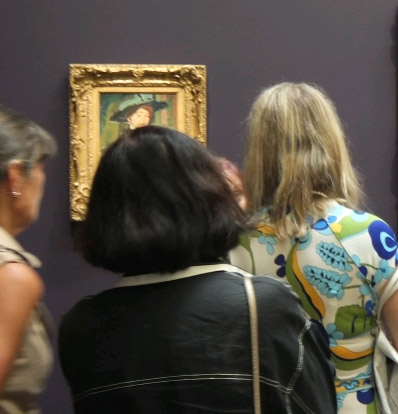
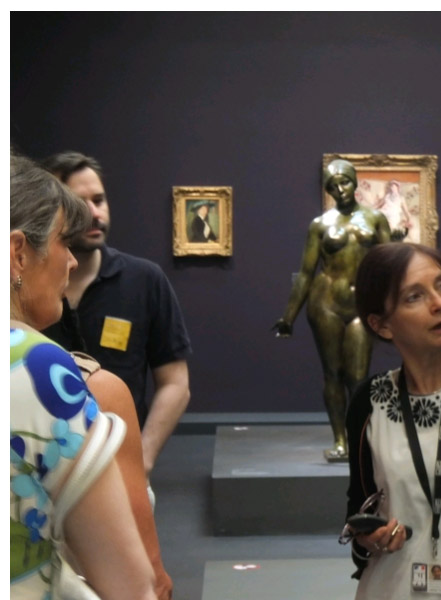
The exhibitions given on the page are: Paris, Galerie Charpentier, Cent tableaux de Modigliani, 1958, no. 10; Tokyo, Seibu department store, 1968, no. 5; Kyoto, National Museum of Modern Art, 1968, no. 5; Tokyo, National Museum of Modern Art, 1985, no. 19; Aichi Prefectural Art Gallery, 1985, no. 19; Martigny, Fondation Pierre Gianadda, 1990, no. 11, p. 87, which the page says gives the medium "uncorrectly as oil on canvas"; and Paris, Musée d'Orsay, The Collection of Marlene and Spencer Hays: A Passion for France, 2013. The page includes photographs of the painting on view at the Orsay exhibition, and of the painting half-hidden behind a curtain in the Hays residence.
Discrepancies.
- Date. Lanthemann gives 1908. Ceroni gives 1909. The Charpentier catalogue of 1958 gives 1910. Martigny 1990 gives c. 1910–11.
- Medium. Ceroni gives oil on canvas. The Secret Modigliani page and its list of the Martigny catalogue give oil on cardboard. The list of the Martigny catalogue reads "Huile sur carton / verso etude pour un paysage".
- Orsay. A search summary suggested that the painting is not among the works donated to the Orsay by the Hays in 2016 and 2019, but I could not confirm that from an opened page.
- Edward G. Robinson. The page names the actor Edward G. Robinson as a former owner. The 1951 Museum of Modern Art catalogue lists Mr and Mrs Edward G. Robinson of Beverly Hills as lenders, but the work they lent there was The Zouave (1918), not this painting. The Robinson ownership of Donna con cappello remains unconfirmed by any source I opened.
Technical analysis
No technical study of this work has been published, as far as I can find. The Secret Modigliani page on the work gives no technical data, and the painting does not appear in the 2018 Burlington Magazine introduction, in the Tate Papers article on hidden paintings, or in the 2023 study of The Cellist in the International Journal of Conservation Science. What follows is visual observation from reproductions, with comparative evidence clearly labelled.
Support. The work is described as oil on cardboard, with a landscape sketch on the verso. If so, it is one of a small number of early Modigliani paintings on board. The Tate Papers study notes that "during the early years of his career, Modigliani painted on various kinds of support, from cardboard to canvas", and links this flexibility largely to his "precarious financial situation". A board painted on both sides fits that account. Painting a landscape on the verso of a portrait support is also notable in itself, because Modigliani's surviving landscapes are very few.
Comparative evidence. On the canvases of the Alexandre years, the published technical studies are consistent. Tate Papers found a thick lead white ground on Jean-Baptiste Alexandre with a Crucifix (1909), and two compositions beneath it. The Burlington introduction says that the canvases studied "seem to have been commercially prepared with an oil-based priming". The IJCS study of The Cellist and the portrait of Brancusi on its reverse found a high-lead white preparation, zinc white, emerald green, chrome pigments and vermilion. None of this can be applied directly to a cardboard support, which would have its own size or priming, or none. It does show the questions a future study should ask: whether there is a ground at all; what the black of the jacket is made of; whether the blue of the ribbon and eyes is cobalt or Prussian blue; and whether the verso landscape and the recto portrait were painted with the same materials and at the same time.
What an examination could settle. Infrared reflectography would show whether there is an underdrawing and whether the hat or the pose was changed. The IJCS study used near-infrared photography to show the drawing under The Cellist and found that the final painting was shifted with respect to it. Examination of the verso, with a photograph published, would settle the questions left open in the discrepancies above. Fibre analysis of the board could help to confirm a date, at least within broad limits.
Conclusion
Donna con cappello is a small, quick and confident portrait of an unnamed woman. Its composition is built from two dark diagonals, the hat and the jacket, which meet at a pale, turned face. A narrow white vertical runs down the centre, and two precise accents, the blue ribbon and the red mouth, hold the whole together. Its fully modelled face and naturalistic eyes place it before the stylised heads of 1910–11, and stylistically I find Ceroni's date of 1909 at least as convincing as the later dates proposed since. The work stands outside the Alexandre circle. It has no name, no signature and no Alexandre provenance. Its documentation disagrees about its date, its support and the catalogue of the 1990 Martigny exhibition, and the verso landscape has not been published. These points could be settled by a simple technical examination and publication of the reverse. Until then, the painting is best seen as evidence of Modigliani's ability, in the years of the Alexandre portraits, to produce an informal and up-to-date likeness of a woman of fashion.
Museum and exhibition sources
- The Museum of Modern Art, New York, in collaboration with the Cleveland Museum of Art, Modigliani: Paintings, Drawings, Sculpture, introduction by James Thrall Soby (1951), list of lenders and catalogue, https://assets.moma.org/documents/moma_catalogue_2916_300191634.pdf
- Tate Modern, Modigliani (23 November 2017–2 April 2018), large-print guide, rooms 1–11 (copy at docslib), https://docslib.org/doc/1601730/modigliani-large-print-guide-room-1-11
Technical literature (comparative)
- Anaïs Genty-Vincent et al., "Works by Modigliani that have Paintings beneath the Visible Surface", Tate Papers, no. 35, https://www.tate.org.uk/research/tate-papers/35/works-by-modigliani-that-have-paintings-beneath-the-visible-surface
- Annette King, Nancy Ireson, Simonetta Fraquelli and Joyce H. Townsend, "The Modigliani Technical Research Study: An introduction to Modigliani's materials and techniques", The Burlington Magazine, vol. 160, no. 1380 (March 2018), pp. 182–88, https://www.burlington.org.uk/archive/article/the-modigliani-technical-research-study-an-introduction-to-modiglianis-materials-and-techniques
- Greta Garcia, David Juanes and Rafael Romero, "Image Study and Material Characterization of the Two-Sided Painting The Cellist and Portrait of Brancusi by Amedeo Modigliani", International Journal of Conservation Science, vol. 14, no. 3 (2023), pp. 1233–48, https://doi.org/10.36868/ijcs.2023.03.30
Sources that could not be opened
Musée d'Orsay, "Marlene and Spencer Hays", https://www.musee-orsay.fr/en/articles/marlene-and-spencer-hays-488, and the exhibition page A Passion for France. The Marlene and Spencer Hays Collection (timed out or returned only a page shell).
Cited but not independently consulted
Lanthemann, Modigliani, catalogue raisonné, 1970, no. 15; Ceroni and Piccioni, I dipinti di Modigliani, 1970, no. 26; Patani, Catalogo generale, 1991–94, no. 28; Soto Caba, Modigliani: The Timeless Face, 2007; the catalogues of Galerie Charpentier, Cent tableaux de Modigliani, 1958; Tokyo and Kyoto, 1968; Tokyo and Aichi, 1985; Martigny, 1990; and Musée d'Orsay, 2013. All are cited from the Secret Modigliani page on the work.
Footnotes
- Joseph Lanthemann, Modigliani, catalogue raisonné: sa vie, son œuvre, son art, Barcelona, G. Condal, 1970.
- Ambrogio Ceroni and Leone Piccioni, I dipinti di Modigliani, Milan, Rizzoli, 1970.
- Osvaldo Patani, Modigliani. Catalogo generale, Milan, Leonardo, 1991–94.
- Victoria Soto Caba, Modigliani: The Timeless Face, Madrid, Libsa, 2007.