Red head woman
Oil on canvas?— 1915 ?

Identification
- Title
- English: Red head woman.
Notes: La ragazza rossa (Testa di donna dai capelli rossi) (GAM, Turin);Testa di donna dai capelli rossi (Ceron); Portrait of a Russian woman (Ceroni and Piccioni, 1970); Beatrice Hastings (d'Atri paperse)
- Date
- 1915 ?
Notes: 1915 (GAM, Turin; Ceroni); 1916 (Pfannstiel 1956; D'Atri) - Medium
- Oil on canvas
- Dimensions
- 46 x 38 cm
Notes: 46 × 38 cm (GAM, Turin; Ceroni); 36 × 27 cm (Pfannstiel, 1956); 54.5 × 45.5 cm (d'Atri papers) - Signature
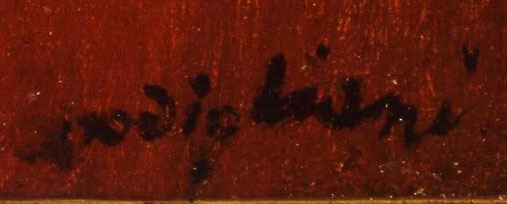
- Signed "modigliani " lower right
- Present location
- Galleria Civica d'Arte Moderna e Contemporanea (GAM), Turin, inv. P/1628, donated by the Comitato Torino '61 in 1962.
Catalogue numbers
| Compiler | Number |
|---|---|
| Arthur Pfannstiel | no. 105 |
| Joseph Lanthemann | no. 58 |
| Ambrogio Ceroni | 1958 / no 175 - 1970 / no. 93 |
| Jeanne Modigliani | YES |
| Christian Parisot | 4/1915 |
| Osvaldo Patani | no. 96 |
| Modigliani Project | ? |
| MR | YES |
| Modigliani Initiative/AMDC | ? |
Legal note on MR: This investigation has not had access to MR’s catalogue raisonné; all research here is based on open sources, publications and exhibitions. By no means has that catalogue been copied at any point. Modigliani Project and Modigliani Initiative are marked YES when the work is published or otherwise recorded by those projects, even if no catalogue number is assigned; otherwise the field is marked ?.
Provenance
- Paul Guillaume Coll. Paris
- Galerie Beyeler, Basel (1956-60?)
- Galleria Civica d' Arte Moderna e Contemporanea, Torino, Italia ( Inv. no. P/1628)
- Donated by the Comitato Torino'61 in 1962.
The sequence follows the published museum, sale, and catalogue record in this investigation. Gaps and uncertain transfers are marked as such.
Selected bibliography
Book-length publications are marked with a footnote giving a full citation. Exhibition catalogues appear in both this list and the exhibition list when this investigation recorded them in both places.
- Pfannstiel, "catalogue presume" Modigliani. L'Art et la Vie. Preface de Louis Latourrettes, Seheur, Paris, 1929, p. 161
- Pfannstiel, Modigliani et son oeuvre, etude critique et catalogue raisonne, bibliotheque des arts, Paris, 1956, no. 105 (with incorrect size 36 x 27 cm) dated in 1916.2
- Beyeler Gallery, Basel 1956, p. 22
- Beyeler Gallery, Basel 1960, pl.10
- Ceroni, Amedeo Modigliani: Peintre; Suivi des Souvenirs de Lunia Czechowska, Edizioni del Milione, 1958 - no. 1753
- Pavolini, Modigliani, Union Générale d'Éditions en accord avec l'Unesco, Milano 1966, pl. 8
- Lanthemann, Modigliani, catalogue raisonné: sa vie, son oeuvre, son art, G. Condal, Barcelona, 1970 - no. 584
- Ceroni & Piccioni, Il dipinti di Modigliani, Rizzoli, Milano, 1970 - no. 93 with the title Portrait of a Russian woman and dated in 19155
- Modigliani J. Racconta Modigliani, Ed. Graphis. 1984 p. 2276
- Patani, Modigliani. Dipinti e disegni. Incontri Italiani 1900-1920, Mazzotta, 1984 - no. 257
- Catalogue National Museum Tokyo, 1985 - no. 49
- Catalogue Aichi Prefectural Art Gallery, 1985 - no. 49
- Mondadori, Modigliani a Montparnasse, Mondadori, Milano, 1988, p. 40
- Verona, Modigliani a Montparnasse, Palazzo Forti, 1988 p. 87
- Barilli, L'espressionismo italiani, Mole antonelliana Torini, Fabbri, 1990 p. 150
- Parisot, Catalogue Raisonee Modigliani, Graphis Arte, 1991 no. 4/19158
- Patani, Catalogo Generale, Leonardo, Milano, 1991-94 - no. 967
- Parisot, Modigliani, Pierre Terrail, Paris, 1992, p. 679
- MR, L'Ange au visage grave, Musée du Luxembourg, Paris, 2002 pp. 198-19910
- Parisot, Modigliani la vita le opere, Ed. Carte Secrete, Milano 200611
- Soto Caba, Modigliani, The timeless face, Libsa, Madrid, 200712
- Marini, Modigliani, Skira, France, 2008 - no. 17, p. 5113
Exhibitions
- Paris, Modigliani, Galerie Bernheim-Jeune, 1922 - no. 25 ? as La fille Rousse
- Basel, Masters of Modern Art, Beyeler Gallery, 1956
- Basel, The Woman, Beyeler Gallery, 1960
- Liege, Modigliani exhibition. Musée Saint Georges, 1980 - no. 5
- Barcelona, Modigliani, Centro Cultural de la Caixa de pensiones,Curated by Christian Parisot, 1983- no. 13
- Madrid, Modigliani, Sala de exposiciones la caja de pensiones, Curated by Christian Parisot, 1983 - no. 13
- Torino, Incontri Italian, Galleria dello Scudo, 1984 - no. 25
- Verona, Incontri Italian, Galleria dello Scudo, 1984-1985 - no. 25
- Tokyo, Modigliani exhibition, National Museum, 1985 - no. 49
- Nagoya, Modigliani exhibition, Aichi Prefectural Art Gallery, 1985 - no. 49
- Verona, Modigliani a Montparnasse, Palazzo Forti, 1988, p. 40
- Paris, Modigliani: l'ange au visage grave, Musée du Luxembourg, 2002 - no. 29
- Milano, Modigliani: l'ange au visage grave, Palazzo Reale, 2003 -no. 24
- Moscow, Meeting Modigliani, Pushkin State Museum of Fine Arts, 2007
- Tokyo, Modigliani et le primitivisme, The national Art Center, 2008 - no. 23
- Osaka, Modigliani et le primitivisme, The national Museum of Art, 2008 - no. 23
- Torino, Isola & Norzi, Galleria d’Arte Moderna, 2012
- Torino, Modigliani e la Bohème di Parigi, Galleria d’Arte Moderna, 2015
- Genova, Modigliani, Palazzo Duccale, 2017
Notes
As no. 286 in D' Atri papers titled "Beatrice Hastings" - 54.5 x 45.5 - dated 1916 - signed lower right - Provenance in Paul Guillaume in 1929.
Note: This painting remains untraced from 1929 to 1956 and when it finally surfaces again in Beyeler is by the hand of Pfannstiel with a new name as Woman with red hair, previously it was known as Beatrice Hastings.
This investigation records that Pfannstiel changes the size on purpose on his catalogue, Pfannstiel was the main purveyor for the Nazi French occupation troops. (original size in Pfannstiel 1956 is 36 x 27 and the painting is 46 x 38, but in D atri he say 54.5 x 45.5 it would be interesting to see if the painting has been cut or altered?)
This painting may probably has a war crime story unsolved.
----------
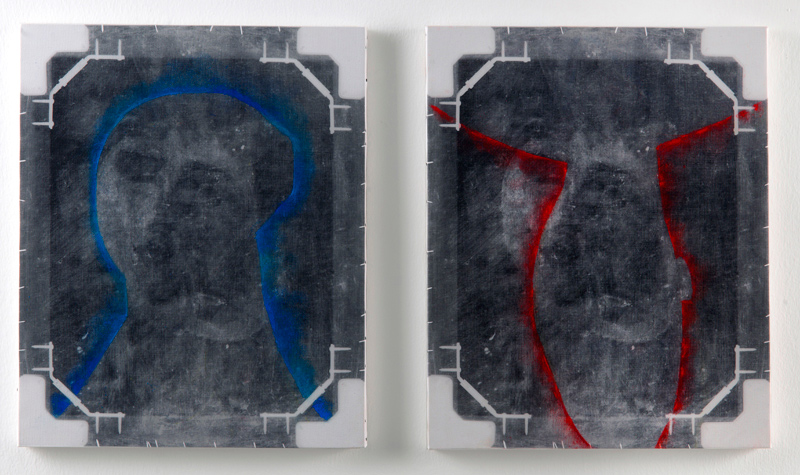
In the exhibition at the GAM - Isola & Norzi, Galleria d’Arte Moderna, 2012 they showed the X- ray of the painting and talked about the possibility that little Louise portrait was underneath the actual painting, but it's not clear if it is real or just a work for the exhibit.
This painting presents holes in the 4 corners (2 of them covered by restoration)
Where sources disagree, both readings are given. This is a working research page, not a catalogue raisonné.
Galleria Civica d’Arte Moderna e Contemporanea, Turin, holds the work as Portrait of a Russian Woman / Fille rousse, inventory P/1628, oil on canvas, donated by the Comitato Torino ’61 in 1962.

Introduction
The Red-haired Woman in the Galleria d'Arte Moderna in Turin is a bust portrait of a young woman whose face, hair, dress and background are all painted in variations of a single warm red. Her copper hair rises high above the forehead and falls in a fringe of short vertical locks; her oval face is divided by a vertical line that runs from the hair through the nose to the chin, and her two eyes are painted differently, one blue-grey and one dark. A small gold earring hangs from her left ear, at the left of the picture, and her dress opens in a V at the neck, bordered with black. Behind her, horizontal bands of striated pattern cross the background at the height of the shoulders.
The work is one of the best-known Modigliani paintings in an Italian public collection, and it has been exhibited widely. Its history is also unusually uncertain. The Secret Modigliani page reports that the painting was listed in the d'Atri papers in 1929 as a portrait of Beatrice Hastings with a larger size, that it is untraced between 1929 and 1956, and that it reappeared at the Galerie Beyeler in Basel under a new title and with a smaller size in Pfannstiel's catalogue. The page also reports an X-radiograph shown in Turin in 2012, in an exhibition of the artists Isola and Norzi, that was presented as suggesting a portrait of Louise beneath the visible image.
For this essay I opened the Secret Modigliani page on the work and its list of the paintings published by Ceroni, the GAM page on the work, the Musée de l'Orangerie page on Modigliani’s Fille rousse, the transcription of Ceroni’s catalogue, a secondary page by Seungyong Chang of the Modigliani Institute Korea, The Burlington Magazine article of March 2018 on the Modigliani Technical Research Study, and Tate Papers, no. 35.
Composition and format
In my measurement, the reproduction used here has a proportion of height to width of 1.175, and the Ceroni plate on modigliani1909.com 1.237. The stated size, 46 × 38 cm, gives 1.211. The two photographs therefore differ from each other by about five per cent, the first wider and the second narrower than the stated size, and they cannot be used to test the size. Pfannstiel's 36 × 27 cm gives 1.333, which neither photograph approaches; the d'Atri size, 54.5 × 45.5 cm, gives 1.198, close to the stated proportion. In my reading, the proportions alone do not show whether the d'Atri size is a different measurement of the same canvas, a measurement including a frame, or evidence of a reduction.
The head is placed high and on the central axis, with the hair reaching the upper edge and the chin at about three-fifths of the height. The face is broad, and in my measurement it takes up about half of the width of the canvas. The neck descends to the V of the neckline, whose point lies near the lower edge, slightly right of centre; the shoulders spread to the side edges as a broad mass of red. The earring is placed at the left, at the level of the mouth, and the signature at the lower right.
In my reading, the composition is organised by two geometries: the verticals of the hair locks, the dividing line of the face, the neck and a dark blue vertical...(truncated 2345 characters)... neckline and the yellow-gold of the earring.
In my reading, the monochrome is not uniform. The face is lighter and pinker than the dress and the background, and the right half of the face, from the viewer's point of view, is slightly lighter than the left, so that the dividing line separates two tones. The striated bands in the background are painted in lighter and darker reds, and they read as an ornamental pattern, perhaps a moulding or the edge of a fabric.
Facture
The surface is uneven. In the reproduction, the face shows a fine network of cracks, especially on the chin and the cheeks, and the paint of the dress and background is laid in broad strokes, some of them scumbled so that the darker layer shows through. The striated bands are painted with short, dragged strokes of lighter paint over darker. The hair locks over the forehead are built up with thicker paint, and the earring is a small raised dab of yellow.
Tate Papers, no. 35, by Anaïs Genty-Vincent et al., describes Modigliani reworking his paint "through scraping, wiping, blotting and scratching – reductive techniques that recall the artist’s beginnings as a sculptor". In my reading, the scratchy texture of the striated bands and the scumbled background may have been produced by such methods, but no technical examination of the work has been opened. This is comparative.
Figure and space
The space is shallow and the figure fills it. The horizontal bands behind the shoulders suggest a wall or a piece of furniture, but they are interrupted by the figure and do not establish a ground plane. The dark area at the upper right and the dark blue vertical at the upper left frame the head. The Orangerie text describes the background of its Fille rousse as "un fond géométrique, peut-être une cimaise, structuré par des lignes horizontales et verticales" (a geometric background, perhaps a dado rail, structured by horizontal and vertical lines); in my reading, the Turin painting has a comparable, if less regular, background.
The expression is calm and slightly withdrawn. The differing eyes give the face a double character, one eye open and light, the other dark and, in my reading, almost closed. The device of the divided face and the two eyes painted differently is found in other works of this period, and it can be read as a sign of the sitter's inner and outer life, or as a purely formal play of symmetry and asymmetry; none of the sources opened for this essay interprets it.
Iconography and sitter
The identity of the sitter is unknown. The titles do not agree: Ceroni’s caption, as transcribed, gives "Testa di donna dai capelli rossi, Torino, Galleria d'Arte Moderna" (head of a woman with red hair, Turin, Galleria d'Arte Moderna); the GAM's page uses La ragazza rossa (Testa di donna dai capelli rossi) (the red girl, or head of a woman with red hair); Ceroni and Piccioni's edition of 1970 used Portrait of a Russian woman, according to the Secret Modigliani page; and the d'Atri papers, according to the same page, listed the work as Beatrice Hastings. The Secret Modigliani page also suggests that the work may be the La fille Rousse exhibited at Bernheim-Jeune in 1922, no. 25, with a query.
In my reading, the identification with Hastings, like that of the Brera head, rests on the general type of the face; the high hair is consistent with Woman Seated in Front of a Fireplace, which Tate Papers, no. 35, describes as thought to be a portrait of Hastings and whose sitter wears dark hair piled on top of the head, but the red colour of the hair is not. The title Russian woman has no explanation in the sources opened.
The GAM's own description, signed by Laura D'Agostino, does not discuss the sitter. It describes Modigliani’s portraits in general as "mai dipinti a memoria ma sempre con un modello" (never painted from memory but always from a model), with an execution "affidata al disegno, sottile come in punta di matita, ma acuto e costruttivo" (entrusted to drawing, as fine as the point of a pencil, but sharp and constructive).
Comparisons
Head of a Young Woman (Ceroni no. 92). The Brera head has the same size, the same first owner, Paul Guillaume, according to the Secret Modigliani page, the same holes in the four corners and the same possible identification with Hastings. The two works differ sharply in colour: the Brera head sets warm flesh against cool blue, while the Turin painting is built in a single warm red. In my reading, they may represent two experiments with the same format and the same type of head in 1915. This is comparative.
Fille rousse (Musée de l'Orangerie). The Orangerie's Fille rousse, 40.5 × 36.5 cm, signed and dated modigliani 1915 at lower right, also came from Paul Guillaume. The museum describes it as one of a series of portraits in which Modigliani made "une interprétation très libre du cubisme" (a very free interpretation of cubism), painted in a "camaïeu de bruns" (monochrome of browns). The Turin painting is comparable in its monochrome palette and its geometric background. The existence of the Orangerie painting, under the title Fille rousse and from the same dealer, makes the identification of the Turin work with the La fille Rousse of 1922 uncertain. This is comparative.
Louise (Ceroni nos. 94 and 95). The X-radiograph shown in Turin in 2012, as reported by the Secret Modigliani page, was presented as suggesting a portrait of the girl known as Louise beneath the visible image. The two paintings of Louise are discussed in the essays on Ceroni nos. 94 and 95. This is comparative.
Provenance and exhibitions
The Secret Modigliani page gives the provenance as: Paul Guillaume, Paris; Galerie Beyeler, Basel (1956–1960?); GAM, Turin, donated by the Comitato Torino '61 in 1962. It states that the work is no. 286 in the d'Atri papers, as Beatrice Hastings, 54.5 × 45.5 cm, dated 1916, signed bottom right, in the Paul Guillaume collection in 1929, and that it is untraced between 1929 and 1956, when it reappeared at Beyeler, through Pfannstiel, under the new name Woman with red hair. The GAM page gives the inventory number P/1628 but no provenance.
The documented facts are the gap in the provenance between 1929 and 1956 and the differences in size and title between the d'Atri papers and Pfannstiel's catalogue of 1956.
The Secret Modigliani page lists the exhibitions: Paris, Bernheim-Jeune, 1922, no. 25, with a query, as La fille Rousse; Basel, Beyeler, 1956 and 1960; Liège, Musée Saint-Georges, 1980, no. 5; Barcelona and Madrid, 1983, no. 13; Turin and Verona, Galleria dello Scudo, Incontri italiani, 1984 and 1984–1985, no. 25; Tokyo and Nagoya, 1985, no. 49; Verona, Palazzo Forti, Modigliani a Montparnasse, 1988; Paris, Musée du Luxembourg, 2002, no. 29, and Milan, Palazzo Reale, 2003, no. 24; Moscow, Pushkin Museum, 2007; Tokyo and Osaka, Modigliani et le primitivisme, 2008, no. 23; Turin, GAM, Isola & Norzi, 2012; Turin, GAM, Modigliani e la Bohème di Parigi, 2015; and Genoa, Palazzo Ducale, 2017.
Discrepancies
- Size. The GAM gives 46 × 38 cm; Pfannstiel gave 36 × 27 cm and the d'Atri papers 54.5 × 45.5 cm, according to the Secret Modigliani page.
- Bernheim-Jeune, 1922. The Secret Modigliani page identifies the work, with a query, with La fille Rousse, no. 25; the Orangerie's Fille rousse, also from Paul Guillaume, is another candidate.
- Lanthemann number. The Secret Modigliani page gives no. 58 for this work and also no. 58, in its bibliography, for the Brera head (Ceroni no. 92).
- The X-radiograph of 2012. The Secret Modigliani page states that it is not clear whether the image shown was a real radiograph or a work made for the exhibition; Chang's page states that the museum announced the results of X-rays of the painting.
Technical analysis
No technical report on the work has been opened. The following remarks are based on the reproductions on the Secret Modigliani page and on comparative literature.
The 2012 image. The Secret Modigliani page reproduces a photograph of two panels from the Isola & Norzi exhibition of 2012. In my reading, each panel shows a radiograph-like grey image of a frontal head and shoulders, with the white shapes of the corner joints of a stretcher at the four corners and small tack marks along the edges. On the left panel a blue line traces a rounded, hood-shaped contour round the head and shoulders; on the right panel two red lines run from the upper corners down towards the lower centre. In my reading, the blue contour recalls the black headscarf and hair that frame the face in the two paintings of Louise, while the red lines follow, roughly, the outer edges of the high hair and the shoulders of the visible red-haired woman. The overlays thus appear to be an interpretation, distinguishing two images, rather than part of the radiograph. Since the Secret Modigliani page itself is uncertain whether the image is a real radiograph or a work made for the exhibition I treat it as a hypothesis, not as evidence.
Reuse. Tate Papers, no. 35, states that Modigliani "frequently used canvas supports that already had paintings on them", and that he sometimes turned images 180 degrees before painting over them. A Louise beneath the Turin painting would therefore be consistent with his practice, but it is not demonstrated by the sources opened. This is comparative.
Corners and size. The Secret Modigliani page notes holes in the four corners of the canvas, two of them covered by restoration. These, and the question of the d'Atri size, could be clarified by an examination of the tacking margins, which would show whether the canvas has been reduced. No such examination has been opened.
Contours. The Burlington article reports that Modigliani often left "a thin border of unpainted ground around the figure, which he might later reinforce with thin black painted lines". In my reading, the black border of the neckline and the dark contour of the neck at the left may belong to such a final stage. This is comparative.
Conclusion
The Red-haired Woman in Turin is a bust portrait built almost entirely in red, in which an oval face divided by a vertical line, with two eyes painted differently, is set beneath a high, ribbed mass of copper hair, against a background of horizontal striated bands and dark verticals. The divided face, the asymmetrical eyes and the geometric background place it among the most experimental heads of 1915, close in palette and setting to the Orangerie's Fille rousse and in format to the Brera head.
Its history is less secure than its style. The sources disagree on its title, its date, its size and its identification with the La fille Rousse of 1922, and the Secret Modigliani page reports a gap in the provenance between 1929 and 1956. The image shown in 2012, presented as revealing a Louise beneath the surface, remains uncertain, and the allegations of the Secret Modigliani page about the painting's wartime history are not supported by any other source opened.
Museum, auction and exhibition sources
- GAM, Galleria Civica d'Arte Moderna e Contemporanea, Turin, online catalogue, Amedeo Modigliani, La ragazza rossa (Testa di donna dai capelli rossi), inv. P/1628, https://www.gamtorino.it/en/archivio-catalogo/la-ragazza-rossa-testa-di-donna-dai-capelli-rossi/
- Musée de l'Orangerie, Amedeo Modigliani, Fille rousse, RF 1960 46, https://www.musee-orangerie.fr/fr/oeuvres/fille-rousse-196297 (comparative)
Technical literature (comparative)
- Annette King, Nancy Ireson, Simonetta Fraquelli and Joyce H. Townsend, "The Modigliani Technical Research Study. An introduction to Modigliani’s materials and techniques", The Burlington Magazine, vol. 160, no. 1380 (March 2018) (comparative)
- Anaïs Genty-Vincent et al., "Works by Modigliani that have Paintings beneath the Visible Surface", Tate Papers, no. 35, https://www.tate.org.uk/research/tate-papers/35/works-by-modigliani-that-have-paintings-beneath-the-visible-surface (comparative)
- Seungyong Chang, "The Introduction of the Works by Amedeo Modigliani: 38. Portrait of Little Louise (1915)", 23 March 2020, https://artcollagejang.blogspot.com/2020/03/the-introduction-of-works-by-amedeo_23.html
Cited but not independently consulted
Pfannstiel, catalogue presume, Modigliani. L'Art et la Vie. Preface de Louis Latourrettes, Seheur, Paris, 1929, p. 16; Pfannstiel, Modigliani et son oeuvre, etude critique et catalogue raisonne, bibliotheque des arts, Paris, 1956, no. 105 (with incorrect size 36 x 27 cm) dated in 1916; Beyeler Gallery, Basel 1956, p. 22; Beyeler Gallery, Basel 1960, pl. 10; Ceroni, Amedeo Modigliani: Peintre; Suivi des Souvenirs de Lunia Czechowska, Edizioni del Milione, 1958, no. 175; Pavolini, Modigliani, Union Générale d'Éditions en accord avec l'Unesco, Milano 1966, pl. 8; Lanthemann, Modigliani, catalogue raisonné: sa vie, son oeuvre, son art, G. Condal, Barcelona, 1970, no. 58; Ceroni & Piccioni, Il dipinti di Modigliani, Rizzoli, Milano, 1970, no. 93 with the title Portrait of a Russian woman and dated in 1915; Modigliani J. Racconta Modigliani, Ed. Graphis, 1984, p. 227; Patani, Modigliani. Dipinti e disegni. Incontri Italiani 1900–1920, Mazzotta, 1984, no. 25; Catalogue National Museum Tokyo, 1985, no. 49; Catalogue Aichi Prefectural Art Gallery, 1985, no. 49; Mondadori, Modigliani a Montparnasse, Mondadori, Milano, 1988, p. 40; Verona, Modigliani a Montparnasse, Palazzo Forti, 1988, p. 87; Barilli, L'espressionismo italiani, Mole antonelliana Torini, Fabbri, 1990, p. 150; Parisot, Catalogue Raisonee Modigliani, Graphis Arte, 1991, no. 4/1915; Patani, Catalogo Generale, Leonardo, Milano, 1991–1994, no. 96; Parisot, Modigliani, Pierre Terrail, Paris, 1992, p. 67; MR, L'Ange au visage grave, Musée du Luxembourg, Paris, 2002, pp. 198–199; Parisot, Modigliani la vita le opere, Ed. Carte Secrete, Milano 2006; Soto Caba, Modigliani, The timeless face, Libsa, Madrid, 2007; Marini, Modigliani, Skira, France, 2008, no. 17, p. 51.
Footnotes
- Arthur Pfannstiel, Modigliani. L’Art et la Vie, preface by Louis Latourette, Paris, Seheur, 1929 (presumed catalogue).
- Arthur Pfannstiel, Modigliani et son œuvre, étude critique et catalogue raisonné, Paris, Bibliothèque des Arts, 1956.
- Ambrogio Ceroni, Amedeo Modigliani: Peintre; suivi des souvenirs de Lunia Czechowska, Milan, Edizioni del Milione, 1958.
- Joseph Lanthemann, Modigliani, catalogue raisonné: sa vie, son œuvre, son art, Barcelona, G. Condal, 1970.
- Ambrogio Ceroni and Leone Piccioni, I dipinti di Modigliani, Milan, Rizzoli, 1970.
- Jeanne Modigliani, Modigliani sans légende, Paris, Gründ, 1961.
- Osvaldo Patani, Amedeo Modigliani: catalogo generale, Milan, Leonardo, 1991–94.
- Christian Parisot, Catalogue raisonné Modigliani, Livorno, Graphis Arte, 1991.
- Christian Parisot, Modigliani, Paris, Pierre Terrail, 1992.
- MR, Modigliani: l’ange au visage grave, Paris, Musée du Luxembourg, 2002. Cited from the published exhibition catalogue only.
- Christian Parisot, Modigliani: la vita, le opere, Rome, Carte Segrete, 2006.
- Victoria Soto Caba, Modigliani: The Timeless Face, Madrid, Libsa, 2007.
- Maurizio Marini, Modigliani, Paris, Skira, 2008.