Beatrice Hastings
Oil on cardboard - 1915
Identification
- Title
- English: Beatrice Hastings.
Notes: Testa di Beatrice Hastings (Ceroni); Ritratto di Béatrice Hastings (Italian Wikipedia). - Date
- 1915
- Medium
- Oil on cardboard
Notes: oil on carton maroufle over wood (MR); oil on paper (Parisot; Ceroni); oil on canvas (Italian Wikipedia). - Dimensions
- 43 x 35 cm
Notes: 43 × 35 cm (Italian Wikipedia); 35 × 27 cm (Parisot; MR in 1999); 35 × 26.5 cm (MR in 2002); 33 × 25 cm (exhibition of 1958). - Signature
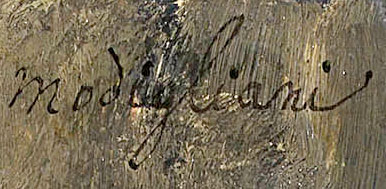
- "modigliani" upper right and unreadable text in lower right
- Present location
- Museo del Novecento, Milan, Italia / inv. no. 8744; formerly Ricardo Juncker Collection, Milan.
Catalogue numbers
| Compiler | Number |
|---|---|
| Arthur Pfannstiel | NO |
| Joseph Lanthemann | no. 96 |
| Ambrogio Ceroni | no. 78 |
| Jeanne Modigliani | YES |
| Christian Parisot | 23/1915 |
| Osvaldo Patani | no. 79 |
| Modigliani Project | ? |
| MR | YES |
| Modigliani Initiative/AMDC | ? |
Legal note on MR: This investigation has not had access to MR’s catalogue raisonné; all research here is based on open sources, publications and exhibitions. By no means has that catalogue been copied at any point. Modigliani Project and Modigliani Initiative are marked YES when the work is published or otherwise recorded by those projects, even if no catalogue number is assigned; otherwise the field is marked ?.
Provenance
- Sale: Drouot, Paris 20 / June / 1941 — Sold for 4.000 FF (previous provenance is unclear, this is probably a work that changed hands during the war)
- Jucker Collection, Milano (after 1940-41)
- Mention in P.C: Milano in 1955 exhib. (Coll. Jucker. Milano?)
- Museo d'arte contemporanea Coll. Jucker. Milano
- Museo del Novecento, Milano, Italia (Inv. no. 8744)
The sequence follows the published museum, sale, and catalogue record in this investigation. Gaps and uncertain transfers are marked as such.
Selected bibliography
Book-length publications are marked with a footnote giving a full citation. Exhibition catalogues appear in both this list and the exhibition list when this investigation recorded them in both places.
- Exh. Cat. Associazione fra gli amatori e i cultori delle arti figurative contemporanee, Milano, 1946, pl. 3
- Carli, Amedeo Modigliani, De Luca, Roma 1952, no. 2
- Russoli, Amedeo Modigliani, Exhib. catalogue Palazzo Reale, Edizioni dell'ente manifestazioni Milanesi, Milano, 1958, pl. 11
- Ceroni, Amedeo Modigliani : dessins et sculptures; avec suite du catalogue illustre des peintures, Edizioni del Milione, Milano, 1965 p. 166
- Lanthemann, Modigliani, catalogue raisonné: sa vie, son oeuvre, son art, G. Condal, Barcelona, 1970 - no. 961
- Ceroni & Piccioni, Il dipinti di Modigliani, Rizzoli, Milano, 1970 - no. 782
- Musée de Art Moderne de la Ville de Paris, Modigliani exhib. cat., 1981, p. 114 (Oil on cardboard - wrong size 35 x 27)
- Roy, Modigliani, Nathan, Paris, 1985, p. 363
- Parisot, Catalogue Raisonné Modigliani, Graphis Arte, 1991 no. 23/19154
- Patani, Catalogo Generale, Leonardo, Milano, 1991-94, no. 795
- Monti a cura de R. Chiappini, Catalogue Amedeo Modigliani, Lugano, Skira, 1999
- MR, L'Ange au visage grave, Musée du Luxembourg, Paris, 2002 pp. 196-197 (incorrect size 35 x 26.5 cm)6
- Soto Caba, Modigliani, The timeless face, Libsa, Madrid, 20077
Exhibitions
- Milano, Associazione fra gli amatori e i cultori delle arti figurative contemporanee, 1946 - no. 3 (size 35 x 27)
- Milano, Borromini Gallery, 1947
- Roma, Modigliani, IV Quadriennale,
- Palazzo delle Esposizioni, 1951-1952
- Bern, Modigliani Campigli Sironi, Kunsthalle Bern, 1955 - no. 7
- Paris, Cent Tableaux de Modigliani, Galerie Charpentier, 1958 - no. 21
- Marseille, Musée Cantini, 1958 - no. 4
- Milano, Mostra di Amedeo Modigliani, Palazzo Reale, Curated by Franco Russoli, 1958- no. 11
- Paris, Modigliani, Musée de Art Moderne de la Ville de Paris, 1981, no. 23
- Lugano, Amedeo Modigliani, Museo d'Arte Moderna, 1999, no. 16
- Paris, Modigliani: l'ange au visage grave, Musée du Luxembourg, 2002- no. 28
- Milano, Modigliani: l'ange au visage grave, Palazzo Reale, 2003 - no. 23
- Genova, Modigliani, Palazzo Duccale, 2017
Notes
Not in D' Atri papers ?
This painting presents holes in the 4 corners (2 of them covered by restoration)
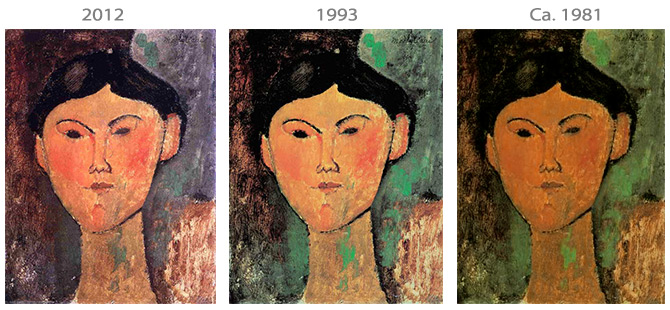
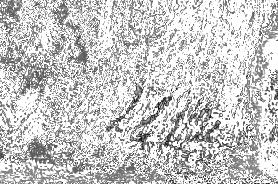
This investigation has no information of restorations or cleaning of the work, but looking at old pictures is curious to see how the green area vanishes with time in pictures (the most actual & real image is up): In lower right there is another signature or dating almost invisible to regular eye, only readable using the red channels: Probably a dedicatory or a dating (12 ???)?
Where sources disagree, both readings are given. This is a working research page, not a catalogue raisonné.
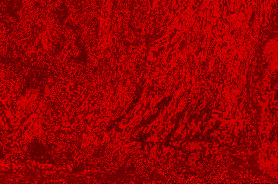
(image in digital infrared)
Introduction
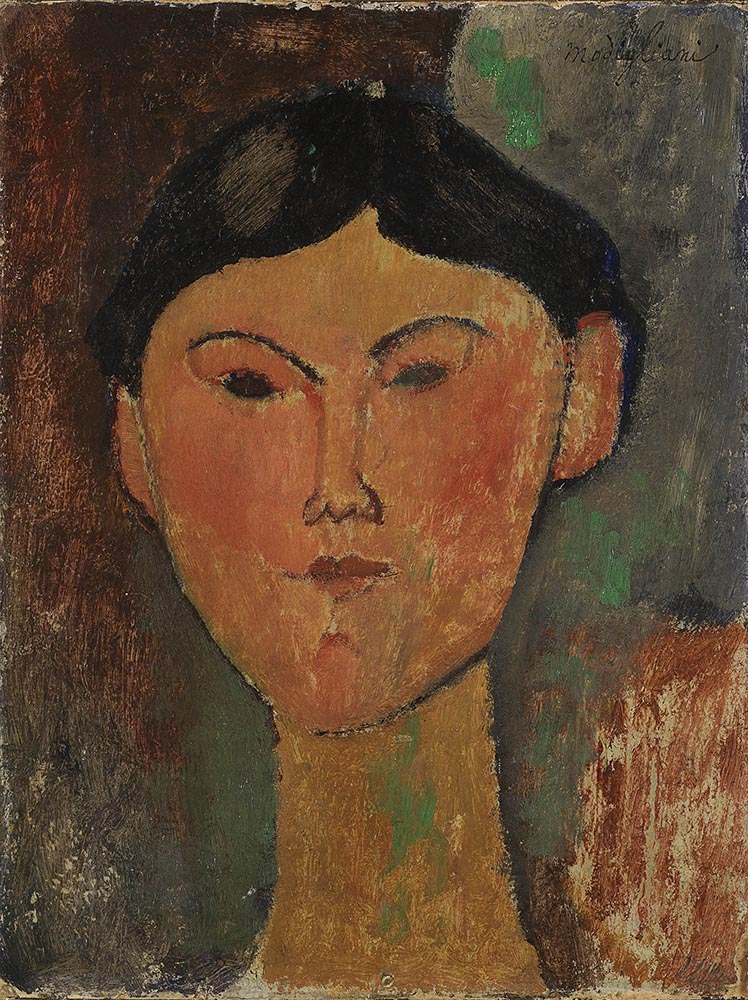
The head of Beatrice Hastings in the Museo del Novecento in Milan is one of the few portraits of her in a public collection in Italy, and it has been exhibited there and abroad since 1946. It shows the sitter frontally, with a black cap of hair, an orange-red face and a long ochre neck, against a background of brown-red, grey-blue, green and rust. Patches of bright green appear in the background and on the neck. The signature is at the upper right.
Ceroni’s caption, reads "Testa di Beatrice Hastings, Milano, proprietà Riccardo Juncker" and Italian Wikipedia describes the work as having formed part of the Collezione Jucker. The spelling Juncker is presumably a misprint in Ceroni or in the transcription.
The literature disagrees on the size and the support of this small head to an extent that is unusual for a museum painting. This essay describes the work from the reproductions on the Secret Modigliani page and shows, by my own measurement of the photographs, that the size now given for it, 43 × 35 cm, does not agree with the proportions of the image, while the older sizes do. Descriptions of the image are my reading unless otherwise attributed.
Composition and format
In my measurement, the main reproduction on the Secret Modigliani page has a proportion of height to width of 1.337, and the Ceroni plate 1.309. The size of 43 × 35 cm, given by the Secret Modigliani page and by Italian Wikipedia, gives a proportion of 1.229. The sizes of 35 × 27 cm (1.296), 35 × 26.5 cm (1.321) and 33 × 25 cm (1.320) all agree much better with the photographs. The reproduction on the Secret Modigliani page shows the edges of the support, including what appear to be the corners, so the difference is unlikely to be explained by cropping alone. In my inference, the earlier sizes, around 35 × 27 cm, describe the painted support, and the figure of 43 × 35 cm may be a framed size or a size taken from another document. The Secret Modigliani list of Ceroni’s paintings nevertheless gives 43 × 35 cm as the correct size, and the Secret Modigliani page on the work describes the 35 × 27 cm of the Paris catalogue of 1981 and the 35 × 26.5 cm of 2002 as wrong or incorrect. The question can only be settled by measuring the work.
The head fills most of the picture. The hair nearly touches the upper edge, and the face, a broad oval, occupies the central third. The neck descends as a short, wide column to the lower edge. The head is set on the vertical axis, with the nose almost exactly in the centre. Both ears are visible. The background is divided into zones: brown-red on the left, grey-blue at the upper right, rust-red at the lower right, and darker green at the lower left. The signature at the upper right sits in the grey-blue zone.
The frontal symmetry of the head is balanced by the asymmetry of the background. In my reading, the green patches at the upper right, which seem to float on the grey-blue, and the corresponding green streak on the neck, create a diagonal that crosses the composition from the upper right to the lower centre.
Line
The contour of the face is drawn with a fine dark line, which is especially visible along the jaw and chin, where it forms a pointed shape. The eyebrows are thin arcs set high above the eyes. The eyes are almond-shaped, with dark irises and pupils, and are more fully described than in most of the portraits of Hastings: the upper lids are marked and the whites visible. The nose is drawn with a line descending from the left eyebrow, but unlike the simplified noses of the other heads, it ends in a defined tip with nostrils indicated by small curves. The mouth is small and full, with a dark line between the lips.
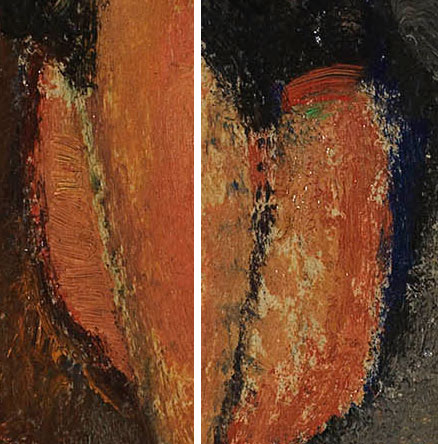
The ears are drawn as simple curves on both sides of the head. The Secret Modigliani page reproduces a detail of the ears and notes: "Detail of the ears where the drawing is clearly visible and is painted in color". In my reading, the outline of the ears, as of the jaw, is left visible as a drawn line.
The hair is a mass of black with a peak at the centre of the forehead. Its lower edge runs straight across the forehead and curves down at the sides to frame the face. A dark line runs down the sides of the neck.
Colour
The face is painted in orange-red, warmer on the cheeks and paler on the forehead and around the eyes. The neck is a deeper ochre or yellow-orange. A streak of bright green crosses the neck from the chin downwards, and further green touches appear at the right of the neck. The hair is black, with a slight brown sheen on its crown.
The background is the most varied in the series of heads of Hastings. On the left, it is a brown-red with darker strokes. At the upper right, a cool grey-blue surrounds the signature, and on it lie several patches of bright green. At the lower right, a rust-red area has a scraped or worn surface through which lighter colour shows. At the lower left, a darker green separates the neck from the brown-red.
The Secret Modigliani page draws attention to a change in the colour of the green areas in photographs taken at different times. It writes that "looking at old pictures is curious to see how the green area vanishes with time in pictures", and reproduces images that it dates to 2012, 1993 and about 1981. In my reading of the comparison sheet, the green is most extensive in the images dated 1993 and about 1981, where much of the background at the right and at the lower left is green, and least extensive in the image of 2012, where the right side is grey-violet and the green is reduced to separate patches. The main reproduction on the page corresponds to the latter state. The page does not say whether this results from cleaning, from a change in the paint or from the photographs themselves, and states that it has no information on restoration or cleaning of the work.
Facture
The paint is applied in short, dense strokes over the face, which follow the forms and leave a slightly granular surface. The forehead and cheeks show a light hatching. The neck is painted with longer vertical strokes. The background is more varied in handling: broad, loose strokes in the brown-red at the left; smoother, flatter paint in the grey-blue; dabs of thicker green at the upper right; and a scraped, dry surface in the rust-red at the lower right, where, in my reading, the paint has been partly removed or applied very dry over the support.
The edges of the support appear worn in the reproduction, and a small hole is visible at the bottom centre. The Secret Modigliani page states that "This painting presents holes in the 4 corners (2 of them covered by restoration)".
Figure and space
The head is close to the picture plane and frontal. It is more modelled than the other heads in Ceroni’s run of portraits of Hastings: the nose has volume, the eyes have depth, and the cheeks are rounded by their warmer colour. Even so, the face remains broad and flat, and the neck is a simple column.
The space is undefined. The background zones do not describe a room, and their colours change abruptly. In my reading, they function as fields of colour that set off the warm head, rather than as a setting. The bright green patches, in particular, have no descriptive role.
Iconography and sitter
Italian Wikipedia states that the painting represents the English writer and journalist Beatrice Hastings, with whom Modigliani was romantically linked for two years. English Wikipedia gives her birth name as Emily Alice Haigh and her dates as 27 January 1879 to 30 October 1943. Tate Papers, no. 35, by Anaïs Genty-Vincent et al., calls her Modigliani’s partner from mid-1914 to mid-1916.
Italian Wikipedia adds that the painting represents the artist’s return to painting after a period devoted to sculpture, a statement it attributes in a footnote to the website of the Museo del Novecento. It also quotes Beatrice Buscaroli on the faces that first appear when Modigliani returns to painting in 1914–1915, among them Béatrice Hastings. I have not consulted Buscaroli's book or the museum page cited.
The face has the round, strong-chinned form that Tate Etc. describes as the more frequent type in the portraits of Hastings. The detailed eyes and nose distinguish it from the more stylised heads in the series.
Comparisons
Head of Beatrice Hastings with wallpaper collage (Ceroni no. 76). The closest comparison. Both heads are frontal, with a black cap of hair with a central peak, an orange-red face with green or turquoise touches, long arched eyebrows and a long neck. The collage head has narrow, slanting eyes and a simpler nose, and its background is divided vertically into dark and brown zones with patterned paper.
Beatrice Hastings, Toronto (Ceroni no. 79). The Toronto portrait shows the same frontal head, but with a pale face, pink cheeks and slit eyes, and with a chair back and a garment that extend the composition below the neck.
Ear drawings. The Secret Modigliani pages on this work and on Ceroni nos. 77 and 79 all reproduce details of the ears and describe the drawing as visible. This suggests a common way of drawing the ears in the portraits of Hastings.
Provenance and exhibitions
The Secret Modigliani page gives the provenance as a sale at Drouot, Paris, on 20 June 1941, where it was sold for 4,000 FF, with the comment that the provenance is unclear because the work probably changed hands during the war; the Jucker Collection, Milan, after 1940–1941, mentioned as a private collection in Milan in the 1955 exhibition; the Museo d'arte contemporanea, Collezione Jucker, Milan; and the Museo del Novecento, Milan, inv. no. 8744. Italian Wikipedia places the work in the Museo del Novecento in the room of the international avant-gardes.
The exhibitions listed on the Secret Modigliani page are Milan, Associazione fra gli amatori e i cultori delle arti figurative contemporanee, 1946, no. 3, at a size of 35 × 27 cm; Milan, Borromini Gallery, 1947; Rome, IV Quadriennale, 1951–1952; Bern, Kunsthalle, Modigliani Campigli Sironi, 1955, no. 7; Paris, Galerie Charpentier, 1958, no. 21; Marseille, Musée Cantini, 1958, no. 4; Milan, Palazzo Reale, 1958, no. 11; Paris, Musée d'Art Moderne de la Ville de Paris, 1981, no. 23; Lugano, Museo d'Arte Moderna, 1999, no. 16; Paris, Musée du Luxembourg, 2002, no. 28; Milan, Palazzo Reale, 2003, no. 23; and Genoa, Palazzo Ducale, 2017.
The Secret Modigliani pages on four of these exhibitions agree with the numbers. The Charpentier page lists no. 21 as "Madame Hastings P. C., Milan 1915 No size"; the Marseille page lists no. 4 as Mme. Hastings, 1915; the Milan 1958 page lists no. 11 as Beatrice Hastings; and the Paris 1981 page lists no. 23 as Beatrice hastings, 1915.
Discrepancies
- Size. The Secret Modigliani page and Italian Wikipedia give 43 × 35 cm. The same page reports 35 × 27 cm for Parisot, for MR in 1999, for the Milan exhibition of 1946 and for the Paris catalogue of 1981; 35 × 26.5 cm for R in 2002; and 33 × 25 cm for an exhibition of 1958. In my measurement, the photographs agree with the smaller sizes and not with 43 × 35 cm.
- Support. The Secret Modigliani page gives oil on cardboard; MR, oil on cardboard laid down on wood; Parisot and Ceroni oil on paper; Italian Wikipedia olio su tela (oil on canvas).
- Owner's name. Ceroni’s caption, as transcribed, gives Ricardo Juncker; the other sources give Jucker.
- Provenance before Jucker. The Drouot sale of 1941 is the only event given before the Jucker Collection, and the Secret Modigliani page notes that the wartime transfer is unclear. The page also notes "Not in D' Atri papers ?".
- Second inscription. The page reports, at the lower right, a second signature or date almost invisible to the eye and readable only in the red channel, and suggests: "Probably a dedicatory or a dating (12 ???)?". The reading is uncertain.
- Colour of the green areas. The page notes that the green areas appear differently in photographs of different dates.
- Pfannstiel. The work is not included in Pfannstiel, this is also very common in the works with a dark WWII provenance, hw was a close collaborator to nazi regime and therefore he erased his footprints in the 1956 edition, but this is also something that has to be studied more carefully.
Technical analysis
No technical report from the Museo del Novecento has been opened. The following remarks are based on the reproductions and on comparative literature.
Support. The descriptions disagree between cardboard, cardboard laid down on wood, paper and canvas. In my reading of the reproduction, the worn edges and corners and the small hole at the bottom centre are consistent with a paper or card support rather than a canvas on a stretcher. Tate Papers, no. 35, by Anaïs Genty-Vincent et al., notes that "During the early years of his career, Modigliani painted on various kinds of support, from cardboard to canvas". This is comparative evidence.
Corner holes. The holes at the four corners reported by the Secret Modigliani page compare with the "push-pin holes at each corner" that Tate Papers, no. 35, observes in other works, where it suggests that "he sometimes pinned canvases directly to the wall". In my inference, the present support may have been pinned to a wall while it was painted. This is a comparison, not a finding about the present work.
Drawing. The ears and jaw show a drawn contour. The Burlington Magazine article by Annette King, Nancy Ireson, Simonetta Fraquelli and Joyce H. Townsend, vol. 160, no. 1380 (March 2018), reports that preparatory drawing in the works studied "varied from clean graphite lines to ones made with thin brushes in paint of varying colours". This is comparative.
The hidden inscription and the green areas. The red-channel image on the Secret Modigliani page and the comparison of photographs of different dates are the only technical evidence offered. Infrared reflectography and examination in raking and ultraviolet light could clarify both the second inscription and the history of the green areas.
Conclusion
The head of Beatrice Hastings in the Museo del Novecento is among the most fully modelled of the heads of Hastings catalogued by Ceroni. The eyes have irises and pupils, the nose has volume, and the warm face is set against the most varied background in the series, with its brown-red, grey-blue, green and rust zones. The bright green patches in the background and on the neck, which appear far more extensive in photographs of 1993 and about 1981 than in the image of 2012, are the most striking feature of its colour.
The documentary questions are of a different kind from those raised by works in private collections. The painting is in a museum and has been exhibited regularly since 1946, yet the size and the support given for it are inconsistent. In my measurement, the photographs agree with the older size of about 35 × 27 cm, not with the 43 × 35 cm now given by the Secret Modigliani page and by Italian Wikipedia. The museum’s own data, which could settle the matter, could not be opened for this essay.
Museum, auction and exhibition sources
- Wikipedia (Italian), "Ritratto di Beatrice Hastings", https://it.wikipedia.org/wiki/Ritratto_di_Beatrice_Hastings
- Wikipedia, "Beatrice Hastings", https://en.wikipedia.org/wiki/Beatrice_Hastings (biographical source)
- Chloe Aridjis, "Modigliani and 'La Poétesse Anglaise'", Tate Etc., issue 41 (Autumn 2017), https://www.tate.org.uk/tate-etc/issue-41-autumn-2017/modigliani-beatrice-hastings-la-poetesse-anglaise
Technical literature (comparative)
- Annette King, Nancy Ireson, Simonetta Fraquelli and Joyce H. Townsend, "The Modigliani Technical Research Study. An introduction to Modigliani’s materials and techniques", The Burlington Magazine, vol. 160, no. 1380 (March 2018) (comparative)
- Anaïs Genty-Vincent et al., "Works by Modigliani that have Paintings beneath the Visible Surface", Tate Papers, no. 35, https://www.tate.org.uk/research/tate-papers/35/works-by-modigliani-that-have-paintings-beneath-the-visible-surface (comparative)
Sources that could not be opened
The Lombardy region's catalogue page for the work on lombardiabeniculturali.it (the fetch returned an authorisation error); the Museo del Novecento's collection page cited by Italian Wikipedia; the catalogue of the Drouot sale of 1941; the exhibition catalogues listed, including those of Milan 1946, Bern 1955, Paris 1981, Lugano 1999, Paris 2002 and Milan 2003; Beatrice Buscaroli, Ricordi via Roma, 2010, quoted by Italian Wikipedia; the d'Atri papers.
Cited but not independently consulted
Exh. Cat. Associazione fra gli amatori e i cultori delle arti figurative contemporanee, Milano, 1946, pl. 3; Carli, Amedeo Modigliani, De Luca, Roma 1952, no. 2; Russoli, Amedeo Modigliani, Exhib. catalogue Palazzo Reale, Edizioni dell'ente manifestazioni Milanesi, Milano, 1958, pl. 11; Ceroni, Amedeo Modigliani : dessins et sculptures; avec suite du catalogue illustre des peintures, Edizioni del Milione, Milano, 1965 p. 166; Lanthemann, Modigliani, catalogue raisonné: sa vie, son oeuvre, son art, G. Condal, Barcelona, 1970 - no. 96; Ceroni & Piccioni, Il dipinti di Modigliani, Rizzoli, Milano, 1970 - no. 78; Musée de Art Moderne de la Ville de Paris, Modigliani exhib. cat., 1981, p. 114; Roy, Modigliani, Nathan, Paris, 1985, p. 36; Parisot, Catalogue Raisonné Modigliani, Graphis Arte, 1991 no. 23/1915; Patani, Catalogo Generale, Leonardo, Milano, 1991–1994, no. 79; Monti a cura de R. Chiappini, Catalogue Amedeo Modigliani, Lugano, Skira, 1999; MR, L'Ange au visage grave, Musée du Luxembourg, Paris, 2002 pp. 196-197; Soto Caba, Modigliani, The timeless face, Libsa, Madrid, 2007. Titles are given as the page gives them, without the footnote digits it attaches to them.
Footnotes
- Joseph Lanthemann, Modigliani, catalogue raisonné: sa vie, son œuvre, son art, Barcelona, G. Condal, 1970.
- Ambrogio Ceroni and Leone Piccioni, I dipinti di Modigliani, Milan, Rizzoli, 1970.
- Claude Roy, Modigliani, Lausanne, Skira, 1958.
- Christian Parisot, Catalogue raisonné Modigliani, Livorno, Graphis Arte, 1991.
- Osvaldo Patani, Amedeo Modigliani: catalogo generale, Milan, Leonardo, 1991–94.
- MR (cited here as MR), Modigliani: l’ange au visage grave, Paris, Musée du Luxembourg, 2002. Cited from the published exhibition catalogue only.
- Victoria Soto Caba, Modigliani: The Timeless Face, Madrid, Libsa, 2007.