Henri Laurens seated at a table
Oil on canvas — 1915

Identification
- Title
- English: Henri Laurens seated at a table.
Notes: Henri Laurens seduto a un tavolo (Ceroni); Portrait of Henri Laurens, Sitting and «Portrait Henri Laurens Assis» (Museum Sammlung Rosengart); Henri Laurens (Museum of Modern Art, New York, 1951); Henri Laurens assis (Paris, 1981); "Portrait de M. Laurens" (D'Atri papers) - Date
- 1915
- Medium
- Oil on canvas
- Dimensions
- 115.8 × 88.3 cm (Museum Sammlung Rosengart)
Notes: 31 × 23 in. / t 81 × 60 cm (Museum of Modern Art, 1951); 81 × 60 cm (D'Atri papers; Pfannstiel; Parisot; Ceroni). - Signature
- Signed "modigliani" lower right (in the border of the table) - usually named as unsigned.
- Present location
- Museum Sammlung Rosengart, Luzern, Switzerland?
Actually not visible in the Museum collection.
Catalogue numbers
| Compiler | Number |
|---|---|
| Arthur Pfannstiel | 1929 / no. 5 - 1956 / no. 37 |
| Joseph Lanthemann | no. 72 |
| Ambrogio Ceroni | 1958 / no. 39 - 1970 / no. 54 |
| Jeanne Modigliani | YES |
| Christian Parisot | 15/1915 |
| Osvaldo Patani | no. 58 |
| Modigliani Project | YES ? |
| MR | YES |
| Modigliani Initiative/AMDC | ? |
Legal note on MR: This investigation has not had access to MR’s catalogue raisonné; all research here is based on open sources, publications and exhibitions. By no means has that catalogue been copied at any point. Modigliani Project and Modigliani Initiative are marked YES when the work is published or otherwise recorded by those projects, even if no catalogue number is assigned; otherwise the field is marked ?.
Provenance
- Zborowski collection, Paris?
- G. Menier Collection, Paris
- Paul Guillaume Collection, Paris
- Renou et Poyer Galerie, Paris
- L. Corbellini Collection, Paris
- Robert J. Newman Collection, New Orleans
- Galerie A. Rosengart, Luzern, Switzerland
- Museum Sammlung Rosengart, Luzern, Switzerland?
Actually - Nov. 2026- not visible in the website of the museum.
The sequence follows the published museum, sale, and catalogue record in this investigation. Gaps and uncertain transfers are marked as such.
Selected bibliography
Book-length publications are marked with a footnote giving a full citation. Exhibition catalogues appear in both this list and the exhibition list when this investigation recorded them in both places.
- Pfannstiel, "catalogue présumé" Modigliani. L'Art et la Vie. Preface de Louis Latourrettes, Seheur, Paris, 1929, p. 6 - no. 51
- Franchi, Modigliani, Arnaud, Firenze, 1944, pl. 4
- Franchi, Modigliani, Arnaud, Firenze, 1947, pl. 4
- T. Soby, Modigliani, Museum of Modern art, New York, catalogue exp. 1951, p. 26
- T. Soby, Modigliani, Museum of Modern art, New York, catalogue exp. 1954, p. 28
- Venturi, Notes on art history, Rome, 1956, p. 207
- Pfannstiel, Modigliani et son oeuvre, étude critique et catalogue raisonne, Bibliothèque des Arts, Paris, 1956 - no. 372
- Ceroni, Amedeo Modigliani: Peintre; Suivi des Souvenirs de Lunia Czechowska, Edizioni del Milione, 1958 - no. 393
- Russoli, Amedeo Modigliani, Fratelli Fabbri, Milano, 1963
- Gindertael, Shop libre diffusion, 1967, pl. 6
- Diehl, Modigliani, Ed. Flamarion, Paris, 1969, p. 344
- Lanthemann, Modigliani, catalogue raisonné: sa vie, son oeuvre, son art, G. Condal, Barcelona, 1970 - no. 725
- Ceroni & Piccioni, Il dipinti di Modigliani, Rizzoli, Milano, 1970 - no. 546
- Hubbard, Modigliani and the painters of Montparnasse, Lamplight Publ. New York, 1975, p. 16, pl. 6
- Mann, Modigliani, Thames and Hudson, London, 1980, p. 100 - no. 667
- Musée de Art Moderne de la Ville de Paris, Modigliani exhib. cat., 1981, p. 113
- Carluccio, Leymarie, Negri, Russoli, Brunhammer, École de Paris, Rive Gauche, Paris, 1981, p. 316
- Catalogue National Museum Tokyo, 1985 - no. 46
- Catalogue Aichi Prefectural Art Gallery, 1985 - no. 46
- Castieau-Barrielle, La vie et l'oeuvre de Amedeo Modigliani, Editions ACR, Paris, 1987, p. 1058
- Schmalenbach, Amedeo Modigliani, Prestel, Munich, 1990, p. 73 - no. 259
- Parisot, Catalogue Raisonné Modigliani, Graphis Arte, 1991 no. 15/191510
- Patani, Catalogo Generale, Leonardo, Milano, 1991-94, no. 5811
- Monti a cura de R. Chiappini, Catalogue Amedeo Modigliani, Lugano, Skira, 1999
- MR, L'Ange au visage grave, Musée du Luxembourg, Paris, 2002, p. 3112
- Soto Caba, Modigliani, The timeless face, Libsa, Madrid, 200713
Exhibitions
- Paris, Modigliani retrospective, Marcel Bernheim (Galerie Bernheim-Jeune), 1931
- Prague, 1931 ?
- Cleveland, Modigliani: Paintings, Drawings, Sculpture, Cleveland Museum of Art,1951, p. 51
- New York, Modigliani: Paintings, Drawings, Sculpture, The Museum of Modern Art, 1951, p. 51
- Cincinnati, Amedeo Modigliani: Paintings, Sculpture and Drawings, The Contemporary Arts Center, 1959 - no. 7
- Chicago, Amedeo Modigliani: Paintings, Sculpture and Drawings, The Arts Club, 1959
- Milwaukee, Amedeo Modigliani: Paintings, Sculpture and Drawings, Milwaukee Art Center, 1959
- Boston. Modigliani: Paintings and Drawings. Exh. cat., Museum of Fine Arts, 1961 - no. 6
- Los Angeles. Modigliani: Paintings and Drawings. Exh. cat., Los Angeles County Museum, 1961- no. 6
- Frankfurt, Steinernes Haus, 1963 - no. 9
- Edinburgh, Modigliani, Royal Scottish Academy, 1963 - no. 7
- London, Modigliani, Tate Gallery, 1963 - no. 7
- New York, Amedeo Modigliani; loan exhibition, Acquavella Galleries, Inc. 1971 - no. 6
- Paris, Modigliani, Musée de Art Moderne de la Ville de Paris, 1981- no. 22
- Tokyo, Modigliani exhibition, National Museum, 1985 - no. 46
- Nagoya, Modigliani exhibition, Aichi Prefectural Art Gallery, 1985 - no. 46
- Martigny, Modigliani, Fondation Pierre Gianadda, 1990 - no. 42
- Düsseldorf, Amedeo Modigliani, Art Gallery of Nordrhein-Westfalen 1991 - no. 17
- Zurich, Amedeo Modigliani, Kunsthaus, 1991 - no. 17
- Tokyo, Exposition Amedeo Modigliani au Japon, Tobu Museum of Art, 1992-93 - no. 13
- Kyoto, Exposition Amedeo Modigliani au Japon, Daimaru Museum, 1992-93
- Osaka, Exposition Amedeo Modigliani au Japon, Daimaru Museum of Umeda, 1992-93
- Ibaraki, Exposition Amedeo Modigliani au Japon, Museum of Modern Art, 1992-93
- Lugano, Amedeo Modigliani, Museo d'Arte Moderna, 1999 - no. 17
Notes
In D' Atri papers as no. 266 - Portrait de M. Laurens 81 x 60 cm - sans signature (signed in the table probably a mistake)- dated 1915 - and in "Meunier" Collection, Paris
Where sources disagree, both readings are given. This is a working research page, not a catalogue raisonné.

Introduction
Modigliani’s second portrait of the sculptor Henri Laurens shows him at half length, seated beside a round table, with a red object on a pedestal behind his head. It is now in the Museum Sammlung Rosengart in Lucerne. The museum’s description of its Modigliani holdings says that "Modigliani also repeatedly painted his artist friends and colleagues in characteristic poses – as attested by the Portrait of Henri Laurens, Sitting (1915)". It continues: "Although only a sketch, this work looks forward to the highly individual style later adopted by Modigliani for his portraits, as exemplified by his oval faces with narrow, pupil-less eyes". The museum also says that a bronze by Laurens, Seated Woman (1932), "is on display in the Rosengart Collection next to Modigliani’s Portrait of Henri Laurens, Sitting (1915)".
The picture is well exhibited and well published, but its dimensions are disputed. Older sources give 81 × 60 cm; the figures now attached to the Rosengart picture are 115.8 × 88.3 cm. This essay first reads the picture as an image, with its unusually open, sketch-like handling, and then examines the documentation of its size.
Composition and format
The format is upright. The Secret Modigliani page’s two colour reproductions have width-to-height ratios of 0.753 and 0.755. A colour image of the same composition, in Ceroni’s caption, has a ratio of 0.756. These figures lie between the ratio of 81 × 60 cm (0.741) and that of 115.8 × 88.3 cm (0.762), and cannot settle the question of size.
Laurens is seated slightly to the left of centre, his body facing the viewer and his head turned a little to his left. The head is placed high, close to the upper edge, and the hair is cut by it. The body fills most of the picture’s height: a broad khaki jacket, a white shirt with a turned-down collar and a long black tie that descends from the collar to below the middle of the picture. The sitter's right hand, seen at lower centre, rests on a pale area with drawn lines, which may be the seat of the chair or a sheet of paper. At lower right, the round top of a dark red table enters the picture, cut by the right and bottom edges. On it are a pipe and a pale object. At lower left, a dark brown form, perhaps the arm of a chair or the sitter's other arm in shadow, fills the corner.
Behind the head, to the right, rises a red-orange object on a dark red pedestal or column. To the left of the head the background is divided into areas of brown, grey and pale green, with long, dark diagonal and horizontal strokes, like the frame of a window or a stretcher. On the right, beyond the sitter's shoulder, the background is a pale grey-green and white, loosely brushed. The whole composition is built on the vertical of the tie and the figure, balanced by the round table at lower right and the pedestal at upper right.
Line
The drawing is the structure of the picture. The contours of the jacket are drawn with long, blue-green lines that run down both sides of the figure and around the sleeves. The same blue-green defines the shirt collar, the lines of the chair or paper under the hand, and the edges of the table. Dark lines mark the edges of the head, the nose and the brows.
The face is drawn with the same features as the bust portrait (Ceroni no. 53): a long, straight nose; thin brows that meet the line of the nose; narrow eyes; a dark moustache over a small red mouth; and a beard, here grey rather than black. The eyes are reduced to thin, horizontal slits, without pupils, as the Rosengart description notes.
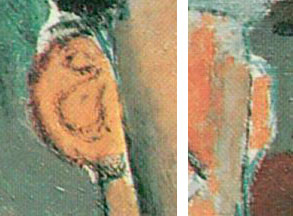
The Secret Modigliani page reproduces a detail of the ear, with the comment "Detail of the ear where the drawing is clearly visible and is painted over the color (on top of the color)". The detail shows an orange ear with dark lines drawn on top of the paint. The same sequence of colour first and drawing afterwards is visible in the blue-green contours of the jacket, which in several places lie on top of the khaki.
Colour
The colour is pale and restrained. The jacket is a khaki or olive-ochre, painted in broad, dragged strokes that leave lighter paint or ground showing. The shirt is white with grey shadows, the tie black. The face is a light orange-pink, warmer on the cheeks and nose, and the beard is grey with darker strokes. The hair is black.
The strongest colour is in two places: the red-orange object and dark red pedestal behind the head, and the dark red table at lower right. These two reds stand at opposite corners of the right side and frame the figure diagonally. The background is otherwise pale: white, grey, pale green and light brown, with patches where the white of the ground seems to show through.
The Secret Modigliani page notes "Color changes since the last restoration or cleaning", and reproduces two colour images that differ in saturation: in one, the red of the pedestal and the brown of the background are deeper; in the other they are paler and browner.
Facture
The handling is open and sketch-like, as the museum’s description says. Much of the background is painted thinly, in loose, crossing strokes, with areas that look almost unpainted. The jacket is laid in with long, dragged strokes that follow the direction of the sleeves and leave the underlying paler colour visible between them. The hand is painted in a few broad strokes of pink and orange, with dark lines for the fingers.
The pedestal and the table are painted more densely. The pedestal is built up of vertical strokes of red and dark red, with an orange-red top. The table is a dark, heavily brushed red-brown, with the pipe and the pale object drawn in lighter paint over it. The face is painted with denser, smoother paint than the jacket, and the beard with short, separate strokes of grey and black.
The contrast between the dense, finished head and the loosely painted body and background is the key to the picture’s character. It gives the impression of a portrait in which the essential, the head, has been resolved, and the rest left at a stage of preparation.
Figure and space
Laurens sits upright, his shoulders square, his head held straight with a slight turn to his left. The pose is calm and formal, but not stiff. The hand at lower centre is relaxed, the fingers pointing towards the table.
The space is shallow. The table at lower right is the only object clearly in front of the figure, and its round top, seen from above, establishes the foreground. The pedestal behind the head and the window-like divisions of the background suggest a studio wall a short distance behind the sitter. But the space is not constructed consistently: the pale background on the right merges with the white of the ground, and the background on the left is a set of flat planes.
Iconography and sitter
Henri Laurens was a sculptor and engraver; Ceroni’s note on the bust portrait (Ceroni no. 53) describes him as "noto incisore e scultore", born in Paris in 1885. The Rosengart page describes his Seated Woman of 1932 as made "using a figurative-Cubist language of form".
The objects in the picture identify Laurens's world rather than his person. The red object on a pedestal behind his head has the look of a sculpture, and it may be a reference to the sitter's work. The pipe on the table is a common attribute of a man at ease in his studio. The table and the chair, if that is what the pale area under the hand represents, place the sitter in a domestic or studio interior. These are interpretations, and the sources I consulted do not identify the objects.
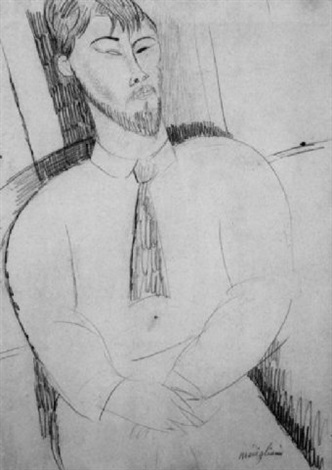
The Secret Modigliani page reproduces a pencil drawing of Laurens seated, with the caption "sketch for herni laurens seated?", and comments that "Several sketches represent the same composition". The drawing shows Laurens seated in a chair, his arms crossed in front of him, his head turned slightly, with a beard and a tie, signed "modigliani" at lower right. It is close to the painting in the pose of the head and the shape of the shoulders, but differs in the crossed arms and the absence of the table. It is better described as a related study than as a sketch for the same composition.
Comparisons
The bust portrait of Laurens (Ceroni no. 53) is the closest comparison. In both pictures a red object appears behind the head on the right, the face is drawn with the same nose, brows and narrow eyes, and the sitter wears a black tie. But the bust is painted in intense colours and thick paint, while the seated portrait is pale and open. The Secret Modigliani page on the present work illustrates the bust as "another smaller version of the same painting". The two pictures are separate compositions: the bust shows the head and shoulders against a different background, without the table or the hand.
A second comparison concerns procedure rather than composition. The Secret Modigliani page on Self-Portrait as Pierrot (Ceroni no. 52) reproduces a detail of the ear with the same comment as the present page, that the drawing is "painted over the color". In both pictures, therefore, the final contour is a line laid on top of the paint. In the present picture, because so much is left open, the sequence can be followed across the whole figure: a first lay-in of colour, then the blue-green and dark lines that redefine the jacket, the hand and the table. The unfinished state shows how such a portrait was constructed.
Provenance and exhibitions
Provenance as "Zborowski collection", "G. Menier Collection, Paris", "Paul Guillaume Collection, Paris", "Renou et Poyer Galerie, Paris", "L. Corbellini Collection, Paris", "Robert J. Newman Collection, New Orleans", "Galerie A. Rosengart, Luzern, Switzerland" and "Museum Sammlung Rosengart, Luzern, Switzerland". It also cites the D'Atri papers, "no. 266 - Portrait de M. Laurens 81 x 60 cm - sans signature (signed in the table probably a mistake)- dated 1915 - and in "Meunier" Collection, Paris".
The Museum of Modern Art's catalogue for the 1951 Cleveland and New York exhibition lists the picture as lent by Luigi Corbellini, Paris, and illustrated on p. 26. The plate caption reads "Henri Laurens. 1915. Oil, 31% x 23%″. Collection Luigi Corbellini, Paris" (the fractions are garbled in the scanned text; the catalogue states that height precedes width). The Secret Modigliani exhibition page for the 1951 exhibition lists "Henri Laurens 1915 Lent by Luigi Corbellini Paris". Ceroni’s caption gives the owner as Robert J. Newman, New Orleans.
The exhibitions listed on the Secret Modigliani page include the Bernheim-Jeune retrospective, Paris, 1931; Cleveland and New York, 1951; Cincinnati, Chicago and Milwaukee, 1959; Boston and Los Angeles, 1961; Frankfurt, Edinburgh and London, 1963; New York, Acquavella Galleries, 1971; Paris, 1981, no. 22; Tokyo and Nagoya, 1985, no. 46; Martigny, 1990, no. 42; Düsseldorf and Zurich, 1991, no. 17; four Japanese venues, 1992–93; and Lugano, 1999, no. 17. The Paris 1981 list gives "22 Henri Laurens assis 1915".
Discrepancies
- Dimensions. The older sources agree on about 81 × 60 cm: the D'Atri papers (81 × 60 cm, according to the Secret Modigliani page); Pfannstiel, Parisot and Ceroni (81 × 60, according to the same page); and the Museum of Modern Art in 1951 (31 × 23 inches plus fractions that the scan does not preserve, that is, about 81 × 60 cm). The figures now attached to the Rosengart picture are different: pubhist.com gives "115.8 x 88.3 cm", and a reproduction shop that sells images under licence from the museum gives "Original size: 88.3 cm x 115.8 cm". I could not find a museum page that states the dimensions. The difference is far too large to be explained by a frame or by measuring the turnover. Either the older sources concern a different picture, which is unlikely given the consistent provenance through Corbellini and Newman, or one set of figures is wrong. The reproductions' proportions do not decide the matter.
- Signature. The page says the picture is "Signed 'modigliani' lower right (in the border of the table) - usually named as unsigned", and the D'Atri papers, as quoted on the page, say "sans signature". A small inscription is visible on the edge of the table in the reproductions.
- "Meunier" and "Menier". The provenance list gives "G. Menier Collection", while the D'Atri papers, as quoted, give "Meunier". The page does not say whether these refer to the same collector.
- Laurens's dates. Ceroni gives Laurens's birth year as 1885. The Rosengart page prints "1881 - 1955" next to Laurens's name, the same dates it prints next to Fernand Léger's. This appears to be an error on the museum’s page.
Technical analysis
No technical study of this picture is known to me. The comparative literature is relevant mainly because of the picture’s open handling. King, Ireson, Fraquelli and Townsend, in their introduction to the Modigliani Technical Research Study, note that the canvases they examined "seem to have been commercially prepared with an oil-based priming". If the present picture is on such a canvas, the white and pale areas of the background may be the priming itself, left unpainted or only lightly covered. That would be consistent with the Rosengart's description of the picture as "only a sketch", but it cannot be confirmed from reproductions.
The same article reports pencil lines defining the limits of the image in the bust portrait of Laurens (Ceroni no. 53), and pinholes in the four corners of some canvases. These are comparative observations: they show what an examination of the present picture would need to look for, especially in view of the conflict about its size. If the canvas was painted unstretched and later mounted on a larger stretcher, or if it was restretched with additional canvas, the dimensions could have changed. This is a hypothesis only, and no source I consulted supports it.
The Secret Modigliani page’s comment on the ear, that the drawing is "painted over the color", and its comment on "Color changes since the last restoration or cleaning", are the only observations on the physical state of the picture available to me.
Conclusion
Henri Laurens Seated at a Table is an open, sketch-like portrait, in which a carefully resolved head is set on a body and a background that are only broadly laid in. The blue-green contours, the pale khaki of the jacket, the white ground and the two reds of the pedestal and the table give it a light, airy character very different from the intense bust portrait of the same sitter. The objects around Laurens, the pedestal, the table and the pipe, place him in his studio and perhaps allude to his work.
The documentation is unusually rich, with a provenance from Zborowski to the Rosengart and exhibitions from 1931 to 1999, but it contains a serious discrepancy. The older sources give about 81 × 60 cm, the modern ones 115.8 × 88.3 cm. Until the museum publishes its measurements, or a technical examination is made, the size of the picture remains an open question.
Museum, auction and exhibition sources
- Museum Sammlung Rosengart, Lucerne, "Artists", https://www.rosengart.ch/en/artists, and "Künstler", https://www.rosengart.ch/de/Kuenstler
- The Museum of Modern Art, New York, Modigliani: Paintings, Drawings, Sculpture, introduction by James Thrall Soby (1951), exhibition catalogue, https://assets.moma.org/documents/moma_catalogue_2916_300191634.pdf
- pubhist.com, "Amedeo Modigliani – Portrait of Henri Laurens", https://www.pubhist.com/w6454 (secondary; citing Kenneth Wayne, Modigliani & the Artists of Montparnasse, 2002, p. 34, fig. 8)
- The Fine Art Gallery, "Porträt Henri Laurens, sitzend", reproduction SR171, https://www.thefineartgallery.ch/en/product/sr171/ (a commercial reproduction page; used only for the dimensions it gives)
Technical literature (comparative)
- Annette King, Nancy Ireson, Simonetta Fraquelli and Joyce H. Townsend, "The Modigliani Technical Research Study: An introduction to Modigliani’s materials and techniques", The Burlington Magazine, vol. 160, no. 1380 (March 2018), https://www.burlington.org.uk/archive/article/the-modigliani-technical-research-study-an-introduction-to-modiglianis-materials-and-techniques (comparative)
Sources that could not be opened
I found no Museum Sammlung Rosengart page for the picture that gives its dimensions or medium. Kenneth Wayne's Modigliani & the Artists of Montparnasse (2002), cited by pubhist.com, was not available. The D'Atri papers were not available. No technical report on the picture was found.
Cited but not independently consulted
Pfannstiel, catalogue présumé, 1929, p. 6, no. 5; Franchi, Modigliani, 1944, pl. 4, and 1947, pl. 4; Soby, Modigliani, 1954, p. 28; Venturi, Notes on Art History, 1956, p. 207; Pfannstiel, Modigliani et son œuvre, 1956, no. 37; Ceroni, Amedeo Modigliani: Peintre, 1958, no. 39; Russoli, Amedeo Modigliani, 1963; Gindertael, 1967, pl. 6; Diehl, Modigliani, 1969, p. 34; Lanthemann, 1970, no. 72; Ceroni and Piccioni, I dipinti di Modigliani, 1970, no. 54; Hubbard, Modigliani and the Painters of Montparnasse, 1975, p. 16, pl. 6; Mann, Modigliani, 1980, p. 100, no. 66; Musée d'Art Moderne de la Ville de Paris, exhibition catalogue, 1981, p. 113; Carluccio, Leymarie, Negri, Russoli and Brunhammer, École de Paris, 1981, p. 316; National Museum, Tokyo, and Aichi Prefectural Art Gallery, catalogues, 1985, no. 46; Castieau-Barrielle, 1987, p. 105; Schmalenbach, Amedeo Modigliani, 1990, p. 73, no. 25; Parisot, 1991, no. 15/1915; Patani, 1991–94, no. 58; Chiappini, ed., Amedeo Modigliani, Lugano, 1999; MR, L'Ange au visage grave, 2002, p. 31; Soto Caba, 2007. Page and catalogue numbers are given without the footnote digits the page attaches to them, which on this page are separated by a space (for example "no. 72 5" is read as no. 72).Footnotes
- Arthur Pfannstiel, Modigliani. L’Art et la Vie, preface by Louis Latourette, Paris, Seheur, 1929 (presumed catalogue).
- Arthur Pfannstiel, Modigliani et son œuvre, étude critique et catalogue raisonné, Paris, Bibliothèque des Arts, 1956.
- Ambrogio Ceroni, Amedeo Modigliani: Peintre; suivi des souvenirs de Lunia Czechowska, Milan, Edizioni del Milione, 1958.
- Gaston Diehl, Modigliani, Paris, Flammarion, 1969.
- Joseph Lanthemann, Modigliani, catalogue raisonné: sa vie, son œuvre, son art, Barcelona, G. Condal, 1970.
- Ambrogio Ceroni and Leone Piccioni, I dipinti di Modigliani, Milan, Rizzoli, 1970.
- Carol Mann, Modigliani, London, Thames and Hudson, 1980.
- Thérèse Castieau-Barrielle, La vie et l’œuvre de Amedeo Modigliani, Paris, ACR, 1987.
- Werner Schmalenbach, Amedeo Modigliani, Munich, Prestel, 1990.
- Christian Parisot, Catalogue raisonné Modigliani, Livorno, Graphis Arte, 1991.
- Osvaldo Patani, Amedeo Modigliani: catalogo generale, Milan, Leonardo, 1991–94.
- MR (cited here as MR), Modigliani: l’ange au visage grave, Paris, Musée du Luxembourg, 2002. Cited from the published exhibition catalogue only.
- Victoria Soto Caba, Modigliani: The Timeless Face, Madrid, Libsa, 2007.