Colour and pigment in Modigliani’s paintings
Amedeo Modigliani — investigation file

| Some experts in a clear symptom of their poor vision or hidden intentions believe that pigments should be kept secret, supposedly to avoid counterfeiters, but let's be frank it is absolutely impossible to do a bulletproof counterfeit with the current means. Doing a bit of revisionism, the first serious study on Modigliani's work scientifically speaking is from 1981, the meeting of French museums and his laboratory did a study for a mega exhibition and the results were quite bittersweet. They discovered without even looking for it that four of their five works were probably false or false beyond any doubt. The study was only partly published, but it remained a reference. The museum continued to exhibit the works as autograph after the laboratory notes had been recorded. 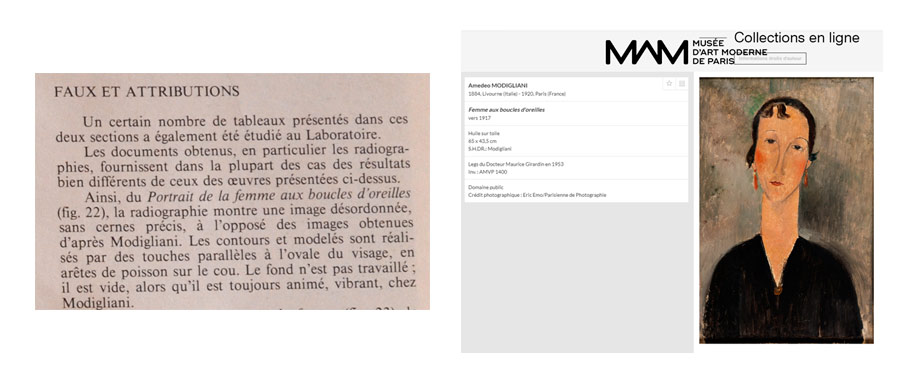 After this first study that opened a door, other independent laboratories tried to study on their own but they reached a black hole: the Amedeo Modigliani Legal Archives led by Christian Parisot and with the unfailing genetic support of Modigliani's daughter (Jeanne Modigliani) who authorized them by the claimed moral right to decide beyond any logical or analytical conclusion. This situation was maintained throughout the eighties and remained practically unchanged until 2010-2020 . In the fight to be the authentic and only certifier of Modigliani (which of course and is not doubtful, it is a great business) new contenders emerged: 1.- Patani in the 1990's, was quickly dismissed and accused of falsehoods by Parisot and even MR, falsehoods that later were not proven but the doubt marked him for the rest of the time. He was already older so he decided to retire, he planted some fight but finally ended up joining Parisot in some ways. 2.- MR emerged strongly thanks to the support of the Wildenstein Institute and began first by saying that scientific analysis was dismissed, what was important was his "connoisseurship" and then pretending that thanks to his privileged access he had all the necessary knowledge. Meanwhile Parisot continued doing his things and presenting examples of science that are worth mentioning such as the alleged x-rays of the "other" version of the married couple: 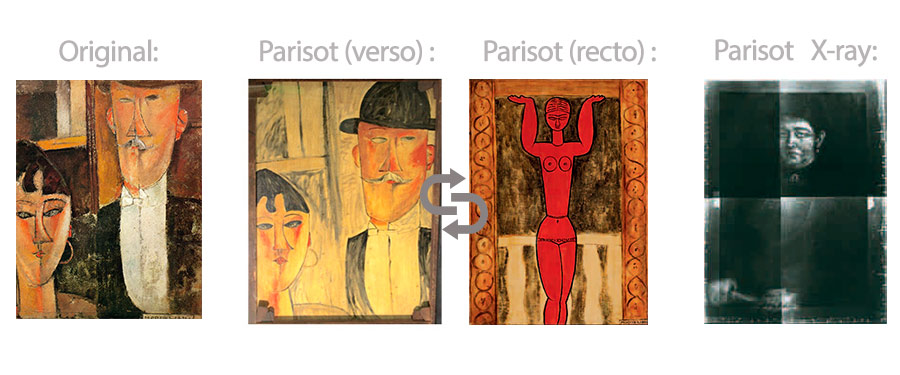 in p. 34 of the 2010 Prague exhibition curated by Parisot he presents this caryatid and attached in the x-rays of the painting to demonstrate the reuse of the canvas, in a later exhibition he shows that on the back of the canvas there is a sketch of the painting "bride and groom", this is simply impossible since both paintings both the front and the back plus the supposedly covered would be visible in the same X-ray, one mounted on the other (he says the 3 are in oil).  This is an example of a Modigliani painting that has another painting under the visible layer and as can be seen both images are one on top of the other: 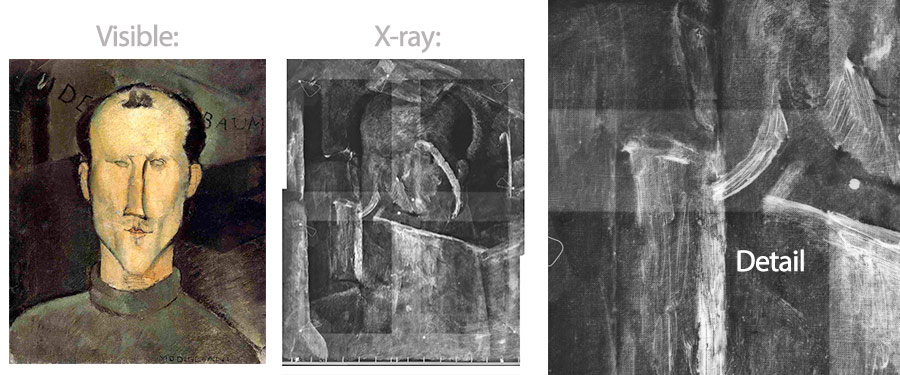 The same mess is applicable to pigments, you first have to define what a pigment or a color is. Apigmentwould be the union of various chemical components to form a base color. (in this website you can find a huge and easy to use technical reference:LINK) Well the issue is that Parisot in his technical reports take it to the most European connoisseur style and treat the matter as a matter of authority, and MR as unpublished evidence withheld from forgers In both cases the published reports withhold the underlying data. Suddenly in this mess a group arises that, taking up the first studies in 1981, decided to do the same with a large group of paints and subject them to a thorough pigment analysis: The Modigliani Technical Research Study. An introduction to Modigliani’s materials and techniques, published in Burlington magazine, March 2018, No. 1380 – Vol 160 and in later editions. This study has "revealed that Modigliani was anything but chaotic in his painting methods. He developed a highly skilled, unique and consistent technique" and this is the same in his use of color. Who made / participated / collaborated in this study: Francesca Casadio, Kim Muir and Frank Zuccari of the Art Institute of Chicago; Robin Craren, Judith Dolkart (formerly), Cindy Kang and Anya Shutov of the Barnes Foundation, Philadelphia; Silvia Amato, Aviva Burnstock and Barnaby Wright from the Courtauld Institute of Art; Elsje Janssen, Lizet Klaasen and Lies Vanbiervliet at Koninklijk Museum voor Schone Kunsten, Antwerp (KMSKA); Elma O’Donoghue, Charlotte Eng, Yosi Pozeilov and Virginia Rasmussen at the Los Angeles County Museum of Art; Sylphide de Daranyi of Musée de l’Orangerie, Paris; Silvia A. Centeno at the Metropolitan Museum of Art, New York; Anny Aviram, Diana Hartman, Kate Lewis, Chris McGlinchey and Ana Martins of the Museum of Modern Art, New York; Ann Hoenigswald from the National Gallery of Art, Washington; Don H. Johnson, Rice University, Houston; Adam Finnefrock, Alyssa Hull and Jennifer Mass at Scientific Analysis of Fine Art (SAFA); Julie Barten, Corey D’Augustine, Susan Davidson, Lauren Engel, Jennifer Hickey and Hillary Torrence at the Solomon R. Guggenheim Museum, New York; Marian Cousijn, Mark Heathcote, Joe Humphries, Emma Jones, Marcella Leith and Emma Lewis of Tate, London; Brian Singer at the University of Northumbria, Newcastle upon Tyne; Pedro H.O.V. Campos and Márcia Rizzutto, Institute of Physics at the University of São Paulo (IF USP); Anikó Bezúr and Pablo Londero at the Institute for the Preservation of Cultural Heritage, Yale University Art Gallery, New Haven, independent art historians Marianne Le Morvan and Modigliani Project and the main names: Nancy Ireson and Simonetta Fraquelli, who approached Tate Conservation to start all the study. A simplified summary of the Burlington conclusions follows (see the article for the full text): Modigliani’s Paris portraits 1915–17: SHORT & BASIC COLOR PALETTE, still under cubist influence but getting free. 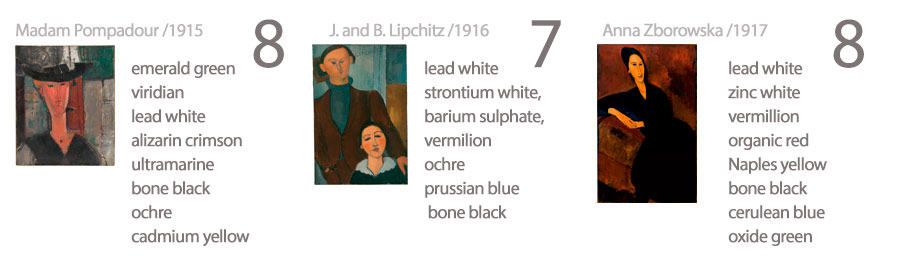 Modigliani’s painted nudes 1916–17: SHORT & BASIC COLOR PALETTE, a consistent and limited range of pigments. 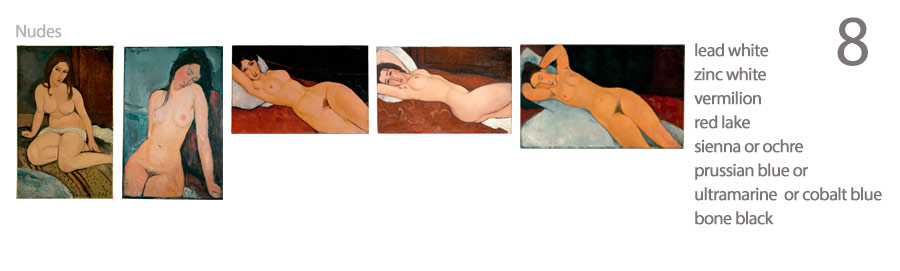 Modigliani in the South of France : SHORT & BASIC COLOR PALETTE significant change in the technique and appearance. 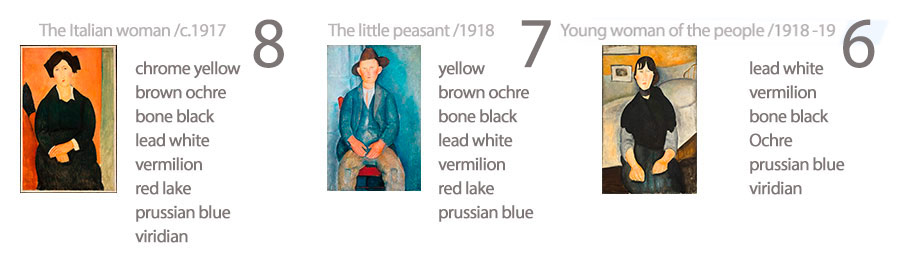 Modigliani’s late portraits: SHORT & BASIC COLOR PALETTE a return to the classical tradition of the Renaissance. 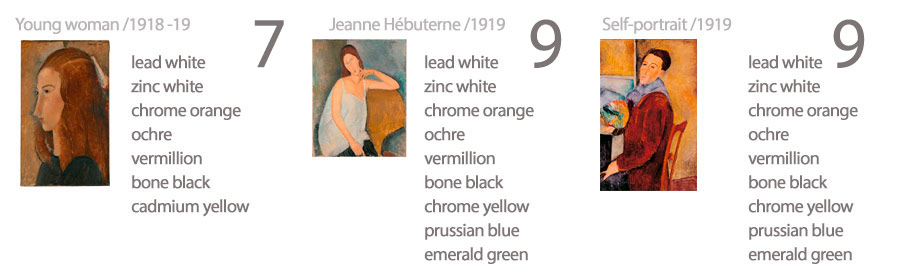 The result is similar all over his production, the palette is short and concise, he always used lead / zinc white and in all over his paintings, Across the production the same six to nine pigments recur. To all the above mentioned you can add the Carbon-14 dating test but the results are so vague that it can only be used to say NO. In raw and simple words: Anything fabricated after the First Nuclear Bomb test will become false, but what happen when we have a relined canvas of a new varnish or even a watercolor restoration... |
Legal note on MR: This investigation has not had access to MR’s catalogue raisonné; all research here is based on open sources, publications and exhibitions. By no means has that catalogue been copied at any point.