The beggar of Livorno
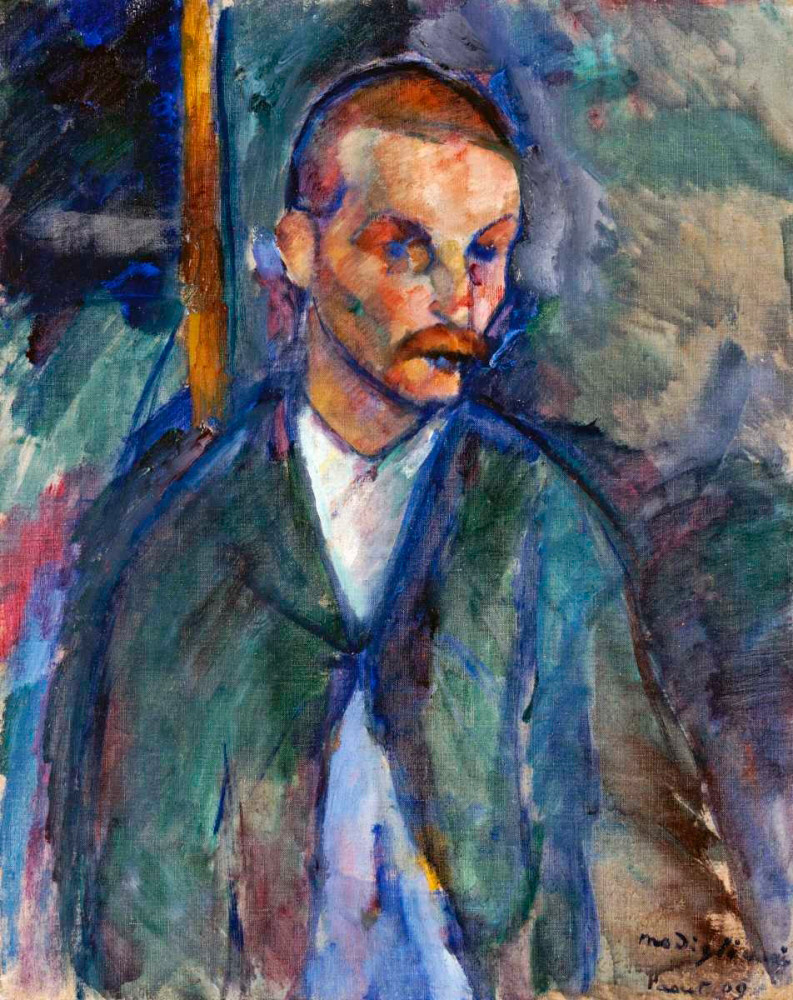
Oil on canvas — 1909
Identification
- Title
- English: The beggar of Livorno - The beggar - Portrait of a man.
French: Le paysan Italien - Le mendiant de Livourne - Portrait d'homme.
Notes: Il mendicante di Livorno (Ceroni 1970); Le mendiant de Livourne (Christie's 2004 and 2015); Le mendiant (Ceroni 1958); Le paysan italien (Brussels 1933, Christie's; D'Atri files); The Beggar of Livorno (Tate 2017–18). - Date
- 1909 (August 1909 - dated on the canvas)
- Medium
- Oil on Canvas
- Dimensions
- 65.8 x 52.4 cm?
Notes: 65.8 × 52.4 cm (Christie's 2004); 55 × 50 cm (Ceroni), 66 × 59 cm (Parisot), 65 × 54 cm (Patani), 67 × 54 cm (Ireson) - Signature
- Signed "modigliani 1'août 1909" - lower right
- Present location
- Private Collection ?
Catalogue numbers
| Compiler | Number |
|---|---|
| Arthur Pfannstiel | no. 17 (1929 no. V) |
| Joseph Lanthemann | no. 32 |
| Ambrogio Ceroni | no. 24 |
| Jeanne Modigliani | YES |
| Christian Parisot | 1/1909 |
| Osvaldo Patani | no. 26 |
| Modigliani Project | YES |
| MR | YES |
| Modigliani Initiative/ AMDC | ? |
Legal note on MR: This investigation has not had access to MR’s catalogue raisonné; all research here is based on open sources, publications and exhibitions. By no means has that catalogue been copied at any point. Modigliani Project and Modigliani Research Project are marked YES when the work is published or otherwise recorded by those projects, even if no catalogue number is assigned; otherwise the field is marked ?.
Provenance
- Amedeo Modigliani
- Jean Alexandre, Paris, by March 1910.
- Paul Alexandre, Paris, by whom inherited from the above in 1913
- Blaise Cendrars, Paris
- Private Collection?
- Sale: Christie's, London, Sale 6882 - Impressionist and Modern Art Evening Sale London | 2 February 2004- Lot 37 sold for: $ 907,447 usd.
The sequence follows the published museum, sale, and catalogue record in this investigation. Gaps and uncertain transfers are marked as such.
Selected bibliography
Book-length publications are marked with a footnote giving a full citation. Exhibition catalogues appear in both this list and the exhibition list when this investigation recorded them in both places.
- Pfannstiel, "catalogue présumé" Modigliani. L'Art et la Vie. Preface de Louis Latourrettes, Seheur, Paris, 1929, p. 41
- R. Franchi, Modigliani, Florence, 1944, pl. 3
- R. Franchi, Modigliani, Florence, 1947, pl. 3
- N. Ponente, Commentari, Rome, 1952
- J. Lipchitz, Amedeo Modigliani, New York, 1954, pl. 3
- Jeanne Modigliani, Modigliani: Man and Myth, Orion Press, New York, 1958, pl. 21 (dated 1909 and located in 1958 at the Alexandre Coll. Paris)2
- Pfannstiel, Modigliani et son oeuvre, étude critique et catalogue raisonne, Bibliothèque des Arts, Paris, 1956 - no. 173
- Ceroni, Amedeo Modigliani: Peintre; Suivi des Souvenirs de Lunia Czechowska, Edizioni del Milione, 1958 - no. 204
- F. Russoli, Amedeo Modigliani, Milano, 1958.
- Jeanne Modigliani, Modigliani sans légende1961, no. 215
- Werner, Amedeo Modigliani, Garzanti, Milano 1967, p. 70
- Werner, Amedeo Modigliani, 1968
- Lanthemann, Modigliani, catalogue raisonné: sa vie, son oeuvre, son art, G. Condal, Barcelona, 1970 - no. 326
- Ceroni & Piccioni, Il dipinti di Modigliani, Rizzoli, Milano, 1970 - no. 247
- Mann, Modigliani, Thames and Hudson, London, 1980, p. 538
- Carluccio, Leymarie, Negri, Russoli, Brunhammer, École de Paris, Rive Gauche, Paris, 1981, p.201
- C. Roy Modigliani, Paris, 1985, p. 28.
- Werner, Modigliani, Harry N. Abrams, NY, 1985, p. 56-57
- Castieau-Barrielle, La vie et l'oeuvre de Amedeo Modigliani, Editions ACR Paris, 1987, page 479
- Parisot, Catalogue Raisonné Modigliani, Graphis Arte, 1991 no. 1/1909, rep. p. 3510
- Patani, Catalogo Generale, Leonardo ed. Milano 1991-9411
- Parisot, Modigliani, Pierre Terrail, Paris, 1992, p. 1812
- D. Krystof, Amedeo Modigliani: The Poetry of Seeing, Taschen Cologne, 2000, p. 22
- MR, L'Ange au visage grave, Musée du Luxembourg, Paris, 2002, p.122-123, no. 913
- Soto Caba, Modigliani, the timeless face, Libsa, 200714
- Madrid, Museo Thyssen-Bornemisza, Modigliani y su tiempo, 2008
- R, La Collection Jonas Netter, Pinacotheque de Paris, 2012, p.102
- Ireson, Fraquelli, Modigliani, London, Tate Modern, Skira Rizzoli, London, 2017, p. 3715
Exhibitions
- Paris, 26e Exposition, Société des Artistes Indépendants, Cours-la-Reine, 1910 - no. 3690 (the Société catalogue specifies the owner as Monsieur Jean Alexandre)
- Venezia, Mostra retrospettiva di Modigliani – Curated by Lionello Venturi - Biennale di Venezia , Sala XII degli Appels d'Italie, 1930 - no. 33
- Brussels, Modigliani: Retrospective Exhibition. Palais des beaux-arts, 1933 - no. 3 (as the italian paysan)
- Basel, Amedeo Modigliani, Kunsthalle, 1934
- Cleveland, Modigliani: Paintings, Drawings, Sculpture, Cleveland Museum of Art,1951
- New York, Modigliani: Paintings, Drawings, Sculpture, The Museum of Modern Art, 1951
- Paris, Galerie Charpentier, Cent tableaux de Modigliani, 1958
- Milano, Palazzo Reale, Mostra di Amedeo Modigliani, 1958 - no. 5
- Liege, Musée Saint-Georges, 1980
- Paris, Modigliani: l'Ange au visage grave, Musée du Luxembourg, 2002 - no. 9
- Milano, Modigliani: l'ange au visage grave, Palazzo Reale, 2003 - no. 8
- Madrid, Museo Thyssen-Bornemisza, Modigliani y su tiempo, 2008
- Bonn, Amedeo Modigliani: Ein Mythos der Moderne, Bundesrepublik, 2009 - no. 9
- London, Modigliani, Tate Modern, 2017-2018
Notes
As no. 3 in D' Atri files as le paysan italien with provenance in Alexandre Coll.
Where sources disagree, both readings are given. This is a working research page, not a catalogue raisonné.

Introduction
A man with close-cropped reddish hair and a heavy ginger moustache stands facing us, his head turned slightly to his right. His face is built of planes of orange, pink and ochre, with blue shadows under the brows and along the nose. His eyes, set deep in blue, do not meet ours. He wears a dark green jacket outlined in heavy blue over a white shirt open at the neck. Behind him, at the upper left, a vertical orange bar rises from his shoulder to the top of the canvas. The rest of the ground is a restless field of blue, green, grey, violet and rose.
This is Le Mendiant de Livourne, Ceroni no. 24, painted in Livorno during Modigliani's stay there in the summer of 1909 and dated 1 August of that year. It is the only painting of that summer that he brought back to Paris, and it is the work in which Cézanne's influence on him is most explicit. Its history is well documented. It was owned by Jean Alexandre by March 1910, when it was lent to the Salon des Indépendants. It then passed to Paul Alexandre and to the poet Blaise Cendrars, and it was sold at Christie's in London in 2004.
Composition and format
The canvas, 65.8 × 52.4 cm according to Christie's, is close to a standard no. 15 figure size (my identification; the sources give a range of measurements, discussed below). The figure is a half-length, set slightly to the right of centre, with the head near the top of the canvas. The orange vertical bar at the left balances the figure and gives the composition a strong vertical accent. The rest of the background is an open field of colour without defined objects.
The format is compact and frontal, concentrating attention on the head and the upper body. There is little space around the figure, and the cropped shoulders press the form close to the edges.
Line and drawing
The drawing is strong and continuous. Heavy blue contours define the face, the jacket and the shoulders. The brows are dark arches; the eyes are set deep; the nose and moustache are drawn with firm lines. The contours sit on top of the colour in places, reinforcing the planes of the face and the structure of the jacket.
Colour
The colour range is cool overall: blue, green and violet dominate. The warm notes are concentrated in the head, the hair and moustache, and the orange bar. Small touches of red and rose at the lower left edge and in the background keep the cool field from becoming monotonous.
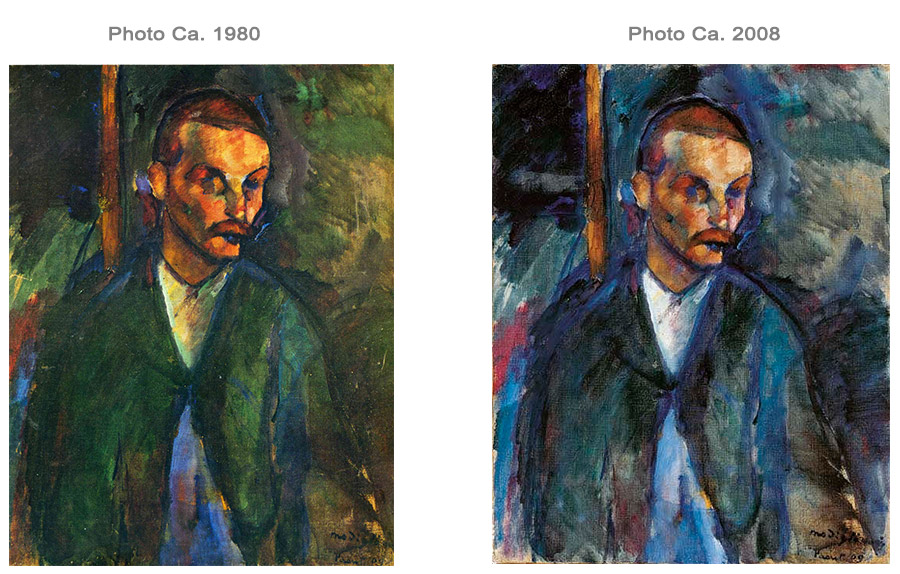
The Secret Modigliani page reproduces the picture "pre and post cleaning". In the earlier state the colour is darker and more yellow. The present brightness is partly the result of conservation. I have found no information on when the cleaning took place or who carried it out.
Facture
The paint is applied in short, separate, directional strokes. In the face, the strokes follow the planes: diagonal on the cheek, vertical on the forehead, horizontal on the moustache. In the jacket, longer strokes run down the cloth. In the background the strokes are broader and more varied in direction, and the canvas weave shows through in places, especially at the edges.
The facture is quick, but it is not careless. Each stroke carries a distinct colour and does a specific job, whether it marks a plane, a contour or an accent. This is the "lively brushwork" the Tate noted. It is quite different from the smoother surfaces of the Alexandre portraits painted in Paris earlier in 1909, and from the large Violoncelliste painted after Modigliani's return.
Figure, space and expression
The man faces us squarely but looks past us. His expression is unreadable: neither pathetic nor hostile, simply present. Despite the title, nothing in the picture marks him as a beggar. His jacket and shirt are worn but not ragged, and he holds no bowl and makes no gesture. The title Le paysan italien, used at Brussels in 1933 and in the D'Atri files, may be closer to how the picture was first understood.
Space is created by colour rather than perspective. The warm head advances; the cool ground recedes. The orange bar sits on a plane just behind the figure. There is no floor, wall or horizon. The figure exists in a field of colour, as in Cézanne's late portraits.
Iconography and the sitter
Ceroni's note, as transcribed by modigliani1909.com, gives the fullest account of the sitter: "Unico dipinto che Modigliani porterà con sè a Parigi dopo il primo soggiorno livornese... l'effigiato si chiamava Roberto Simoncini ed era un venditore di frutta e verdura" at the "mercato centrale di Livorno", near "via Gherardi del Testa luogo in cui Modigliani scolpì e dipinse durante l'estate del 1909". In English: it was the only painting Modigliani took with him to Paris after his first stay in Livorno; the sitter was called Roberto Simoncini and sold fruit and vegetables at the central market of Livorno, near via Gherardi del Testa, where Modigliani carved and painted during the summer of 1909.
The identification of the sitter as Roberto Simoncini rests on Ceroni's note. I have not found an independent source for it. If he was a market trader, the title The Beggar is a misnomer, and Le paysan italien would be more accurate. The various titles reflect a sitter whose social identity was never fixed in the literature.
Christie's 2004 quoted Schmalenbach: "This was the only work painted during Modigliani's stay in Leghorn (July-September) that he was anxious to bring back to Paris. He is said to have kept it for several months on the wall of his Rue Falguière studio." The Tate's guide describes it as "made on a trip to Italy two years later" than the 1907 Cézanne exhibition. The two accounts agree with Ceroni's note on the picture's special status.
Comparisons
With Cézanne. The Tate's guide stated: "A Paul Cézanne exhibition that Modigliani had seen in 1907 left a lasting impression. This painting ... bears witness to its impact... The artist even kept an image of a Cézanne painting in his pocket." Christie's 2004 added that Modigliani "apparently even made a small watercolour of Cézanne's Garçon au gilet rouge, 1888-90" (National Gallery of Art, Washington). The comparison is persuasive. The construction of the face in planes of colour, the use of blue for shadow and contour, and the field-like background all recall Cézanne's portraits. But the heavy contour lines are Modigliani's own, and they point forward to his mature work.
With the other paintings of 1909. In its direct, frontal presentation and its coloured ground, the Beggar is close to Pedro and Maurice Drouard. In its handling it is closer to the oil study for Le Violoncelliste (Ceroni no. 22a), painted soon after Modigliani's return to Paris. The study's constructive strokes and the bright, contrasting colour revealed by its cleaning are similar. The finished Violoncelliste (Ceroni no. 23) is smoother and darker.
With La mendiante (Ceroni no. 20). The two "beggars" were shown together at the 1910 Salon, as nos. 3690 and 3691, and both belonged to Jean Alexandre. But they are very different pictures. La mendiante, given to Jean Alexandre by March 1909, before the Livorno summer, is a small, dark-toned image of a young woman with bowed head and closed eyes. Le Mendiant de Livourne is larger, brighter and built of colour. The pairing of the titles in the Salon catalogue seems to have been a matter of subject, not of style.
Provenance, exhibitions and discrepancies
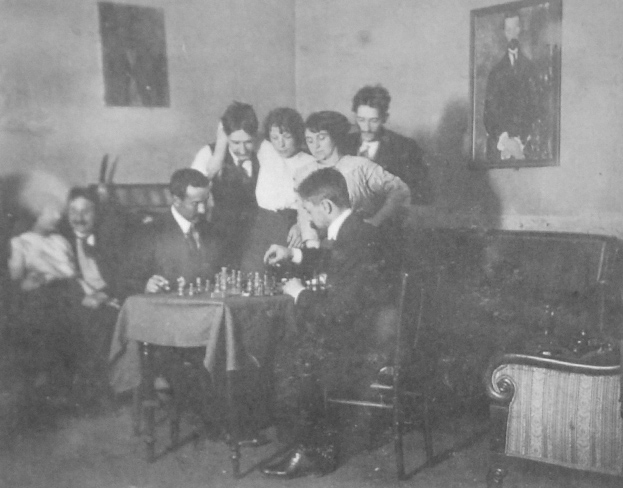
Christie's 2004 gives the provenance as follows: "Jean Alexandre, Paris, by March 1910. Dr Paul Alexandre, Paris, by whom inherited from the above in 1913. Blaise Cendrars, Paris." It adds that Jean "acquired the work directly from the artist" and "loaned it to the Salon des Indépendants in 1910", and that "By 1912 the painting was hanging in a room in Paul's house where it was photographed". The picture was sold at Christie's, London, on 2 February 2004 (sale 6882, lot 37), with an estimate of £400,000–600,000, and realised £498,050. Christie's 2015 confirmed: "Formerly in the collection of Jean Alexandre, Paris; sold, Christie's, London, 2 February 2004, lot 37." The Tate showed it in 2017–18 as from a private collection.
Christie's 2004 lists the exhibitions as follows: the Salon des Indépendants, 1910, no. 3690 ("the Société catalogue specifies the owner as Monsieur J[ean] A[lexandre]"); Brussels, Palais des Beaux-Arts, 1933, no. 3, as Le paysan italien; Cleveland and New York, 1951; Paris, Galerie Charpentier, Cent tableaux de Modigliani, 1958, no. 7; Milan, Palazzo Reale, 1958, no. 5; Liège, 1980; Paris, Musée du Luxembourg, 2002–03, no. 9. The Secret Modigliani page adds Venice, Biennale, 1930, no. 33; Basel, 1934; Milan, 2003, no. 8; Madrid, Thyssen-Bornemisza, 2008; Bonn, 2009, no. 9; and London, Tate Modern, 2017–18.
Discrepancies to flag:
- Dimensions. Christie's gives 65.8 × 52.4 cm. The figures reported by Secret Modigliani range from 55 × 50 cm (Ceroni) to 66 × 59 cm (Parisot), 65 × 54 cm (Patani) and 67 × 54 cm (Ireson). Ceroni's 55 × 50 cm is the same figure that he gives for La mendiante (Ceroni no. 20), and in both cases it seems to be an error.
- Later provenance. Between Cendrars and the 2004 sale there is a gap in the documented provenance.
- Title. Le mendiant, Le mendiant de Livourne, Le paysan italien and The Beggar of Leghorn are all used. If Ceroni's identification of the sitter as a market trader is correct, the earliest title, Le paysan italien, may be the most accurate description.
Technical analysis
I have found no published technical study of this painting: no radiograph, infrared image, pigment analysis or published condition report. It is not discussed in Tate Papers no. 35 or in the 2018 Burlington introduction to the Modigliani Technical Research Study, although it was lent to the Tate exhibition of 2017–18 that accompanied that research.
What can be said rests on visual evidence and comparison.
Surface and condition. The Secret Modigliani page shows the painting before and after cleaning, and the difference in colour is considerable. The undated cleaning is the only conservation intervention documented in the sources consulted.
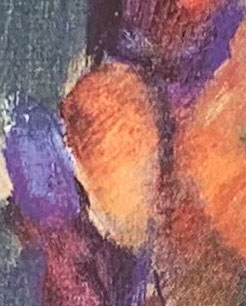
Drawing. The page's detail of the ear shows dark drawing on top of the colour. This visual observation, made from a photograph, is consistent with the dark contour lines elsewhere in the picture.
Support. The weave of the canvas is visible in reproduction at the edges of the background, where the paint is thin. Whether the canvas was new or reused, and whether it was commercially primed, is unknown. King, Ireson, Fraquelli and Townsend (2018) reported that the canvases in their study "seem to have been commercially prepared with an oil-based priming", and Tate Papers no. 35 documented frequent reuse. Neither finding can be transferred to this picture without examination.
Comparison with the study for Le Violoncelliste. The closest technically studied work is the oil study for Le Violoncelliste (Ceroni no. 22a), painted in Paris a few months later. Garcia, Juanes and Romero (2023) identified zinc white, cobalt blue, chromium-oxide green, emerald (Paris) green, red earth and organic lakes on that canvas. The Beggar's palette of blue, green, orange and rose looks similar. That is a visual resemblance, not evidence of shared materials.
Conclusion
Le Mendiant de Livourne is the most Cézannian of Modigliani's paintings and, according to Ceroni and Schmalenbach, the only picture from the summer of 1909 that he chose to bring back to Paris. It builds the head of a Livornese market trader out of planes of colour, sets it against a field of blues and greens, and fixes the whole with heavy contours of blue. The result is a portrait that looks back to Cézanne in its construction and forward to Modigliani's own work in its line.
The documentation is unusually good. The painting is dated on the canvas, it was shown at the 1910 Salon under Jean Alexandre's name, and its provenance is clear from the Alexandre brothers to Blaise Cendrars. It was sold at Christie's in 2004. The discrepancies are of detail: the dimensions, the transcription of the date, the Lanthemann and Charpentier numbers, the identification of the painting in a photograph of 1912 and the gap after Cendrars. Each should be noted. The real gap is technical. No examination of the canvas has been published, so its materials, its support and any underlying composition remain unknown.
Sale literature
- Christie's, London, Impressionist and Modern Art Evening Sale (sale 6882), 2 February 2004, lot 37, Modigliani, Le mendiant de Livourne: details, provenance, literature, exhibitions, lot essay, estimate and price realised, https://www.christies.com/en/lot/lot-4233459
- Christie's, New York, 14 May 2015, sale 3736, lot 3, Modigliani, Jean Alexandre (recto) / Nu assis (verso): comparative captions, https://www.christies.com/en/lot/lot-5893247
Museum documentation
- Tate Modern, Modigliani (23 November 2017–2 April 2018), large-print guide, rooms 1–11, label for The Beggar of Livorno (copy at docslib), https://docslib.org/doc/1601730/modigliani-large-print-guide-room-1-11
Technical literature (comparative)
- Greta Garcia, David Juanes and Rafael Romero, "Image Study and Material Characterization of the Two-Sided Painting The Cellist and Portrait of Brancusi by Amedeo Modigliani", International Journal of Conservation Science, vol. 14, no. 3 (2023), pp. 1233–48, https://doi.org/10.36868/ijcs.2023.03.30
- Anaïs Genty-Vincent et al., "Works by Modigliani that have Paintings beneath the Visible Surface", Tate Papers, no. 35, https://www.tate.org.uk/research/tate-papers/35/works-by-modigliani-that-have-paintings-beneath-the-visible-surface
- Annette King, Nancy Ireson, Simonetta Fraquelli and Joyce H. Townsend, "The Modigliani Technical Research Study: An introduction to Modigliani's materials and techniques", The Burlington Magazine, vol. 160, no. 1380 (March 2018), pp. 182–88, https://www.burlington.org.uk/archive/article/the-modigliani-technical-research-study-an-introduction-to-modiglianis-materials-and-techniques
Cited but not independently consulted
Pfannstiel, Modigliani. L'Art et la Vie (1929), p. 4, no. V, and Modigliani et son oeuvre (1956), p. 61, no. 17; Franchi 1944 and 1947, pl. III; Ponente, Commentari, 1952, pl. XLII; Lipchitz 1954, pl. 3; Jeanne Modigliani 1958, pl. 21, and Modigliani sans légende, 1961, no. 21; Ceroni 1958, no. 20; Russoli 1958; Werner 1967, 1968 and 1985; Lanthemann 1970, no. 32; Ceroni and Piccioni 1970, no. 24; Ceroni 1972, no. 24; Mann 1980, no. 29; Claude Roy 1985, p. 28; Castieau-Barrielle 1987, p. 47; Parisot 1988, 1991 (no. 1/1909) and 1992; Patani, no. 26; Krystof 2000, p. 22; Schmalenbach, "Les portraits", in Modigliani, L'ange au visage grave, Musée du Luxembourg, 2002, p. 122 (quoted by Christie's); Soto Caba 2007; Thyssen-Bornemisza 2008; Bonn 2009; La Collection Jonas Netter, 2012, p. 102; Ireson and Fraquelli (eds.), Modigliani, Tate, 2017, p. 37; the catalogues of the 1910 Indépendants, Venice 1930, Brussels 1933, Basel 1934, Charpentier 1958 and Milan 1958; the D'Atri files (no. 3); Cézanne, Garçon au gilet rouge, and Modigliani's watercolour after it (as reported by Christie's). All are cited from Christie's, the Tate guide or the Secret Modigliani page on the work.
Footnotes
- Arthur Pfannstiel, Modigliani. L’Art et la Vie, preface by Louis Latourette, Paris, Seheur, 1929 (presumed catalogue).
- Jeanne Modigliani, Modigliani: Man and Myth, New York, Orion Press, 1958.
- Arthur Pfannstiel, Modigliani et son œuvre, étude critique et catalogue raisonné, Paris, Bibliothèque des Arts, 1956.
- Ambrogio Ceroni, Amedeo Modigliani: Peintre; suivi des souvenirs de Lunia Czechowska, Milan, Edizioni del Milione, 1958.
- Jeanne Modigliani, Modigliani sans légende, Paris, Gründ, 1961.
- Joseph Lanthemann, Modigliani, catalogue raisonné: sa vie, son œuvre, son art, Barcelona, G. Condal, 1970.
- Ambrogio Ceroni and Leone Piccioni, I dipinti di Modigliani, Milan, Rizzoli, 1970.
- Carol Mann, Modigliani, London, Thames and Hudson, 1980.
- Thérèse Castieau-Barrielle, La vie et l’œuvre de Amedeo Modigliani, Paris, ACR, 1987.
- Christian Parisot, Catalogue raisonné Modigliani, Livorno, Graphis Arte, 1991.
- Osvaldo Patani, Amedeo Modigliani: catalogo generale, Milan, Leonardo, 1991–94.
- Christian Parisot, Modigliani, Paris, Pierre Terrail, 1992.
- MR (cited here as MR), Modigliani: l’ange au visage grave, Paris, Musée du Luxembourg, 2002. Cited from the published exhibition catalogue only.
- Victoria Soto Caba, Modigliani: The Timeless Face, Madrid, Libsa, 2007.
- Nancy Ireson and Simonetta Fraquelli, Modigliani, London, Tate Modern / Skira Rizzoli, 2017.