The beggar woman
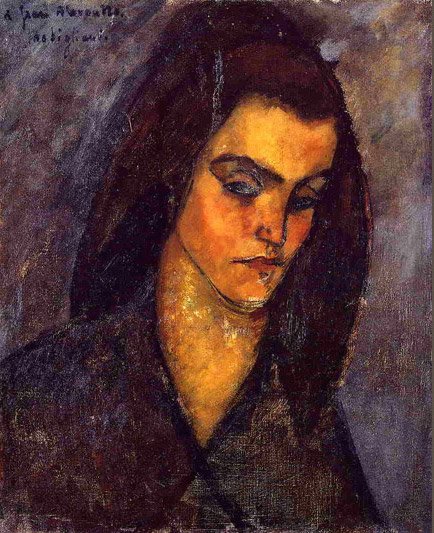
Oil on canvas — 1909
Identification
- Title
- English: The beggar woman
Italian: La Mendicante.
French: La Mendiante.
Notes: La mendicante (Ceroni 1970); La mendiante (Salon des Indépendants 1910; Christie's 2015); The Beggar Woman (Jewish Museum 2017–18). - Date
- 1909
- Medium
- Oil on Canvas
- Dimensions
- 46 x 37.5 cm (Christie's 2015)
Notes: 46 × 38 cm (Pfannstiel, Parisot, Patani, Jewish Museum checklist; D'Atri papers); 55 × 50 cm (Ceroni,1970) - Signature
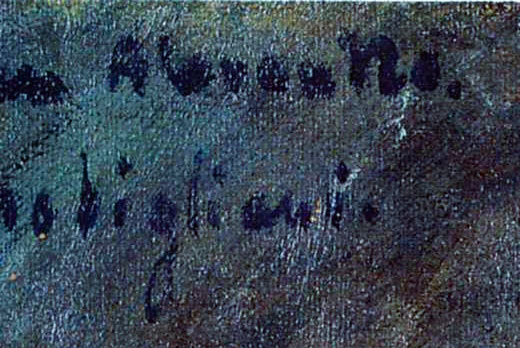
- Signed "modigliani" and the text "à Jean Alexandre" upper left
Note: Ceroni describes the dedication as being to Paul Alexandre. - Present location
- Private Collection?
Catalogue numbers
| Compiler | Number |
|---|---|
| Arthur Pfannstiel | no. 14 |
| Joseph Lanthemann | no. 31 |
| Ambrogio Ceroni | no. 20 |
| Jeanne Modigliani | YES |
| Christian Parisot | 10/1909 |
| Osvaldo Patani | no. 25 |
| Modigliani Project | YES |
| MR | YES |
| Modigliani Initiative/ AMDC | ? |
Legal note on MR: This investigation has not had access to MR’s catalogue raisonné; all research here is based on open sources, publications and exhibitions. By no means has that catalogue been copied at any point. Modigliani Project and Modigliani Research Project are marked YES when the work is published or otherwise recorded by those projects, even if no catalogue number is assigned; otherwise the field is marked ?.
Provenance
- Jean or Paul Alexandre, Paris?
- Laure Denier Collection?
- Paul Alexandre Family, Paris?
The sequence follows the published museum, sale, and catalogue record in this investigation. Gaps and uncertain transfers are marked as such.
Selected bibliography
Book-length publications are marked with a footnote giving a full citation. Exhibition catalogues appear in both this list and the exhibition list when this investigation recorded them in both places.
- Pfannstiel, "catalogue présumé" Modigliani. L'Art et la Vie. Preface de Louis Latourrettes, Seheur, Paris, 1929, p. 31
- Paris, Galerie Charpentier, Cent tableaux de Modigliani, 1958, p. 27
- Pfannstiel, Modigliani et son oeuvre, étude critique et catalogue raisonne, Bibliothèque des Arts, Paris, 1956 - no. 142
- Ceroni, Amedeo Modigliani: Peintre; Suivi des Souvenirs de Lunia Czechowska, Edizioni del Milione, 1958 - no. 163
- Lanthemann, Modigliani, catalogue raisonné: sa vie, son oeuvre, son art, G. Condal, Barcelona, 1970 - no. 314
- Ceroni & Piccioni, Il dipinti di Modigliani, Rizzoli, Milano, 1970 - no. 205
- Parisot, Catalogue Raisonné Modigliani, Graphis Arte, 1991 - no. 10/19096
- Patani, Catalogo Generale, Leonardo, Milano, 1991-94 - no. 257
- MR, L'Ange au visage grave, Musée du Luxembourg, Paris, 2002, p.120-121, no. 88
- Soto Caba, Modigliani, the timeless face, Libsa, 20079
- R, La Collection Jonas Netter, Pinacotheque de Paris, 2012, p.102
- Klein, Modigliani Unmasked, The jewish Museum, New York, 201710
Exhibitions
- Paris, 26e Exposition, Société des Artistes Indépendants, Cours-la-Reine, 1910 (the Société catalogue specifies the owner as Monsieur Jean Alexandre) - no. 3691
- Brussels, Modigliani: Retrospective Exhibition. Palais des beaux-arts, 1933 - no. 2
- Basel, Amedeo Modigliani, Kunsthalle, 1934
- Paris, Gallerie Charpentier, Cent Tableaux de Modigliani, 1958 - no. 7
- Paris, Modigliani: l'ange au visage grave, Musée du Luxembourg, 2002 - no. 8
- Milano, Modigliani: l'ange au visage grave, Palazzo Reale, 2003 - no. 7
- Torino, Modigliani e la Bohème di Parigi, Galleria d’Arte Moderna, 2015
- New York, Modigliani unmasked, Jewish Museum, 2017-18
Notes
As no. 259 in D'Atri papers as La Mendiante - 46 x 38 - dated 1909 - Alexandre Collection.
Where sources disagree, both readings are given. This is a working research page, not a catalogue raisonné.

Introduction
A young woman with long dark hair bends her head forward and looks down, her eyes almost closed. Her face, lit from the left, is a warm orange-ochre mask, sharply drawn at the brows, nose and lips. Her hair falls on both sides of the face like a hood and merges with a dark, blue-black garment wrapped across her chest. Behind her, a ground of grey, violet and blue is brushed in loose diagonal strokes. In the upper left corner a dedication is written in dark paint: "à Jean Alexandre / modigliani".
The picture is the Mendiante (Beggar Woman), Ceroni no. 20. It is the best-documented of Modigliani's small early figure paintings. A letter of 26 March 1909 from Jean Alexandre to his brother Paul records the gift of the painting. It was then shown, with its pendant Le mendiant, at the Salon des Indépendants of 1910 as the property of "M. J. A...". It has remained in the Alexandre family ever since. In 2017–18 it was shown at the Jewish Museum in New York as part of the Paul Alexandre family loans.
Composition and format
The canvas measures 46 × 37.5 cm. This is the size of a standard French no. 8 figure canvas, the same format Modigliani used for several of his small early heads. The figure is shown at bust length, and the head occupies the centre and the upper half of the canvas. The hair forms a dark, roughly triangular mass whose apex is at the top edge, and the garment widens the triangle at the bottom. The face is a small, bright oval set within this dark pyramid.
The composition is simple and stable, almost devotional in character. The bent head, the hooded hair and the triangular silhouette recall images of the Madonna or of mourning saints. The dedication and signature fill the upper left corner, the only area of the ground not occupied by the hair, and so they become part of the design.
Line and drawing
The drawing is concentrated in the face. The brows are two long, dark, slightly arched lines; the eyelids are heavy and lowered, painted in grey-blue with dark lines along the lashes. The nose is a long, straight form drawn with a single dark contour on its shadowed side. The mouth is small, with red lips that turn down at the corners. The jaw and chin are given a firm dark outline that separates the lit face from the neck.
Elsewhere, line is used more freely. The hair is painted with long, dark strokes that follow its fall, and the edges of the garment are drawn with a few dark blue lines that form a V at the chest. The contours of the neck and the left side of the face are loose and broken, so that the figure seems to emerge from, rather than be cut out from, the ground.
Colour
The colour is built on a contrast between the warm face and the cool surroundings. The face is painted in orange, yellow ochre and pink, with deeper red on the lips and nostrils and with green and grey-blue in the eye sockets and on the shadowed side. The neck is lighter, in yellow and greenish tones flecked with white. The hair is a dark red-brown that becomes almost black in places, and the garment is a deep blue-black. The ground is a mixture of grey, violet and blue, warmer at the top and cooler towards the right.
The palette relates the picture to the Blue Period of Picasso, as Christie's observed in 2015. The cool, sombre ground and the theme of poverty both point in that direction. But the colour of the face is far warmer than in Picasso's figures of 1901–04, and the contrast of complementary oranges and blues shows Modigliani's own interest in colour construction after Cézanne.
Facture
The paint is thinly and rapidly applied in most areas. In the ground, short and long diagonal strokes are laid over each other, leaving the weave of the canvas visible in places. The hair is painted with fluid dark strokes over a lighter underlayer. The face is the most worked area, with thicker paint in the lights of the forehead, nose and cheek, and with visible brushstrokes that follow the planes of the face.
The handling has the freshness of a work painted in one or two sessions. That would be consistent with the circumstances of the gift recorded by Jean Alexandre (see below), but the documents do not say when the picture was painted.
Figure, space and expression
The girl's expression is withdrawn and inward. Her lowered eyes do not engage the viewer. The bent head, the slight tilt and the drooping mouth convey sadness or resignation. There is no attribute of begging, no outstretched hand, no bowl and no street setting. The title alone tells us that this is a beggar. The figure belongs to a type common in Montmartre painting around 1900–05: the young woman of the streets, often also the model of the painters.
Space is shallow. The ground is a coloured field without depth, and the figure is pressed close to the picture plane. The dark mass of hair and garment, however, gives the figure a sculptural weight, and the face projects forward from it like a lit mask. This sense of the face as a mask set within a frame of hair anticipates the heads Modigliani would carve from 1909 to 1914.
Iconography and the sitter
Ceroni's note, as transcribed by modigliani1909.com, states that the woman "era conosciuta nell'ambiente bohémien frequentato da Modigliani e dai fratelli Alexandre" ("was known in the bohemian milieu frequented by Modigliani and the Alexandre brothers"). He gives no name.
Christie's 2015 essay on Jean Alexandre (Ceroni no. 16) adds a more specific proposal. The seated nude on the reverse of that portrait is "probably the same pre-pubescent girl the artist depicted in La Mendiante". The essay adds that "she may have also appeared in the painting of the two beggar-women, a work unknown today". Christie's describes the model as a "lean gamine subject" and connects Modigliani's fondness for her with "his admiration for Picasso's Blue Period". The figure in the Mendiante looks older than a child, and Christie's identification rests on comparison rather than documentation. It is therefore a plausible suggestion, not an established fact.
The gift: Jean Alexandre's letter
The most important document for the picture is a letter from Jean Alexandre to Paul Alexandre, who was then in Vienna. Christie's 2015 essay quotes it from the published Alexandre papers and dates it 26 March 1909. Jean writes that he has lent Modigliani 20 francs against the portrait of the Amazon, and that his own portrait is not finished. He continues: "To keep me happy, he very sweetly gave me his painting of a beggar woman [Ceroni, no. 20]. He's working quite hard at the moment, particularly on that picture of two beggar-women... really one of his best works..."
The letter does three things:
- It fixes a date before which the picture must have been finished, 26 March 1909, or shortly before.
- It confirms that the painting belonged to Jean, not Paul, from the start.
- It shows that the subject interested Modigliani enough at that moment for him to be working on a second, larger composition of two beggar women, which is now lost.
Dedication: Jean or Paul?
The inscription, which can be read in the reproduction on the Secret Modigliani page, is "à Jean Alexandre". The Secret Modigliani page transcribes it the same way. Ceroni's note, as transcribed, says "In alto a sinistra la dedica a Paul Alexandre" ("in the upper left, the dedication to Paul Alexandre"). Jean's letter, the Indépendants catalogue of 1910 ("appartient à M. J. A..."), Christie's ("formerly in the collection of Jean Alexandre") and the inscription itself all point to Jean. Ceroni's "Paul" is therefore an error, possibly caused by the fact that the painting later passed into the collection of Paul Alexandre's family.
Comparisons
The pendant to the Mendiante is Le mendiant de Livourne (The Beggar of Livorno, Ceroni no. 24). The two pictures were shown side by side at the 1910 Indépendants as nos. 3690 and 3691, both lent by "M. J. A...", and Christie's records that the Mendiant was formerly owned by Jean Alexandre. The two pictures were not painted at the same time, however. The Tate 2017 guide says that the Beggar of Livorno was "made on a trip to Italy two years later" than the Cézanne exhibition of 1907, that is in 1909. Ceroni's note places it in Livorno in summer 1909 and identifies the sitter as Roberto Simoncini, a fruit and vegetable seller. The Mendiante had been given to Jean by March 1909. The pairing as "beggar" and "beggar woman" was therefore probably made after the event, by Jean or by Modigliani when the two pictures were sent to the Salon.
The "Ceroni 55 × 50" as the dimensions of both beggar pictures, although the Mendiante is about 46 × 38 cm and the Mendiant about 65 × 54 cm. It is possible that a measurement was transposed in Ceroni or in the site's transcription. Without Ceroni's printed volume, this essay cannot decide which.
The Mendiante can also be compared with the heads of young women painted in 1908, such as the Lille Buste de jeune femme (Ceroni no. 6). The Tate guide relates that work to the colour and strong definition of Kees van Dongen. The Mendiante is quieter and more sombre. Its long, oval face and drooping mouth, though, announce the stylised faces of Modigliani's later work more clearly than any of the 1908 heads.
Provenance and exhibitions
The provenance is short and reliable. The painting was a gift from the artist to Jean Alexandre in March 1909, according to Jean's letter as quoted by Christie's. It later passed into the Paul Alexandre family, and it is now in the Laure Denier Collection, Paul Alexandre Family, courtesy of Richard Nathanson, London (Jewish Museum large-print guide, no. 21, and checklist). Early ownership as "Jean or Paul Alexandre, Paris?" and the present location as "Laure Denier Collection ?". The Jewish Museum's documentation removes the second doubt, and the 1909 letter removes the first. Ceroni's 1970 caption, "Francia, proprietà privata", is consistent with this.
Technical analysis
No technical study of this painting has been published, as far as the sources consulted show. It is not among the works discussed in the Tate Papers article on Modigliani's paintings with earlier compositions beneath the surface, nor in the Burlington Magazine introduction to the Modigliani Technical Research Study.
As comparative evidence, the Burlington introduction reports that the canvases examined in the Modigliani Technical Research Study "seem to have been commercially prepared with an oil-based priming". The Tate Papers article shows that in 1908–09 he often reused canvases. Christie's suggests that the model of the Mendiante also appears in the seated nude on the reverse of Jean Alexandre, which raises the question of whether other studies of the same girl survive under other paintings of 1909. Only examination with X-radiography and infrared reflectography could answer that. The thinness of the paint in the ground of the Mendiante suggests that such examination would also reveal the preparatory drawing clearly.
Conclusion
La mendiante is a small picture with an unusually solid documentary foundation. Jean Alexandre's letter of 26 March 1909 dates it and records the gift. The dedication "à Jean Alexandre" confirms the owner, and the 1910 Indépendants catalogue records its first public showing. It has stayed in the Alexandre family to the present day. The essay has noted three discrepancies: Ceroni's dedication to "Paul", his dimensions of 55 × 50 cm, and the Lanthemann number. None of them affects the identity of the work.
As a painting, the Mendiante stands at a turning point. Its sombre blue ground and its theme of poverty look back to Picasso's Blue Period. Its warm, mask-like face, set in a frame of dark hair, looks forward to the sculpture of the next few years and to the elongated faces of Modigliani's maturity.
Sale literature
- Christie's, New York, 14 May 2015, sale 3736, lot 3, Modigliani, Jean Alexandre (recto) / Nu assis (verso): lot essay (quoting Jean Alexandre's letter of 26 March 1909; figure captions for La Mendiante and Le Mendiant de Livourne), https://www.christies.com/en/lot/lot-5893247
Museum documentation
- The Jewish Museum, New York, Modigliani Unmasked, large-print guide (no. 21, The Beggar Woman), https://thejewishmuseum.org/wp-content/uploads/2025/06/Modigliani_Large_Print_FINAL.pdf
- The Jewish Museum, New York, Modigliani Unmasked, exhibition checklist, https://thejewishmuseum.org/wp-content/uploads/2025/07/Modigliani_Unmasked_checklist.pdf
- Tate Modern, Modigliani (23 November 2017–2 April 2018), large-print guide, rooms 1–11 (copy at docslib), https://docslib.org/doc/1601730/modigliani-large-print-guide-room-1-11
Technical literature (comparative)
- Anaïs Genty-Vincent et al., "Works by Modigliani that have Paintings beneath the Visible Surface", Tate Papers, no. 35, https://www.tate.org.uk/research/tate-papers/35/works-by-modigliani-that-have-paintings-beneath-the-visible-surface
- Annette King, Nancy Ireson, Simonetta Fraquelli and Joyce H. Townsend, "The Modigliani Technical Research Study: An introduction to Modigliani's materials and techniques", The Burlington Magazine, vol. 160, no. 1380 (March 2018), pp. 182–88, https://www.burlington.org.uk/archive/article/the-modigliani-technical-research-study-an-introduction-to-modiglianis-materials-and-techniques
Cited but not independently consulted
Pfannstiel, Modigliani. L'Art et la Vie (1929), p. 3, and Modigliani et son oeuvre (1956), no. 14; Ceroni 1958, no. 16; Lanthemann 1970, no. 31/32; Ceroni and Piccioni 1970, no. 20; Parisot, no. 10/1909; Patani, no. 25; Musée du Luxembourg, L'Ange au visage grave, 2002, pp. 120–21, no. 8; Soto Caba 2007; La Collection Jonas Netter, Pinacothèque de Paris, 2012, p. 102; Klein (ed.), Modigliani Unmasked, 2017; the catalogues of Brussels 1933, Basel 1934, Charpentier 1958, Milan 2003 and Turin 2015; the D'Atri papers (no. 259); the published Alexandre correspondence quoted by Christie's.
Footnotes
- Arthur Pfannstiel, Modigliani. L’Art et la Vie, preface by Louis Latourette, Paris, Seheur, 1929 (presumed catalogue).
- Arthur Pfannstiel, Modigliani et son œuvre, étude critique et catalogue raisonné, Paris, Bibliothèque des Arts, 1956.
- Ambrogio Ceroni, Amedeo Modigliani: Peintre; suivi des souvenirs de Lunia Czechowska, Milan, Edizioni del Milione, 1958.
- Joseph Lanthemann, Modigliani, catalogue raisonné: sa vie, son œuvre, son art, Barcelona, G. Condal, 1970.
- Ambrogio Ceroni and Leone Piccioni, I dipinti di Modigliani, Milan, Rizzoli, 1970.
- Christian Parisot, Catalogue raisonné Modigliani, Livorno, Graphis Arte, 1991.
- Osvaldo Patani, Amedeo Modigliani: catalogo generale, Milan, Leonardo, 1991–94.
- MR (cited here as MR), Modigliani: l’ange au visage grave, Paris, Musée du Luxembourg, 2002. Cited from the published exhibition catalogue only.
- Victoria Soto Caba, Modigliani: The Timeless Face, Madrid, Libsa, 2007.
- Mason Klein, Modigliani: Beyond the Myth, New York, The Jewish Museum / Yale University Press, 2004.