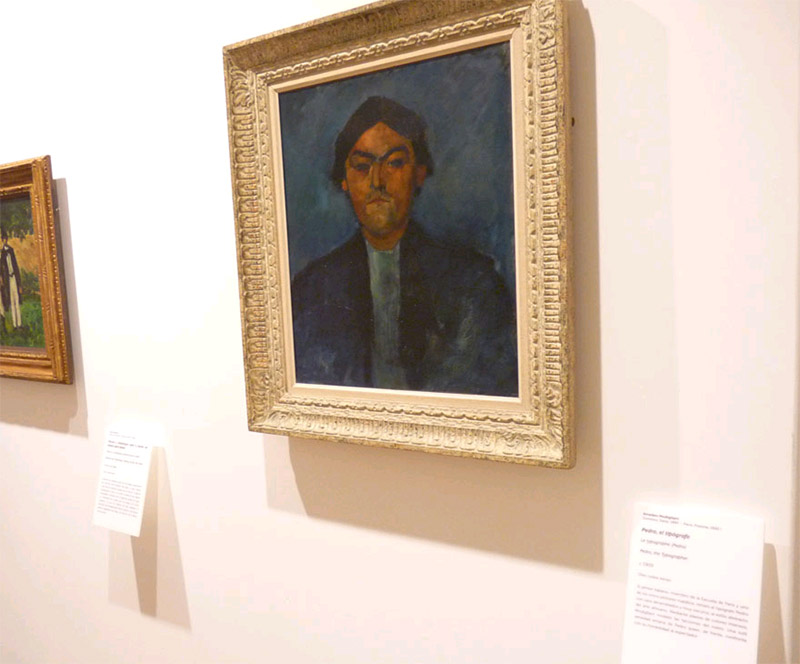
Pedro the typographer
Oil on canvas — 1909
Identification
- Title
- English: Pedro the typographer - Portrait of a man - Pedro the printer.
French: Pierre le typographe
Also as: Le typographe (Pedro) (Christie's 2002); Il tipografo Pedro [?] (Ceroni 1970); Pedro the typographer; Portrait d'homme (Lanthemann 1970, as cited by Christie's); Portrait of Pedro (Tate 2017). - Date
- c. 1909
- Medium
- Oil on Canvas
- Dimensions
- 54.9 x 46.3 cm (Christie's; Tate 2017)
(55 × 46 cm (Ceroni); 52.3 × 46 cm (Parisot) and 52.3 × 46.3 cm (Patani), as reported by Secret Modigliani; 55 × 46.5 cm (Charpentier 1958 and Museo Soumaya) - Signature
- Signed "Modigliani " - upper right
Notes: considered apocryphal (Ceroni note, as transcribed, signature is difficult to see) - Present location
- Museo Soumaya, Fundación Carlos Slim, México City, México.
Catalogue numbers
| Compiler | Number |
|---|---|
| Arthur Pfannstiel | NO |
| Joseph Lanthemann | no. 30 |
| Ambrogio Ceroni | no. 17 |
| Jeanne Modigliani | YES |
| Christian Parisot | 5/1909 |
| Osvaldo Patani | no. 23 |
| Modigliani Project | ? |
| MR | YES |
| Modigliani Initiative/ AMDC | ? |
Legal note on MR: This investigation has not had access to MR’s catalogue raisonné; all research here is based on open sources, publications and exhibitions. By no means has that catalogue been copied at any point. Modigliani Project and Modigliani Research Project are marked YES when the work is published or otherwise recorded by those projects, even if no catalogue number is assigned; otherwise the field is marked ?.
Provenance
- Leopold Zborowski, Paris.
- Galerie Barreiro, Paris.
- Edouard Herriot (1942)
- Thürlimann Collection, Zürich (located there in 1958).
- Homburger Collection, Dedham, Mass. (1957) Ceroni mentions Dedhamm USA as owner ?
- Lent to John and Mable Ringling Museum of art, Sarasota, Florida.
- Christie's, New York, 6 November 2002, sale 1147, lot 13: estimate $500,000–700,000; sold for $471,500
- Carlos Slim Collection, Mexico.
- On loan to Soumaya Museum Mexico city.
The sequence follows the published museum, sale, and catalogue record in this investigation. Gaps and uncertain transfers are marked as such.
Selected bibliography
Book-length publications are marked with a footnote giving a full citation. Exhibition catalogues appear in both this list and the exhibition list when this investigation recorded them in both places.
- Paris, Galerie Charpentier, Cent tableaux de Modigliani, 1958, page 27.
- Modigliani J. , Modigliani: Man and Myth, Orion Press, New York, 1958, pl. 20 (dated 1908-1909 and located in Zürich, P.C. 1958)12
- Modigliani J. , Modigliani senza leggenda, Vallecchi Editore, Firenze, 1958, pl. 201
- Museum of Fine Arts, Boston 1961, p. 30
- Las Angeles County Museum, Los Angeles 1961, p. 30
- Royal Scottish Academy, Edinburgh, 1963, no. 3
- Tate Gallery, London, 1963, no. 3
- Ceroni, Amedeo Modigliani : dessins et sculptures ; avec suite du catalogue illustre des peintures, Edizioni del Milione, Milano, 1965 - no. 159
- Diehl, Modigliani, Ed. Flamarion, Paris, 1969, p. 17
- Ponente, Modigliani, Ed. Toray, Barcelona, 1969 - no. 1
- Lanthemann, Modigliani, catalogue raisonné: sa vie, son oeuvre, son art, G. Condal, Barcelona, 1970 - no. 303
- Ceroni & Piccioni, Il dipinti di Modigliani, Rizzoli, Milano, 1970 - no. 174
- Hall, Modigliani, Phaidon, Oxford, 1979, pl. 1
- Catalogue Musée d ’Art Moderne de Paris, 1981, p. 102
- Hall, Modigliani, Oxford, 1984, no. 2.
- C. Roy, Beaux livres, Ed. Nathan, 1985, p. 20
- Castieau-Barrielle, La vie et l'oeuvre de Amedeo Modigliani, Editions ACR Paris, 19875
- Diehl, Modigliani, Crown Publishers, New York, 1989, p. 17
- Parisot, Catalogue Raisonné Modigliani, Graphis Arte, 1991 - no. 5/19096
- Patani, Catalogo Generale, Leonardo, Milano, 1991-94 - no. 237
- Soto Caba, Modigliani, the timeless face, Libsa, 20078
- Ireson, Fraquelli, Modigliani, London, Tate Modern, Skira Rizzoli, London, 2017, pp. 389
Exhibitions
- Paris, Gallerie Charpentier, Cent Tableaux de Modigliani, 1958 - no. 4
- Marseille, Musée Cantini, 1958 - no. 15
- Northhampton, Smith College museum of art, the Freddy and Regina T. Homburger Coll., 1961 - no. 14
- Boston, Museum of Fine Arts, Modigliani paintings and drawings, 1961 p. 30 - no. 1
- Las Angeles, Los Angeles County Museum, Modigliani paintings and drawings, 1961, p. 30 - no. 1
- Maine, Orono, University of Maine, the Freddy and Regina T. Homburger Coll., 1962 no. 16
- Edinburgh, Royal Scottish Academy, Modigliani, 1963 - no. 3
- London, Tate Gallery, Modigliani, 1963 - no. 3
- Cambridge, Harvard University, Fogg art museum, 1971 - no. 26
- New York, Amedeo Modigliani; loan exhibition, Acquavella Galleries, 1971 - no. 1
- Augusta, Maine State Museum, Freddy and Regina T. Homburger Art Collection - no. 26
- Sarasota, Florida, Ringling Museum of Art; A Collector's World: Art of Four Continents, 1978- 1979 - no. 6
- Melbourne, Florida, Brevard Museum of Art & Science, A Collector's World: Art of Four Continents, 1978- 1979 - no. 6
- Daytona Beach, The Museum of Arts and Sciences, a Collector's World: Art of Four Continents, 1978- 1979 - no. 6
- Paris, Musée d'Art Moderne de la Ville de Paris, Amedeo Modigliani, 1981 - no. 4
- Maine, Portland Museum of Art, Long term November 1991-June 2002.
- London, Modigliani, Tate Modern, 2017-2018
- Mexico city, Museo Soumaya
Notes
Museo Soumaya (Mexico City) confirms: oil on canvas, c. 1909, approx. 55 × 46.5 cm. The museum holds the work in its permanent collection (Carlos Slim / Fundación Carlos Slim). Some sources note possible underdrawing related to other compositions.
Not in D' Atri files?
Dr. Phyllis Hattis Rubin informs that underneath Pedro there is an early version of the Amazon painting visible in X-ray
Where sources disagree, both readings are given. This is a working research page, not a catalogue raisonné.
Introduction
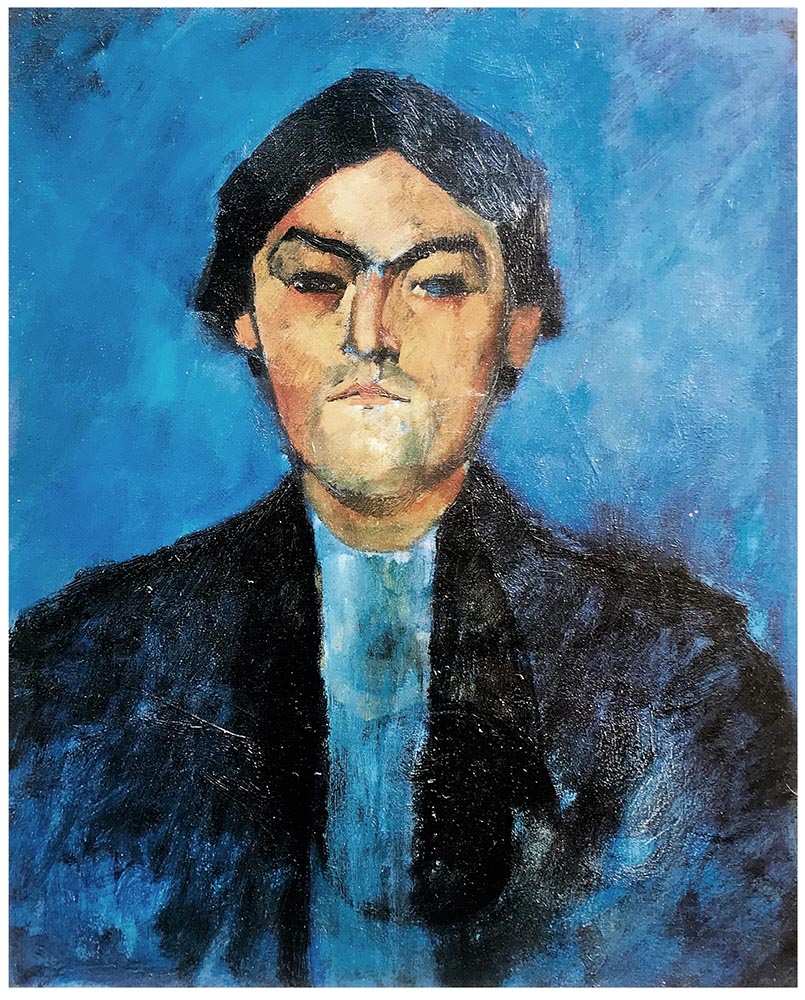
A young man with a heavy fringe of black hair stares out of a field of saturated blue. His face is a broad, almost square mask of orange flesh, the eyebrows joined in a single bar, the eyes half-closed and set at slightly different heights, the mouth pressed into a level line. He wears a dark jacket open over a pale blue shirt, and the jacket's blue-black merges with the blue of the ground, so that the head seems to float above a dark, unstable mass. Nothing in the picture tells us who he is. The title by which it is known, Le typographe (Pedro), names a trade and a first name, but no source consulted for this essay explains either. Ceroni himself printed the title with a question mark: Il tipografo Pedro [?].
This is Ceroni no. 17. It follows the five Alexandre family portraits of 1909 (nos. 12–16) in the catalogue's sequence, but it does not belong to that group. The painting has no Alexandre provenance, and Ceroni's note, as transcribed by modigliani1909.com, says that it first appeared at the Galerie Charpentier exhibition in Paris in 1958. It is also absent from Ceroni's first catalogue of the paintings, published in 1958: Christie's lists its first appearance in Ceroni's work as the 1965 supplement (Amedeo Modigliani: dessins et sculptures, avec suite du catalogue illustré des peintures, p. 40, no. 159). The work therefore entered the literature late, and with an uncertain identity. This essay looks at the painting itself, then at what the documents do and do not establish.
Composition and format
The canvas measures about 55 × 46 cm, the size of a standard French no. 10 figure canvas (55 × 46 cm; my identification). Unlike several of the Alexandre portraits, which use landscape or marine strainers turned upright, this is the format traditionally intended for a head or bust. The Burlington Magazine's introduction to the Modigliani Technical Research Study notes that Modigliani often adapted paysage and marine formats for portraits. That makes the choice of a conventional figure size here worth noting, even though nothing more can be inferred from it.
The figure is strictly frontal and centred. The head occupies the upper half of the canvas, its crown close to the top edge; the shoulders spread almost to the side edges at the bottom. The composition is a pyramid: the narrow dark cap of hair at the apex, the broad dark jacket at the base, and the pale vertical strip of the shirt running down the axis from chin to bottom edge. That central strip is the strongest structural device in the picture. It continues the line of the nose and the cleft of the chin, and it divides the jacket into two symmetrical flaps. The effect is close to heraldic. The sitter is not turned, does not lean, and holds nothing; his hands are cut off by the lower edge.
The background is an even, undescribed blue with no wall, window or furniture. In this respect the picture differs from the Alexandre portraits of the same year, which place the sitter in a room, with a picture, a curtain or a crucifix behind him. Here the space is reduced to a coloured plane. The only depth comes from the overlap of head over ground and ground over jacket.
Line and drawing
The drawing is done largely with the brush in dark blue-black. A firm contour runs round the jaw and cheeks and returns at the ears; the eyebrows are a single heavy stroke that bends down at the bridge of the nose; the nose is drawn as a long straight wedge with a dark line on its shaded side; the upper lip is a short horizontal bar. The eyes are almond-shaped slits, the lids heavy, the pupils barely indicated. The left eye (the sitter's right) is set a little lower than the other, and the two halves of the face are not quite symmetrical, a slight imbalance that animates an otherwise rigid scheme.
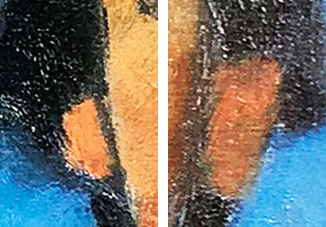
The Secret Modigliani page reproduces a detail of the ears with the comment that "the drawing is clearly visible and is painted over the color (on top of the color)". In the detail, the orange of the ear is bounded by dark strokes that lie over the flesh tone rather than under it. If that reading is correct, the contours were reinforced at a late stage rather than laid in first as an underdrawing and then covered. The same comment, word for word, appears on the Secret Modigliani page on Maurice Drouard (Ceroni no. 18), which suggests that the site's author treats this late redrawing as a shared habit of the 1909 portraits. It is an observation made from photographs, and no technical report on the painting has been published that would confirm the order of the layers.
Colour
The palette is built on two complementary families: blue in the ground, shirt and jacket, and orange in the flesh. The flesh is warm and intense, modelled by darker orange-brown on the shaded side of the nose and cheeks and by a cooler, greenish tone at the chin and jaw, where a shadow of beard is suggested. The dark hair and the dark jacket act as a frame of near-black around the face.
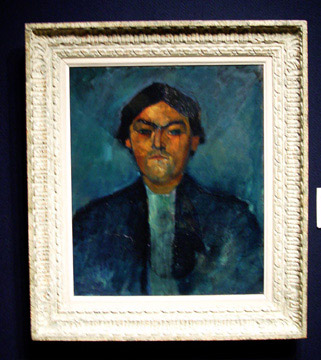
The two reproductions on the Secret Modigliani page differ markedly. The image captioned "previously to cleaning" shows a deeper ultramarine ground and a hot, reddish flesh; the main image shows a lighter, more turquoise blue and a paler, more yellow flesh. The site does not say when or by whom the painting was cleaned, and reproductions are not reliable evidence of colour, so the difference may be partly photographic. Both images, however, agree on the essential relation of a cold ground and a hot face, and on the way the blue invades the shirt and the jacket.
Writers on this period have often related such blue grounds to Picasso's Blue Period and, more broadly, to the lessons of Cézanne, whose influence on Modigliani's work of 1909 the Tate 2017 guide stresses in its label for The Beggar of Livorno, shown in the same room as Pedro. The comparison should not be pressed too far. In Pedro the blue is not a means of melancholy, as in Picasso's figures of 1902–04, but a flat foil that makes the face advance.
Facture
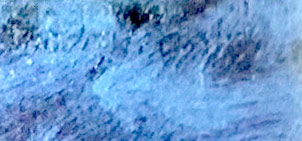
The handling is rapid and loaded. In the ground the brush moves in short diagonal and curving strokes, leaving visible ridges and some thinner patches where an underlying tone shows through. In the jacket the paint is darker and broken, with strokes of blue dragged over black. In the face it is denser and more blended, though still worked in visible planes: a lighter patch on the forehead, an orange plane on each cheek, a shadowed plane down the left side of the nose. The shirt is painted in thin vertical strokes of pale blue and grey, with small touches of yellow and green.
The surface, in short, has the vivacity of a sketch, but the structure is fixed. There is no sign in the reproductions of the scraped or rubbed passages found in some of Modigliani's reused canvases of 1908–09. Whether anything lies beneath the visible portrait is discussed below.
Figure, space and expression
The expression is the picture's most discussed feature. The half-closed eyes, joined brows and set mouth give the face an air of reserve that has been read in very different ways, as pride, as weariness or as the blankness of a mask. Spanish-language commentators, including the Wikipedia article consulted for this essay, report a suggestion that the painting might be a self-portrait, on the basis of a resemblance to a photograph of Modigliani taken in 1909. No published source opened for this essay develops that hypothesis, and it is mentioned here only as a reported opinion. The heavy fringe and broad face do not obviously resemble Modigliani's own features as known from photographs of 1909, though that is a subjective judgement.
What can be said is that the painting belongs to the moment when Modigliani was moving from the descriptive, room-based portraits of the Alexandre family towards a more schematic head. The joined brows, the long straight nose and the small, compressed mouth anticipate the stylised faces of the stone heads of 1911–13 and of the portraits of 1915–19. Here they are still combined with a heavy, almost Fauve colour that he would later abandon.
Iconography and the identity of the sitter
The title records two claims: that the man was a typographer and that he was called Pedro. Neither is explained in any source opened for this essay. Christie's in 2002 used the title Le typographe (Pedro); Ceroni, in 1970, queried it; Lanthemann (as cited by Christie's) called the picture simply Portrait d'homme. The Tate in 2017 used Portrait of Pedro, and the Museo Soumaya uses Pedro, el tipógrafo. No sitter called Pedro is mentioned in the Alexandre correspondence quoted by Christie's in its 2015 essay on Jean Alexandre, which is the best-published body of letters from Modigliani's circle in 1909.
The absence of attributes is itself significant. A typographer might have been shown with an apron, a composing stick or a page of type; Modigliani gives no such sign. The title may derive from a dealer, an early owner or an oral tradition. Until a primary source is found, the man should be regarded as unidentified, and the trade and name as traditional rather than established.
Comparisons
The closest comparison in date and type is Maurice Drouard (Ceroni no. 18), another frontal bust of a young man with a dark jacket and a vivid, brushy blue ground. Christie's in 2020 described the Drouard portrait as embracing "the lessons of Fauvism with the use of pure, unmodulated colors", while also recalling Cézanne in "the geometric treatment of his face, with its frontal perspective marked by a vertical axis". Both descriptions fit Pedro closely. In both paintings a strong vertical axis runs through the nose, both use a blue field, and both have late, dark redrawing of the contours.
The differences are just as instructive. Drouard is bearded, his eyes are open and pale, and he looks directly at the viewer; Pedro's eyes are nearly closed. The Drouard portrait has a recorded history at the Delta, where Christie's says it hung "for several years". Pedro has no comparable documentation before the Second World War.
A second comparison is with The Beggar of Livorno (Ceroni no. 24; formerly owned by Jean Alexandre, according to Christie's, and probably the Le mendiant lent by "M. J. A..." to the Indépendants in 1910), which the Tate 2017 guide presents as the work that best shows Cézanne's impact on Modigliani in 1909. Pedro was hung beside it in the Tate's Room 2, but it is more frontal and more simplified, and its colour is far less naturalistic.
Provenance and exhibitions
Christie's 2002 gives the provenance as: Leopold Zborowski, Paris; Galerie Barreiro, Paris; Edouard Herriot (1942); Mrs Regina Thürlimann, Zurich; by descent to the late owners (Dr and Mrs Freddy and Regina T. Homburger), 1957. The Secret Modigliani page follows this sequence, adds that the painting was in Zurich in 1958 (as stated by Jeanne Modigliani) and in the Homburger Collection, Dedham, Massachusetts, from 1957, and gives the later history: Christie's, 6 November 2002, lot 13; Carlos Slim Collection; on loan to the Museo Soumaya. Ceroni's 1970 caption, as transcribed, locates the work at "Dedham (Massachusetts), proprietà Dr. & Mrs. Freddy Homberger" (sic).
Several points need comment:
- Zborowski. The name of Leopold Zborowski at the head of the provenance is unexpected for a picture of 1909. Zborowski is generally associated with Modigliani from 1916, and no source consulted explains how he came to own a work painted seven years earlier. The provenance may be accurate (dealers acquired earlier works), but the link is not documented.
- Zurich and Dedham. Christie's says the painting passed by descent to the Homburgers in 1957, while Jeanne Modigliani's book of 1958, as reported by the Secret Modigliani page, still placed it in a private collection in Zurich. The two statements can be reconciled if the transfer took place within the family, but the site's own note ("Ceroni- Dedhamm USA as owner ?") shows the uncertainty.
- The sale. The painting sold for $471,500, including premium, against an estimate of $500,000–700,000 (Christie's). This modest result, for a work with a full exhibition history, may reflect doubts about its signature, its dating or its title; no source states this, and it is mentioned only as a fact of the sale.
Christie's also notes that the painting was on extended loan to the Portland Museum of Art, Maine, from November 1991 to June 2002, and that it was illustrated on the cover of the catalogue of the Ringling Museum's touring exhibition A Collector's World: Art of Four Continents (1978–79). The Tate 2017 large-print guide lists Portrait of Pedro, 1909, as lent by the Museo Soumaya, Fundación Carlos Slim Collection, Mexico City, in Room 2. The Fundación Carlos Slim published a video talk on the painting by Francesca Conti of the museum's curatorial department in 2023.
The signature
Christie's catalogued the inscription with the formula "bears signature 'Modigliani' (upper right)". That wording is normally used when the cataloguer does not consider the signature to be in the artist's hand. Ceroni's note, as transcribed by modigliani1909.com, is explicit: "La firma, in alto a destra, è ritenuta apocrifa" ("the signature, upper right, is considered apocryphal"). The Secret Modigliani page, by contrast, describes the work as "Signed 'Modigliani' – upper right" and reproduces a detail of the area, in which no letters are clearly legible at the resolution available. On the present evidence, the inscription should be described as a signature of doubtful authenticity. This does not in itself affect the attribution of the painting, which Ceroni accepted, but it is a discrepancy that the site's summary does not acknowledge.
Technical analysis
No technical study of this painting has been published, as far as the sources consulted for this essay show. It is not among the works examined in the Tate Papers article "Works by Modigliani that have Paintings beneath the Visible Surface", nor does it appear in the Burlington Magazine introduction to the Modigliani Technical Research Study.
Two claims about what lies beneath the surface are in circulation:
If the first claim were confirmed, it would be important. L'Amazone measures 92 × 65.6 cm, while Pedro measures about 55 × 46 cm; an "early version" beneath Pedro would therefore have to be a smaller, abandoned start, not a fragment of the finished picture. Jean Alexandre's letter of 26 March 1909, quoted by Christie's in 2015, says that the portrait of the Amazon was then "barely sketched onto the canvas", and that Modigliani reworked his portraits repeatedly; Jean feared it would "change ten times again before it's finished". A discarded beginning on another canvas would be consistent with that account, but consistency is not proof.
As comparative evidence only, the Tate Papers article shows that reuse of canvases was common in Modigliani's work of 1908–09: Jean-Baptiste Alexandre with a Crucifix (Ceroni no. 12), for example, was painted over an earlier composition, and Christie's describes the portrait of Jean Alexandre (no. 16) as painted on the back of a canvas that already bore a seated nude. The suggestion that Pedro conceals another picture is therefore plausible in principle, but it remains unpublished and unverified.
Conclusion
Le typographe (Pedro) is one of the most forceful heads of Modigliani's early Paris years: strictly frontal, built on a central axis, set against a field of blue and drawn with heavy, late contours. It belongs stylistically with the Maurice Drouard of 1909, and it points towards the simplified faces of Modigliani's sculpture. Its documentation is weak. The sitter is unidentified, and the title is traditional. The signature was considered apocryphal by Ceroni and is catalogued with reserve by Christie's. The provenance begins improbably with Zborowski, and the work entered the catalogues only in 1958–65. The claim that an early version of L'Amazone lies beneath it is intriguing but undocumented. Until a technical examination is published, the painting is best understood through its visible surface, which is strong enough to justify its place among the accepted works of 1909.
Sale literature
- Christie's, New York, 6 November 2002, sale 1147, lot 13, Modigliani, Le typographe (Pedro): details, provenance, literature and exhibitions, https://www.christies.com/en/lot/lot-3998883
- Christie's, New York, 14 May 2015, sale 3736, lot 3, Modigliani, Jean Alexandre (recto) / Nu assis (verso): lot essay quoting Jean Alexandre's letters of 1909, https://www.christies.com/en/lot/lot-5893247
- Christie's, Paris, 10 July 2020, lot 20, Modigliani, Portrait de Maurice Drouard: lot essay, https://www.christies.com/en/lot/lot-6270027
Museum documentation
- Tate Modern, Modigliani (23 November 2017–2 April 2018), large-print guide, rooms 1–11 (copy at docslib), https://docslib.org/doc/1601730/modigliani-large-print-guide-room-1-11
- Fundación Carlos Slim, "Cápsula sobre Pedro, el tipógrafo en Museo Soumaya" (15 September 2023), https://fundacioncarlosslim.org/capsula-sobre-pedro-el-tipografo-en-museo-soumaya/
Technical literature (comparative)
- Anaïs Genty-Vincent et al., "Works by Modigliani that have Paintings beneath the Visible Surface", Tate Papers, no. 35, https://www.tate.org.uk/research/tate-papers/35/works-by-modigliani-that-have-paintings-beneath-the-visible-surface
- Annette King, Nancy Ireson, Simonetta Fraquelli and Joyce H. Townsend, "The Modigliani Technical Research Study: An introduction to Modigliani's materials and techniques", The Burlington Magazine, vol. 160, no. 1380 (March 2018), pp. 182–88, https://www.burlington.org.uk/archive/article/the-modigliani-technical-research-study-an-introduction-to-modiglianis-materials-and-techniques
Secondary transcriptions and reference
- "Pedro, el tipógrafo", Wikipedia (Spanish), https://es.wikipedia.org/wiki/Pedro,_el_tip%C3%B3grafo (used only for the reported self-portrait suggestion and the attribution of the X-ray claim to Phyllis Hattis)
Cited but not independently consulted
Ceroni, Amedeo Modigliani: dessins et sculptures, avec suite du catalogue illustré des peintures, Milan, 1965, p. 40, no. 159; Ceroni and Piccioni, I dipinti di Modigliani, Milan, 1970, p. 89, no. 17; Lanthemann 1970, p. 109, no. 30; Jeanne Modigliani, Modigliani: Man and Myth, New York, 1958, pl. 20, and Modigliani senza leggenda, Florence, 1958, pl. 20; Diehl 1969 and 1989, p. 17; Ponente 1969, no. 1; Hall 1979, pl. 1, and 1984, no. 2; Roy 1985, p. 20; Castieau-Barrielle 1987; Parisot 1991, vol. II, p. 266, no. 5/1909; Patani 1991, p. 55, no. 23; Soto Caba 2007; Ireson and Fraquelli (eds.), Modigliani, Tate, 2017, p. 38; the exhibition catalogues listed above (Charpentier 1958 to Paris 1981); Phyllis Hattis Rubin's reported X-ray observation (no publication identified); the Museo Soumaya's own catalogue information (not opened directly). All are cited from Christie's, the Secret Modigliani page on the work or the other sources listed above.
Footnotes
- Jeanne Modigliani, Modigliani sans légende, Paris, Gründ, 1961.
- Jeanne Modigliani, Modigliani: Man and Myth, New York, Orion Press, 1958.
- Joseph Lanthemann, Modigliani, catalogue raisonné: sa vie, son œuvre, son art, Barcelona, G. Condal, 1970.
- Ambrogio Ceroni and Leone Piccioni, I dipinti di Modigliani, Milan, Rizzoli, 1970.
- Thérèse Castieau-Barrielle, La vie et l’œuvre de Amedeo Modigliani, Paris, ACR, 1987.
- Christian Parisot, Catalogue raisonné Modigliani, Livorno, Graphis Arte, 1991.
- Osvaldo Patani, Amedeo Modigliani: catalogo generale, Milan, Leonardo, 1991–94.
- Victoria Soto Caba, Modigliani: The Timeless Face, Madrid, Libsa, 2007.
- Nancy Ireson and Simonetta Fraquelli, Modigliani, London, Tate Modern / Skira Rizzoli, 2017.