Maurice Drouard
Oil on canvas? — 1909
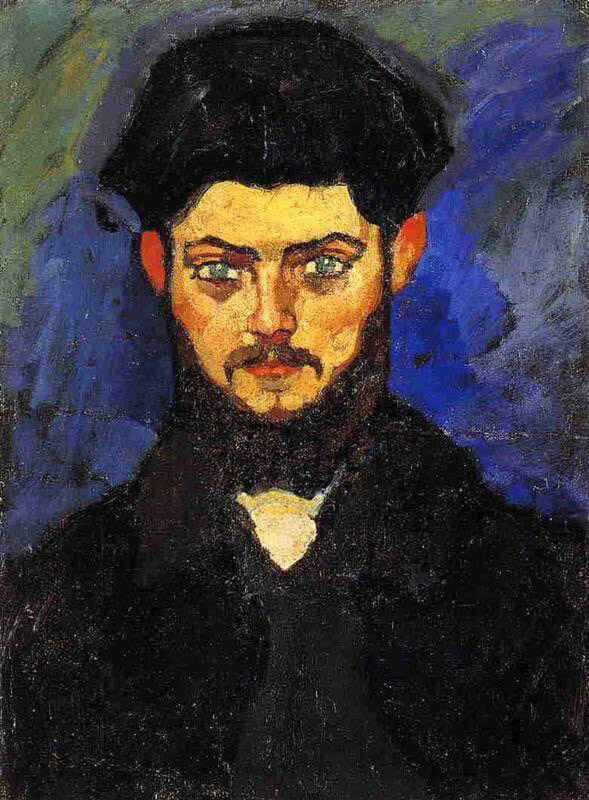
Identification
- Title
- English: Maurice Drouard - Portrait of a man.
French: Portrait du sculpteur Drouard. - Date
- 1909
Notes: 1909 (Christie's; Ceroni);1909–10 (Jeanne Modigliani 1958); 1908 (Lanthemann 1970); 1910 (Charpentier 1958). - Medium
- Oil on Canvas ?
Notes: Christie's: oil on canvas
MR states in the back there is a portrait of Brancusi (this investigation has never seen it and Christie's give no mention) - Dimensions
- 59 x 44 cm
Notes: 59 × 44 cm (Christie's); 61 × 46 cm (Ceroni, Patani, Parisot) - Signature
- Unsigned ?
- Present location
- Private Collection ?
Catalogue numbers
| Compiler | Number |
|---|---|
| Arthur Pfannstiel | NO |
| Joseph Lanthemann | no. 12 |
| Ambrogio Ceroni | no. 18 |
| Jeanne Modigliani | YES |
| Christian Parisot | 6/1909 |
| Osvaldo Patani | no. 22 |
| Modigliani Project | ? |
| MR | YES |
| Modigliani Initiative/ AMDC | ? |
Legal note on MR: This investigation has not had access to MR’s catalogue raisonné; all research here is based on open sources, publications and exhibitions. By no means has that catalogue been copied at any point. Modigliani Project and Modigliani Research Project are marked YES when the work is published or otherwise recorded by those projects, even if no catalogue number is assigned; otherwise the field is marked ?.
Provenance
- L. E. van Leer
- Roger Dutilleul (1922)
- Paul Alexandre Coll. Paris (1958?)
- Sale Christie's, Paris, 10 July 2020, lot 20 ("Property from the Coll. of Dr. Paul Alexandre"): Sold for €4,485,500 (Christie's)
- Private Collection?
The sequence follows the published museum, sale, and catalogue record in this investigation. Gaps and uncertain transfers are marked as such.
Selected bibliography
Book-length publications are marked with a footnote giving a full citation. Exhibition catalogues appear in both this list and the exhibition list when this investigation recorded them in both places.
- Paris, Galerie Charpentier, Cent tableaux de Modigliani, 1958, no. 12
- Jeanne Modigliani, Modigliani: Man and Myth, Orion Press, New York, 1958, pl. 25 (dated 1909-1910 and located at Alexandre Coll, Paris in 1958)1
- Ceroni, Edizioni del Milione, 1958, no. 152
- Modigliani Jeanne , Modigliani sans légende, Paris 1961, no. 253
- Lanthemann, Modigliani, catalogue raisonné: sa vie, son oeuvre, son art, G. Condal, Barcelona, 1970 - no. 124
- Ceroni & Piccioni, Il dipinti di Modigliani, Rizzoli, Milano, 1970 - - no. 185
- Parisot, Catalogue Raisonné Modigliani, Graphis Arte, 1991 - no. 6/19096
- Patani, Catalogo Generale, Leonardo, Milano, 1991-94 - no. 227
- Alexandre, The Unknown Modigliani: Drawings from the Collection of Paul Alexandre, 1993, p. 42
- MR, L'Ange au visage grave, Musée du Luxembourg, Paris, 2002, p.110-111, no. 48
- Soto Caba, Modigliani, the timeless face, Libsa, 20079
Exhibitions
- Paris, Gallerie Charpentier, Cent Tableaux de Modigliani, 1958 - no. 9
- Paris & Milano, Modigliani: l'Ange au visage grave, Musée du Luxembourg, 2002 - no. 4
- Moscow, Meeting Modigliani, Pushkin State Museum of Fine Arts, 2007 - no. 1
Notes
Not in D'Atri papers
Probably painted in a reused canvas or cardboard?
MR states in the back there is a portrait of Brancusi (this investigation has never seen it) ?
Biographical notes on the sitter:
Henri E. Maurice Drouard (Paris 1886 - Versailles 1915)
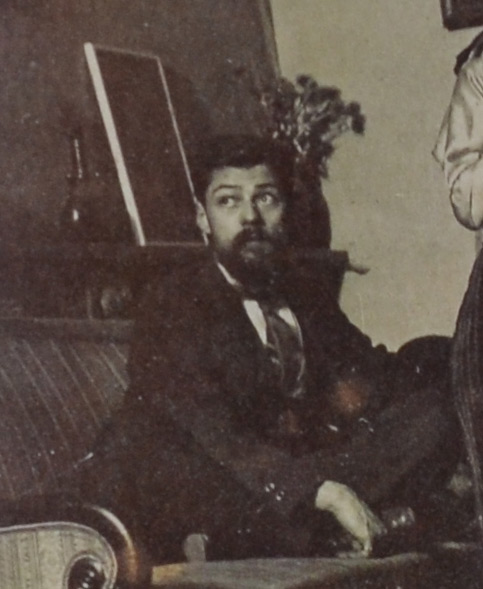
French Sculptor and Illustrator died the 29 of September 1915 in the 236 regiment d' infanterie. Lived in the 7 place du tertre and was a popular young illustrator and sculptor of Montmartre when Modigliani knew him. His Death certificate in combat and actual grave:
Where sources disagree, both readings are given. This is a working research page, not a catalogue raisonné.


Introduction
A bearded young man looks straight out of the picture with pale, wide-open eyes. His face is a block of yellow and orange, cut by a dark moustache and a short, thick beard that runs down into the black of his jacket. A great black mass crowns the head, and behind him the ground is painted in rough strokes of ultramarine and blue-green. A white triangle of shirt-front at the centre and a black tie are the only details of dress. The man is Maurice Drouard (1886–1915), a sculptor and illustrator of Montmartre who belonged to the circle of artists gathered by Paul and Jean Alexandre at 7 rue du Delta, and who was killed in the First World War.
The portrait is Ceroni no. 18 in the 1970 catalogue and no. 15 in Ceroni's first catalogue of 1958; Christie's, in 2020, cited the earlier number when it described the painting as "among the earliest works that Ambrogio Ceroni recorded in his catalogue raisonné of the artist". Ceroni's note, as transcribed, is brief: "Maurice Drouard era uno scultore amico di Modigliani e di Paul Alexandre" ("Maurice Drouard was a sculptor, a friend of Modigliani and of Paul Alexandre"). The painting is better documented than most of Modigliani's early works. It hung at the Delta, a photograph of 1913 is said to show it there, and its provenance is continuous from the 1910s to its sale in 2020. That sale is not mentioned on the Secret Modigliani page, which still gives the location as "Private Collection ?".
Composition and format
The canvas is upright and small, 59 × 44 cm according to Christie's and the Secret Modigliani page, or 61 × 46 cm according to Ceroni, Parisot and Patani. The larger figure corresponds to a standard French no. 12 paysage canvas (61 × 46 cm; my identification). The smaller figure does not correspond to a standard size. The sources do not explain the difference.
The head is set high and centrally, with the dark crown almost touching the upper edge. The bust fills the lower half and is cut by the bottom edge above the elbows. As in Le typographe (Pedro) (Ceroni no. 17), the design is a pyramid on a vertical axis. Here the axis runs from the parting of the black crown through the bridge and ridge of the nose to the moustache, the point of the beard and the white shirt-front. Christie's describes this as "the geometric treatment of his face, with its frontal perspective marked by a vertical axis", and relates it to Cézanne. The axis gives the portrait a hieratic stillness, while the broken brushwork of the ground keeps the surface in motion.
The proportions of the head are noticeably large in relation to the canvas: it occupies roughly half the height of the picture. That scale, combined with the close cropping of the shoulders, brings the sitter very near to the picture plane. The viewer meets him at close range, almost face to face.
Line and drawing
The face is drawn in dark blue and black brush lines over the flesh. A continuous contour runs from the temple down each cheek into the beard; the eyebrows are heavy curved strokes; the eyes are outlined top and bottom and the irises are filled with a pale blue-green that is the brightest note in the face. The nose is a long straight wedge, shaded on its left side; the moustache is a single dark shape that droops at both ends; the lips are a small red form beneath it.
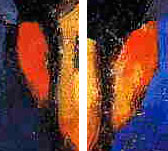
As in Pedro, the dark contours appear to have been laid over the orange of the ear at a late stage, sharpening the forms after the colour was in place. This reading is based on photographs; it has not been confirmed by a published technical examination.
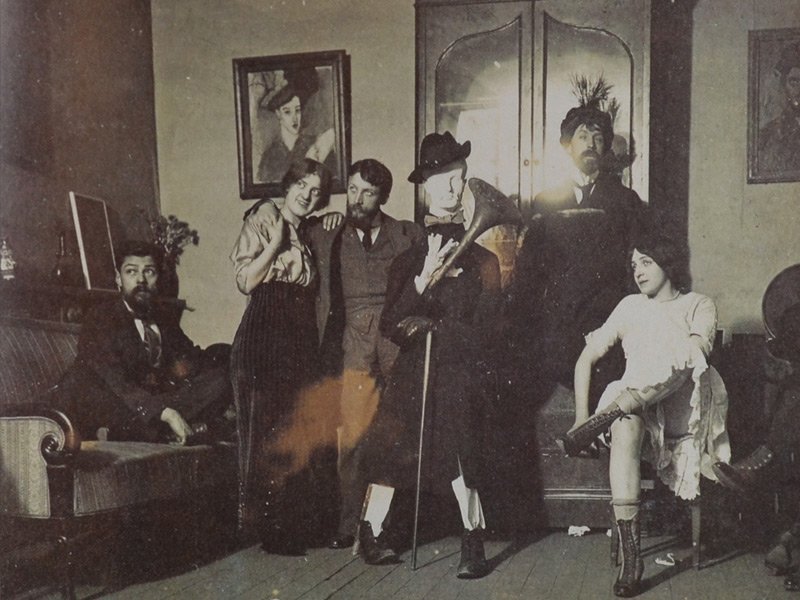
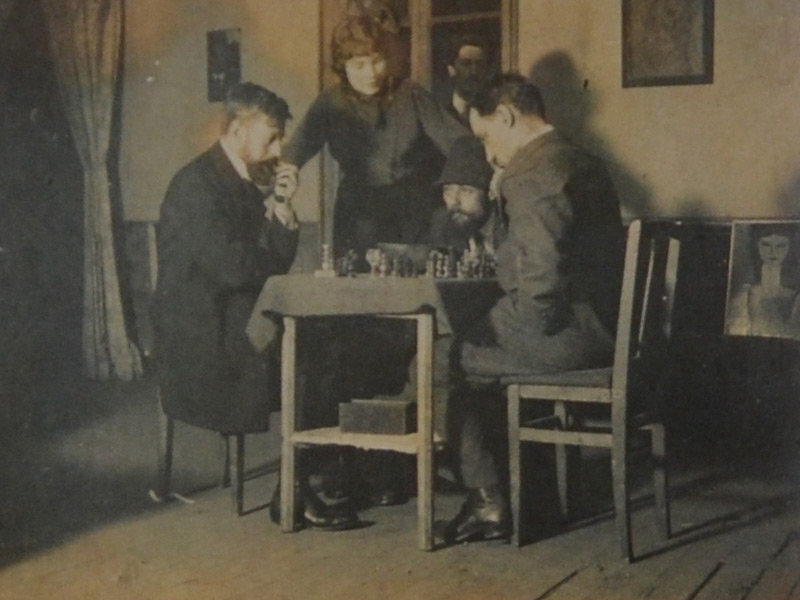
The black mass on the head is the least legible form in the picture. It may be a thick crop of hair or a soft dark hat, and the reproduction does not allow certainty. The Secret Modigliani page reproduces a 1913 photograph that, it says, shows Drouard "with a hat in the middle of a chess game"; in that photograph the bearded man at the centre wears a dark, soft cap or hat. The painting may show the same headgear, but this is a possibility rather than a demonstration.
Colour
The colour is the most striking feature of the portrait. The ground is divided between a deep, almost violet ultramarine on the right and below, and a cooler blue-green in the upper left; the strokes are broad and loose and leave the colours unblended. The face is built in yellow, orange and red ochre, with green-grey shadows at the temples and in the cheeks, and a flash of red at the lips. The pale irises pick up the green of the ground. Jacket, beard and the mass on the head are painted in a black that absorbs most of the lower half of the canvas.
Christie's described the picture as showing Modigliani embracing "the lessons of Fauvism with the use of pure, unmodulated colors, painted with a vigorous, expressionist touch", and noted that "the tones of the background evoke the untamed audacity of Matisse and the range of colors characteristic of Picasso during his Blue period". The comparison with Fauvism is apt for the ground and for the hot face. But the palette is more restricted than in Fauve portraits of 1905–06. There is no pure red or green in the flesh, and the effect depends on the contrast between a few saturated zones and a great deal of black.
Facture
The handling is quick and varied. In the ground the paint is applied in long, curving and diagonal strokes, sometimes thin enough for the weave or an underlayer to show. In the face it is more opaque, laid in small planes that follow the structure of the head: a yellow plane on the forehead, orange planes on the cheeks, a greyish plane on the side of the nose. The beard and jacket are painted more thinly and summarily, with strokes of black dragged over dark blue. Christie's speaks of "the speed of execution, the spontaneity of touch". That impression is confirmed by the reproductions, though not, so far, by any technical study.
There is no published evidence of reused canvas by the moment.
Figure, space and expression
Of the portraits of 1909, this is the one that most directly confronts the viewer. Drouard's eyes are open and fixed, his mouth closed, his head upright. The bright irises, set in an orange face against a dark beard, give him an intense, almost visionary look. Christie's called the picture "a key moment in the lives of these two artists as they scrutinized and understood one another", and this is a fair description of the mutual gaze the picture establishes.
Space is reduced to two planes. There is the figure, and behind it there is a coloured field with no indication of a room. In this the portrait is closer to Pedro than to the Alexandre portraits (Ceroni nos. 12–16), which show interiors with pictures, curtains or a crucifix. Christie's also saw in "this quasi-geometrization of the facial features" an anticipation of "the minimalist lines of Modigliani's stone sculptures, especially the caryatids produced between 1910 and 1913". The long nose and the small mouth set close beneath it do recall the heads Modigliani carved from about 1911, and the comparison has some force. It is significant that the sitter was himself a sculptor, and that Christie's places him in Antonin Mercié's workshop at the École des Beaux-Arts at the same time as Brancusi, to whom, according to Christie's 2015 essay on Jean Alexandre, Paul Alexandre introduced Modigliani in late 1908.
The sitter
Christie's gives the essential facts. Maurice Drouard (1886–1915) studied sculpture at the École des Arts Décoratifs and at the Beaux-Arts, "with Brancusi, in the workshop of Antonin Mercié". He was "famous for his many portraits and decorative medallions", played the violin, and was one of the regulars at the Delta, the house at 7 rue du Delta that the Alexandre brothers rented to artist friends from 1907. Like Henri Doucet and Gaston Coustillier, he died in the war.
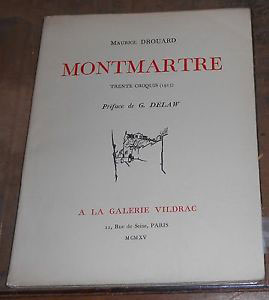
Biographical documents: his full name, given as Henri E. Maurice Drouard; his death on 29 September 1915, serving with the 236th Infantry Regiment; an address at 7 place du Tertre; a plaque in his honour in the place du Tertre; and a book of his drawings of Montmartre published as a tribute after his death by the Galerie Vildrac in Paris.
Comparisons
The nearest comparison is Le typographe (Pedro) (Ceroni no. 17), painted in the same year with the same frontal pose, central axis, blue ground and late redrawing of contours. The two pictures differ in mood: Pedro's eyes are nearly closed and his face is unreadable, whereas Drouard meets the viewer's eye. They also differ in documentation: Drouard has a known sitter and a Delta provenance, while Pedro has neither.
A second comparison is with the portraits of Paul Alexandre of 1909 (Ceroni nos. 13–15), which show the young doctor in an interior, three-quarter length, with the restrained, naturalistic colour of a commissioned likeness. Drouard, a portrait of a fellow artist, is freer in every respect. The difference suggests that Modigliani adapted his manner to the relationship. Formal and descriptive for the patron's family, he became experimental and summary for a friend.
Provenance and exhibitions
Christie's 2020 gives the provenance as follows: L. E. Van Leer, Amsterdam (after February 1913); Roger Dutilleul, Paris (acquired from the above, 1922); Dr Paul Alexandre, Paris (acquired from the above, in 1946); by descent to the 2020 owner. It adds that "the work, a symbol of the friendship between the two men, hung on the wall at the Delta colony for several years", and that Alexandre bought it back from Dutilleul after the Second World War, probably out of "nostalgia for this period of intense artistic discovery at the Delta".
The Secret Modigliani page gives the same three names, but dates Paul Alexandre's ownership to "1958?". Christie's date of 1946 is more specific and comes from the family's own sale, so it should be preferred. The site's page, accessed in October 2026, does not mention the 2020 sale.
The page reproduces a photograph "from February 1913 at the Delta studio", in which, it says, the "middle of the painting can be seen in the right wall". The photograph shows four or five people around a chess table, with framed pictures on the walls; a picture is visible at the right edge. At the resolution available it is not possible to confirm that it is the Drouard portrait. The photograph's date fits Christie's statement that Van Leer acquired the picture "after February 1913", and that statement may well be based on this photograph.
There are discrepancies in the exhibition and bibliographic data:
- Dates. The portrait has been dated 1908 (Lanthemann), 1909 (Ceroni, Parisot, Christie's), 1909–10 (Jeanne Modigliani) and 1910 (Charpentier 1958). The consensus is 1909, which agrees with the portrait's stylistic closeness to Pedro.
- Dimensions. 59 × 44 cm versus 61 × 46 cm, as noted above.
- Later exhibitions. Christie's lists the Luxembourg exhibition of 2002 as touring to the Palazzo Reale, Milan (2003), and gives the Moscow exhibition of 2007 as no. 1. It also notes that the painting was illustrated in the Tate's 2017 catalogue (p. 23, fig. 9). The painting does not appear among the exhibits listed in the Tate's large-print guide, so it appears to have been reproduced in the catalogue rather than shown.
Technical analysis
No technical study of this painting has been published, as far as the sources consulted show. The painting is not among the works discussed in the Tate Papers article on Modigliani's paintings with earlier compositions beneath the surface, or in the Burlington Magazine's introduction to the Modigliani Technical Research Study.
The Secret Modigliani page states that "MR states in the back there is a portrait of Brancusi (this investigation has never seen it) ?". "MR" refers to a catalogue raisonné project that the site says it has not consulted. Christie's, which sold the painting from the Alexandre family in 2020, catalogued it as a single-sided oil on canvas and mentioned no verso. The claim of a Brancusi portrait on the back is therefore unverified. It should be distinguished from the documented double-sided canvas in the Alexandre collection that bears the Étude pour Le Violoncelliste on one side and a study of Brancusi on the other (Ceroni nos. 22a and 22b). Christie's discussed that work in 2015, and the Tate showed it in 2017 as The Cellist (front) and Portrait of Constantin Brancusi (back).
As comparative evidence only, the Tate Papers article and Christie's 2015 essay on Jean Alexandre (Ceroni no. 16) show that Modigliani frequently reused canvases in 1908–09. They also show that hidden compositions in such works have been revealed only by X-radiography or infrared imaging. A similar examination of the Drouard portrait would be needed to settle the site's questions about the support and the verso.
Conclusion
Portrait de Maurice Drouard is a direct, intensely coloured image of a fellow artist from the Delta circle. A strict vertical axis organises it, and the face is modelled in hot ochres against a field of blue. The pale eyes give it its force. It is closely related to Le typographe (Pedro) of the same year, and it is among the clearest statements of Modigliani's absorption of Fauve colour and Cézannean structure in 1909. Unlike many early works, it has a coherent history: the Delta, Van Leer, Dutilleul and finally Paul Alexandre, whose family sold it in 2020. The discrepancies concern the Charpentier number, the dimensions and the date of Alexandre's reacquisition. They also include the unverified claim of a Brancusi on the reverse and the Secret Modigliani page's omission of the 2020 sale. None of them affects the attribution. A technical study would be welcome, both to test the site's questions about the support and to compare the painting's layer structure with that of Pedro.
Sale literature
- Christie's, Paris, 10 July 2020, lot 20, Modigliani, Portrait de Maurice Drouard: details, provenance, literature, exhibitions and lot essay, https://www.christies.com/en/lot/lot-6270027
- Christie's, "Lichtenstein fetches $46,242,500 as historic ONE sale tops $420m — setting seven artist records" (July 2020), https://www.christies.com/en/stories/one-sale-results-2020-d2bb113b29f94379886c12a336d025f3
- Christie's, New York, 14 May 2015, sale 3736, lot 3, Modigliani, Jean Alexandre (recto) / Nu assis (verso): lot essay, https://www.christies.com/en/lot/lot-5893247
Museum documentation
- Tate Modern, Modigliani (23 November 2017–2 April 2018), large-print guide, rooms 1–11 (copy at docslib), https://docslib.org/doc/1601730/modigliani-large-print-guide-room-1-11
Technical literature (comparative)
- Anaïs Genty-Vincent et al., "Works by Modigliani that have Paintings beneath the Visible Surface", Tate Papers, no. 35, https://www.tate.org.uk/research/tate-papers/35/works-by-modigliani-that-have-paintings-beneath-the-visible-surface
- Annette King, Nancy Ireson, Simonetta Fraquelli and Joyce H. Townsend, "The Modigliani Technical Research Study: An introduction to Modigliani's materials and techniques", The Burlington Magazine, vol. 160, no. 1380 (March 2018), pp. 182–88, https://www.burlington.org.uk/archive/article/the-modigliani-technical-research-study-an-introduction-to-modiglianis-materials-and-techniques
Cited but not independently consulted
Jeanne Modigliani, Modigliani: Man and Myth, New York, 1958, p. X, no. 25, pl. 25, and Modigliani sans légende, Paris, 1961, no. 25; Ceroni, Amedeo Modigliani: Peintre, Milan, 1958, p. 42, no. 15; Lanthemann 1970, p. 108, no. 12; Ceroni and Piccioni, I dipinti di Modigliani, Milan, 1970, p. 89, no. 18; Parisot 1991, vol. II, p. 266, no. 6/1909; Patani 1991, p. 54, no. 22; Noël Alexandre, Modigliani inconnu, Bruges, 1993, pp. 42, 53–54 and 59 (source of Paul Alexandre's statements as quoted by Christie's); Jeanne Modigliani, Modigliani, une biographie, Paris, 1990, p. 64; Soto Caba 2007/2008; Fraquelli and Ireson (eds.), Modigliani, Tate, 2017, p. 23, fig. 9; the catalogues of Charpentier 1958, Luxembourg/Milan 2002–03 (pp. 110–11, no. 4) and Moscow 2007 (pp. 32–33, no. 1); "MR" (catalogue raisonné project cited by Secret Modigliani for the verso claim). All are cited from Christie's.
Footnotes
- Jeanne Modigliani, Modigliani: Man and Myth, New York, Orion Press, 1958.
- Ambrogio Ceroni, Amedeo Modigliani: Peintre; suivi des souvenirs de Lunia Czechowska, Milan, Edizioni del Milione, 1958.
- Jeanne Modigliani, Modigliani sans légende, Paris, Gründ, 1961.
- Joseph Lanthemann, Modigliani, catalogue raisonné: sa vie, son œuvre, son art, Barcelona, G. Condal, 1970.
- Ambrogio Ceroni and Leone Piccioni, I dipinti di Modigliani, Milan, Rizzoli, 1970.
- Christian Parisot, Catalogue raisonné Modigliani, Livorno, Graphis Arte, 1991.
- Osvaldo Patani, Amedeo Modigliani: catalogo generale, Milan, Leonardo, 1991–94.
- MR (cited here as MR), Modigliani: l’ange au visage grave, Paris, Musée du Luxembourg, 2002. Cited from the published exhibition catalogue only.
- Victoria Soto Caba, Modigliani: The Timeless Face, Madrid, Libsa, 2007.