Study for a portrait of Constantin Brancusi (Recto The Cellist)
Oil on canvas — 1909

Identification
- Title
- English: Study for a portrait of Constantin Brancusi (recto study for the cello player).
Notes: Abbozzo per un ritratto di Constantin Brancusi (Ceroni); Portrait of Constantin Brancusi (Tate 2017–18; Garcia, Juanes and Romero 2023); Étude pour un portrait de Constantin Brancusi (Christie's 2015). - Date
- 1909
- Medium
- Oil on canvas
- Dimensions
- 73 × 60 cm
Notes: Parisot: 74× 60 cm - Signature
- unsigned (the Recto "Cellist study" is signed)
- Present location
- Abello collection, Madrid
Catalogue numbers
| Compiler | Number |
|---|---|
| Arthur Pfannstiel | NO |
| Joseph Lanthemann | NO |
| Ambrogio Ceroni | no. 22(b) |
| Jeanne Modigliani | YES |
| Christian Parisot | 8bis/1909 |
| Osvaldo Patani | no. 29 B |
| Modigliani Project | YES |
| MR | YES? |
| Modigliani Initiative/ AMDC | ? |
Legal note on MR: This investigation has not had access to MR’s catalogue raisonné; all research here is based on open sources, publications and exhibitions. By no means has that catalogue been copied at any point. Modigliani Project and Modigliani Research Project are marked YES when the work is published or otherwise recorded by those projects, even if no catalogue number is assigned; otherwise the field is marked ?.
Provenance
- Paul Alexandre Collection, Paris
- Private collection, France
- Abello collection, Madrid
The sequence follows the published museum, sale, and catalogue record in this investigation. Gaps and uncertain transfers are marked as such.
Selected bibliography
Book-length publications are marked with a footnote giving a full citation. Exhibition catalogues appear in both this list and the exhibition list when this investigation recorded them in both places.
- Roy , Modigliani, Skira, Lausanne, 1958, p. 27
- Ceroni & Piccioni, Il dipinti di Modigliani, Rizzoli, Milano, 1970 - no. 22 b1
- Mann, Modigliani, Thames and Hudson, London, 1980, p. 592
- Roy, Modigliani, Nathan, Paris, 1985, p. 30
- Castieau-Barrielle, Modigliani, Editions Graphis Arte Paris, 1988, p. 523
- Parisot, Catalogue Raisonné Modigliani, Graphis Arte, 1991 - no. 8bis/19094
- Patani, Catalogo Generale, Leonardo ed. Milano 1991-94 - no. 29 B (Recto studio Cello player 29 A)5
- Alexandre, The Unknown Modigliani: Drawings from the Collection of Paul Alexandre, 1993, p. 42
- D. Krystof, Amedeo Modigliani: The Poetry of Seeing, Taschen Cologne, 2000, p. 20
- Soto Caba, Modigliani, the timeless face, Libsa, 20076
- Madrid, Museo Thyssen-Bornemisza, Modigliani y su tiempo, 2008
- Dallas, Meadows museum, The Abelló Collection: A Modern Taste for European Masters, 2015
- Ireson, Fraquelli, Modigliani, London, Tate Modern, Skira Rizzoli, London, 2017, pp. 34-357
Exhibitions
- Madrid, Museo Thyssen-Bornemisza, Modigliani y su tiempo, 2008
- Dallas, Meadows Museum, The Abelló Collection: A Modern Taste for European Masters, 2015
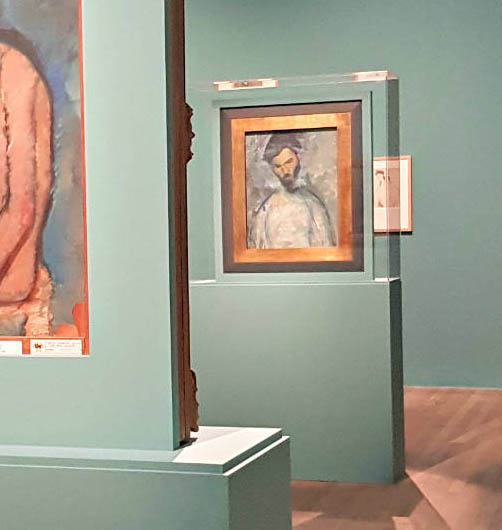
- London, Modigliani, Tate Modern, 2017-2018
Notes
As no. 5 in D' Atri files as a mention in the recto: The cello player, studio with a provenance in Alexandre. Painted both sides, in recto study for the cello player.
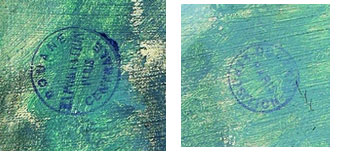
This portrait present the various stamps placed by the French export authorities used during the 30's to 50's.
First Stamp: Configuration used during the 30's - Second Stamp: Configuration used during the 40's -50's.
Painting was submited to a complete studio by Technician G. García Hernández.
Where sources disagree, both readings are given. This is a working research page, not a catalogue raisonné.

Introduction
A bearded man looks down and slightly to the left, his brows drawn together in a frown. His face is a block of yellow ochre, shadowed with green and touched with red at the lips and ear. A dark mass of hair and beard frames it. Around the head, a pale blue-white scumble spreads like a ruff or halo. Below, the torso is no more than an outline: two long blue contours for the shoulders and arms, a few strokes of green and turquoise, and in places the bare white ground of the canvas. Everything around the figure is a field of loose, sea-green brushwork.
This unfinished head is the reverse of the canvas that carries the Study for the Cello Player, and it is generally identified as a portrait of the Romanian sculptor Constantin Brancusi. Ceroni catalogued it as no. 22b, sharing a single number with the cello study (22a). As the method of this series requires, the duplicate number is flagged. This essay treats the Brancusi side on its own terms, while taking account of the technical study that examined both sides together.
The picture matters for two reasons. It is one of very few painted images of Brancusi by Modigliani, the friend who had perhaps the strongest influence on his turn to sculpture. And it is, according to the 2023 technical study, the earlier of the two paintings on the canvas, which was itself painted over an older portrait of a woman.
Composition and format
The canvas is 73 × 60 cm, a standard no. 20 figure size (my identification). The head is placed high, its crown close to the upper edge, and the bust fills the lower two-thirds of the field. The figure is almost frontal, with the head tilted down and to the viewer's left. The two contours of the shoulders descend from the base of the beard in a broad, symmetrical arch that is cut by the lower edge.
The composition is simple and centred, and nothing distracts from the head. There is no furniture, no wall, no object. The background is a field of green, turquoise and grey, worked in broad diagonal and zigzag strokes. A darker green surrounds the head on the left, and a lighter, more opaque turquoise fills the right. In this respect the Brancusi side is close to Modigliani's other portraits of 1909, such as Pedro and Maurice Drouard, which set the sitter against a coloured field. It is very different from the cello study on the other side, which places its figure in a crowded interior.
Line and drawing
The drawing is done with the brush. The face is outlined by a dark line along the jaw and cheek, merging into the beard. The brows are two heavy dark strokes that meet at the bridge of the nose. The nose is long and straight, its lower edge marked with a short dark line. The eyes are almost closed, drawn as heavy lids under the brows. The mouth is a small red shape set in the beard.
The body is drawn with long, fluid blue lines. On the left, a strong blue contour runs from the neck down over the shoulder and arm; on the right, a darker line does the same. A thinner vertical line running down from the beard to the lower edge may mark the opening of a jacket or shirt. A small patch of bright, saturated blue at the left shoulder shows the colour of the line at full strength.
The technical study adds that the underdrawing of this figure was itself made in paint. The authors found that it was "impossible to view the underlying drawing in the face area", because the drawing "was made with a cobalt blue brush, like the rest of the figure, which is not covered in paint and visible to the naked eye. The cobalt blue pigment is invisible in IR images." What the viewer sees in the torso, in other words, is the preparatory drawing itself, left uncovered.
Colour
The palette is narrow and cool. Green and turquoise dominate the ground and the torso. The blue of the contours, the dark blue-black of the hair and beard and the pale blue-white around the head complete the cool range. Against them, the face is a warm island of ochre, with an orange-red ear and red lips. The contrast concentrates attention on the head. The warm face is modelled with green in the shadows, around the eyes and beside the nose, so that the cool ground enters the flesh.
The X-ray fluorescence analysis identified the main pigments on this side. The white of the "unpainted bottom preparation area" contains lead white, zinc white and "a small amount of barite and/or lithopone". The blue of the right shoulder is cobalt blue mixed with zinc white. The green of the ground is "a green pigment based on chromium oxides with zinc white". The orange of the ear contains vermilion with a chromium yellow, or possibly chromium orange tinted with vermilion, together with iron, which points to earth pigments. The black could not be identified beyond being compatible with organic or bone black. In their summary table, the authors add ochre (iron-oxide earth) and red earth to the Brancusi palette, and they note differences from the cello side in the yellows, greens and reds. Emerald green, found on the cello side, is not listed for the Brancusi side.
The authors also observe that "the painter uses the same aquamarine green background" on both sides. This shared ground colour links the two paintings, even though their compositions are very different.
Facture
The handling is strikingly uneven, and this is the clearest sign that the picture is unfinished. The authors describe it exactly: "some areas, such as the background and the shirt, are stained with large and loose brushstrokes in a rapid zigzag pattern and only have the fine texture of this diluted brushstroke. However, the face, beard, and hair are modelled with brushstrokes that sculpt and build their features." They add that "Modigliani did not comb the paint but applied concentrated oil and spread it with a brush in different ways, depending on the area".
In reproduction the difference is obvious. The face is painted with thick, opaque paint in small planes: one for the forehead, one for each cheek, one for the side of the nose. The beard and hair are laid in with dense dark paint, and the ruff of pale blue-white around the head is scrubbed on thinly over the green. The torso, by contrast, is thin: diluted green and turquoise strokes over the white ground, which shows through in several places. The pale area around the head is hard to interpret. It may be a first layer of the background, a correction or a deliberate halo of light. The technical study's area 4, described as "violet grey background (at hairline)", lies in this zone and contained mainly zinc, with a little calcium.
Figure, space and expression
The face is serious, almost severe. The downcast eyes and the furrowed brow suggest concentration rather than melancholy, and the slight tilt of the head gives it a certain weight, as if the sitter were absorbed in thought. There is little space around the figure: the ground is flat and does not recede, and the torso, without modelling, reads as a flat shape. Only the head has volume.
That contrast between a modelled head and a flat body may be partly a matter of unfinish. But it also anticipates something Modigliani did deliberately in later years: concentrating plastic attention on the head and treating the body as a simplified support. The head of the Brancusi study already has some of the qualities of his carved heads of 1911–13, with its long nose, its simplified planes and its closed, inward expression. I make the comparison as an observation of form, not as a documented connection.
Iconography and the sitter
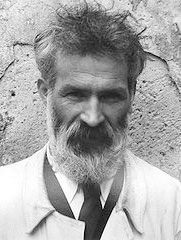
The identification of the sitter as Brancusi is accepted by every source consulted. Ceroni titled the picture "abbozzo per un ritratto di Constantin Brancusi" and added a note: "Modigliani, per suo desiderio, fu presentato dall'amico Paul Alexandre allo scultore Brancusi" ("At his own wish, Modigliani was introduced to the sculptor Brancusi by his friend Paul Alexandre"). The Secret Modigliani page reproduces a photograph of Brancusi beside the painting. In it, the full dark beard and heavy brows agree in general with the painted head, although a comparison of a photograph and a sketch is suggestive, not conclusive.
The sources disagree slightly about the date of the introduction. Christie's, in its 2015 essay on Jean Alexandre, wrote that Dr Alexandre introduced Modigliani to Brancusi "in late 1908". Christie's 1999 essay on Le violoncelliste placed it "shortly before he began work on Le violoncelliste in 1909". The Tate's 2017 guide states that "Brancusi found Modigliani a space in the Cité Falguière studios in Montparnasse and encouraged him to return to using stone". Christie's 2015 placed Modigliani's studio at 14, Cité Falguière, "where he was delighted to have as a neighbor his new friend Brancusi". The Meadows Museum press release of 2015 described Brancusi as "the artist's close friend and neighbor", who encouraged him "to investigate Cycladic sculpture".
Christie's 1999 also noted that "Brancusi was a shy man who seldom agreed to be photographed or painted", and called this "a rare portrait of Brancusi by Modigliani that remained unfinished". The 2023 article, citing the Thyssen-Bornemisza catalogue of 2008–09, says that Modigliani painted it "in the studio of a Romanian sculptor from whom he learned 'the primitivity of his work,' but which he never completed".
The picture is, then, a portrait of a sculptor by a painter who wanted to be a sculptor. It shows a man whom Modigliani admired, painted at the moment when he was moving from painting towards carving.
Comparisons
With the cello study on the other side. Both are bearded, dark-haired men with bowed heads, painted on the same aquamarine ground. Christie's 1999 reported the suggestion that the cellist might also be Brancusi, and rejected it as "insubstantial". Comparing the two sides supports Christie's view. The cellist has a narrow face in strict profile and a slight body. The Brancusi head is broad and frontal, with heavier features.
With the portraits of 1909. The Brancusi study is a head-and-shoulders portrait against a coloured field, like Pedro, Maurice Drouard and Jean Alexandre. Its facial planes, built in separate patches of ochre, green and orange, recall the Cézannian construction of The Beggar of Livorno (Ceroni no. 24), painted the same summer.
With Modigliani's sculpture. The simplified planes of the face, the long nose and the downcast eyes anticipate the stone heads. The Tate's guide placed this canvas in a room with the early portraits and stressed Brancusi's "clean, geometric style" and its "profound influence" on Modigliani. This is a comparison of style. No source consulted links this painted head to a specific carving.
Provenance, exhibitions and discrepancies
The provenance is that of the shared canvas: Paul Alexandre, Paris; a private collection, France; the Abelló collection, Madrid. Christie's 2015 captioned it "Formerly in the collection of Dr. Paul Alexandre, Paris; Private collection". The Secret Modigliani page lists three exhibitions: Madrid, Thyssen-Bornemisza, 2008; Dallas, Meadows Museum, 2015; London, Tate Modern, 2017–18. The page does not list the 1910 Salon des Indépendants, and there is no reason to think the Brancusi side was shown there.
Discrepancies to flag:
- Recto and verso. Ceroni's transcribed caption calls this side "(recto 22a)", while his caption for the cello study calls that side "(verso)". The Tate ("The Cellist (front) / Portrait of Constantin Brancusi (back)"), the Meadows Museum and the 2023 study treat the cello study as the front. The X-ray evidence suggests that the Brancusi head was painted first. That may be why Ceroni's captions read as they do, but they conflict with the canvas as it is now shown.
- When it entered the literature. Christie's 2015 stated that "Ambrogio Ceroni included the Brancusi portrait only in the final version of his Modigliani catalogue, published posthumously in 1972". Its absence from Pfannstiel and Lanthemann, as reported by Secret Modigliani, is consistent with a late appearance. But the page's bibliography begins with Claude Roy, 1958, p. 27. I have not been able to check whether Roy reproduced the Brancusi side or only discussed it.
- Signature. The page gives the work as unsigned. The signature on the canvas, lower right on the cello side, belongs to the cello study.
- Export stamps. Two round stamps are visible in the upper corners of the Secret Modigliani image of this side. The page identifies them as French export stamps of the 1930s and of the 1940s–50s. I have not been able to verify that account.
Technical analysis
This side of the canvas was examined in 2016 together with the cello study, and the results were published by Garcia, Juanes and Romero in 2023. Their methods were non-invasive: raking-light and macro photography, ultraviolet fluorescence, infrared reflectography, X-radiography and portable EDXRF. No samples were taken.
An earlier painting. The most important finding concerns this side. In the radiograph, "a portrait of a woman with long hair can be seen in the foreground, occupying the whole pictorial surface", and the authors date it, on stylistic grounds, to about 1906–07. They compare it with Ceroni nos. 1, 2 and 5, small heads of women of those years. Modigliani, they suggest, covered the old portrait "with a dense white layer of preparation before painting the Portrait of Brancusi", applying the lead white in "wide horizontal brush strokes". Then, "unsatisfied, he unpinned the canvas from the stretcher, turned it over to its reverse side, covered it with a layer of white preparation, and painted The cellist". The support "was used three times". The authors' reconstruction of the female head is labelled "hypothetical".
Ground and preparation. EDXRF of the bare ground at the bottom showed lead white, zinc white and a little barium, read as barite and/or lithopone. UV fluorescence "distinguishes the white zinc pigment from the white base of the preparation". The authors identify this white layer as a preparation applied by the artist over earlier work, not a commercial priming. That differs from the general finding of King, Ireson, Fraquelli and Townsend (2018) that the canvases studied in the Tate programme "seem to have been commercially prepared with an oil-based priming", a point that applies to other works and is cited here only for comparison.
Underdrawing. No graphite drawing was found on this side. The drawing was done in cobalt blue paint, which does not show in infrared, and it remains visible in the unfinished torso.
Pigments. The pigments are summarised under "Colour" above. The authors write in terms of probability ("suggesting", "compatible with", question marks for chrome yellow and chrome orange), and those qualifications should be kept. EDXRF detects elements, not compounds.
Comparative context. Tate Papers no. 35 (Genty-Vincent et al.) shows that Modigliani often painted over earlier compositions. It does not discuss this canvas. The finding of a woman's portrait under the Brancusi head fits that wider pattern, but its specific interpretation rests on the 2023 article alone.
Conclusion
The Study for a Portrait of Constantin Brancusi is a sketch, and it should be judged as one. Its interest lies in its contrasts. The head is modelled with dense, sculptural brushwork, while the body is left as a blue outline over bare ground. The sitter is a sculptor painted by a painter on the verge of becoming a sculptor. And the canvas, it now appears, had already served for a woman's portrait before it carried Brancusi's head and, on the other side, the study for the Cellist.
The documentation is good but not seamless. Ceroni shares a single number between the two faces and contradicts the present display in his recto and verso captions. The sources differ on when the picture entered the literature and on the date of the introduction to Brancusi, and the story of the export stamps is unverified. The technical study gives the clearest evidence about the work, and its findings should be cited with the caution its authors use. What can be said with confidence is that Modigliani began a portrait of Brancusi in 1909, abandoned it, and turned the canvas to paint the musician who was his neighbour at the Cité Falguière.
Technical literature
- Greta Garcia, David Juanes and Rafael Romero, "Image Study and Material Characterization of the Two-Sided Painting The Cellist and Portrait of Brancusi by Amedeo Modigliani", International Journal of Conservation Science, vol. 14, no. 3 (2023), pp. 1233–48, DOI 10.36868/IJCS.2023.03.30, https://doi.org/10.36868/ijcs.2023.03.30
- Anaïs Genty-Vincent et al., "Works by Modigliani that have Paintings beneath the Visible Surface", Tate Papers, no. 35 (comparative), https://www.tate.org.uk/research/tate-papers/35/works-by-modigliani-that-have-paintings-beneath-the-visible-surface
- Annette King, Nancy Ireson, Simonetta Fraquelli and Joyce H. Townsend, "The Modigliani Technical Research Study: An introduction to Modigliani's materials and techniques", The Burlington Magazine, vol. 160, no. 1380 (March 2018), pp. 182–88 (comparative), https://www.burlington.org.uk/archive/article/the-modigliani-technical-research-study-an-introduction-to-modiglianis-materials-and-techniques
Sale literature
- Christie's, New York, 14 May 2015, sale 3736, lot 3, Modigliani, Jean Alexandre (recto) / Nu assis (verso): lot essay and comparative captions, https://www.christies.com/en/lot/lot-5893247
- Christie's, London, 20th Century Art (sale 6146), 30 June 1999, lot 506, Modigliani, Le violoncelliste: lot essay, https://www.christies.com/en/lot/lot-1478448
Museum documentation
- Tate Modern, Modigliani (23 November 2017–2 April 2018), large-print guide, rooms 1–11 (copy at docslib), https://docslib.org/doc/1601730/modigliani-large-print-guide-room-1-11
- Southern Methodist University, "Meadows Museum to present first exhibition in U.S. of paintings from Juan Abelló Collection", press release, 14 April 2015, https://www.smu.edu/news/archives/2015/meadows-museum-abello-exhibit-14april2015
Cited but not independently consulted
Claude Roy, Modigliani, 1958, p. 27, and 1985, p. 30; Mann 1980, p. 59; Castieau-Barrielle 1988, p. 52; Noël Alexandre, Modigliani inconnu, 1993, p. 42; Krystof 2000, p. 20; Soto Caba 2007; Ceroni, Tout l'oeuvre peint de Modigliani, 1972; Parisot, no. 8bis/1909; Patani, no. 29B; J. A. Manzanares López, "Biografía", in Modigliani y su tiempo, Museo Thyssen-Bornemisza, 2008–09 (quoted in the 2023 article); the Meadows Museum catalogue, 2015; Ireson and Fraquelli (eds.), Modigliani, Tate, 2017, pp. 34–35. All are cited from the Secret Modigliani page on the work, Christie's or Garcia, Juanes and Romero 2023.
Footnotes
- Ambrogio Ceroni and Leone Piccioni, I dipinti di Modigliani, Milan, Rizzoli, 1970.
- Carol Mann, Modigliani, London, Thames and Hudson, 1980.
- Thérèse Castieau-Barrielle, La vie et l’œuvre de Amedeo Modigliani, Paris, ACR, 1987.
- Christian Parisot, Catalogue raisonné Modigliani, Livorno, Graphis Arte, 1991.
- Osvaldo Patani, Amedeo Modigliani: catalogo generale, Milan, Leonardo, 1991–94.
- Victoria Soto Caba, Modigliani: The Timeless Face, Madrid, Libsa, 2007.
- Nancy Ireson and Simonetta Fraquelli, Modigliani, London, Tate Modern / Skira Rizzoli, 2017.