The Cello Player
Oil on canvas — 1909
Identification
- Title
- English: The Cello Player - The Cellist.
French: Le Violoncelliste.
Italian: Le Violonchelo.
Notes: Il suonatore di violoncello (Ceroni); Le joueur de violoncelle (Salon des Indépendants, 1910); Le violoncelliste (Christie's 1999); The Cello Player, The Cellist (Others) - Date
- 1909
- Medium
- Oil on canvas
- Dimensions
- 131 × 81 cm (Christie's 1999 - D'Atri papers)
Notes: 130 × 81 cm (Ceroni, Parisot, Patani and R) - Signature
- Signed "modigliani" lower right
- Present location
- Private Collection ?
Catalogue numbers
| Compiler | Number |
|---|---|
| Arthur Pfannstiel | no. 15 |
| Joseph Lanthemann | no. 36 |
| Ambrogio Ceroni | no. 23 |
| Jeanne Modigliani | YES |
| Christian Parisot | 9 /1909 |
| Osvaldo Patani | no. 32 |
| Modigliani Project | YES |
| MR | YES |
| Modigliani Initiative/ AMDC | ? |
Legal note on MR: This investigation has not had access to MR’s catalogue raisonné; all research here is based on open sources, publications and exhibitions. By no means has that catalogue been copied at any point. Modigliani Project and Modigliani Research Project are marked YES when the work is published or otherwise recorded by those projects, even if no catalogue number is assigned; otherwise the field is marked ?.
Provenance
- Paul Alexandre Collection, Paris
- Galerie Jan Krugier, Genève
- Galerie Jean-Francois Gobbi, Paris
- Christie's, London, 20th Century Art (sale 6146), 30 June 1999, lot 506; estimate £1,200,000–1,800,000; price realised £826,500.
- Private collection ?
The sequence follows the published museum, sale, and catalogue record in this investigation. Gaps and uncertain transfers are marked as such.
Selected bibliography
Book-length publications are marked with a footnote giving a full citation. Exhibition catalogues appear in both this list and the exhibition list when this investigation recorded them in both places.
- Waldemar, "trente ans d'art independant", l' amour de l'art, 1926 p. 91.
- Pfannstiel, "catalogue présumé" Modigliani. L'Art et la Vie. Preface de Louis Latourrettes, Seheur, Paris, 1929, p. 3 no. 61
- Jeanne Modigliani, Modigliani: Man and Myth, Orion Press, New York, 1958, pl. 23 (dated 1909 and located at the Paul Alexandre Coll. Paris in 1958)2
- Scheiwiller-Arche, 1958, p. 24
- Pfannstiel, Modigliani et son oeuvre, étude critique et catalogue raisonne, Bibliothèque des Arts, Paris, 1956 - no. 153
- Roy , Modigliani, Skira, Lausanne, 1958, p. 28
- Ceroni, Amedeo Modigliani: Peintre; Suivi des Souvenirs de Lunia Czechowska, Edizioni del Milione, 1958 - no. 194
- Jeanne Modigliani, Modigliani sans légende 1961- no. 235
- Csorba Geza, Small book of art series, Czechoslovakia, 1969, no. 8
- Lanthemann, Modigliani, catalogue raisonné: sa vie, son oeuvre, son art, G. Condal, Barcelona, 1970 - no. 366
- Ceroni & Piccioni, Il dipinti di Modigliani, Rizzoli, Milano, 1970 - no. 237
- Jeanne Modigliani, Racconta Modigliani, E. G. Arte, 1984, p. 70
- Cat. national museum of art, Tokyo, 1985, no. 10
- C. Roy Modigliani, Paris, 1985, p. 24
- Castieau-Barrielle, Modigliani, ACR, 1987, p. 498
- Royal Academy of Arts, Italian Art in the 20th Century: painting and Sculpture, 1900-1988, Prestel, London, 1989, p. 136
- Parisot, Catalogue Raisonné Modigliani, Graphis Arte, 1991 - no. 9/19099
- Patani, Catalogo Generale, Leonardo, Milano, 1991-94 - no. 3210
- Schmalenbach, Amedeo Modigliani, Prestel Verlag, 1990-91 p.62 - no. 1411
- Zürich, Kunstshaus, Amedeo Modigliani. Malerei, Skulpturen, 1991, no. 6
- Patani, Catalogo Generale, Leonardo ed. Milano 1991-9410
- Alexandre, The Unknown Modigliani: Drawings from the Collection of Paul Alexandre, 1993, p. 64
- MR, L'Ange au visage grave, Musée du Luxembourg, Paris, 2002, p.124-125, no. 1012
- Soto Caba, Modigliani, the timeless face, Libsa, 200713
Exhibitions
- Paris, 26e Exposition, Société des Artistes Indépendants, Cours-la-Reine, 1910 - no. 3686
- Paris, Trente ans d'Art Indépendant, Grand Palais des Champs-Elysées, 1884-1914, 1926 - no. 3098
- Czechoslovakia, Modigliani, 1969
- Liege, Modigliani exhibition. Musée Saint Georges, 1980
- Tokyo, Modigliani exhibition, National Museum, 1985 - no. 10
- Nagoya, Modigliani exhibition, Aichi Prefectural Art Gallery, 1985
- London, Italian Art in the 20th Century: painting and Sculpture, 1900-1988, Royal Academy of Arts, 1989 - no. 60
- Düsseldorf, Kunstsammlung Nordrheim-Westfalen, Amedeo Modigliani, 1991 - no. 6
- Zürich, Kunsthaus, Amedeo Modigliani, 1991 - no. 6
- Paris, Modigliani: l'Ange au visage grave, Musée du Luxembourg, 2002 - no. 10
- Milano, Modigliani: l'ange au visage grave, Palazzo Reale, 2003 - no. 9
Notes
As no. 261 in D'Atri papers as The Cello player - 130 × 80 - dated 1909 - Alexandre Coll. - There are 2 versions and multiple drawings.
Where sources disagree, both readings are given. This is a working research page, not a catalogue raisonné.


Introduction
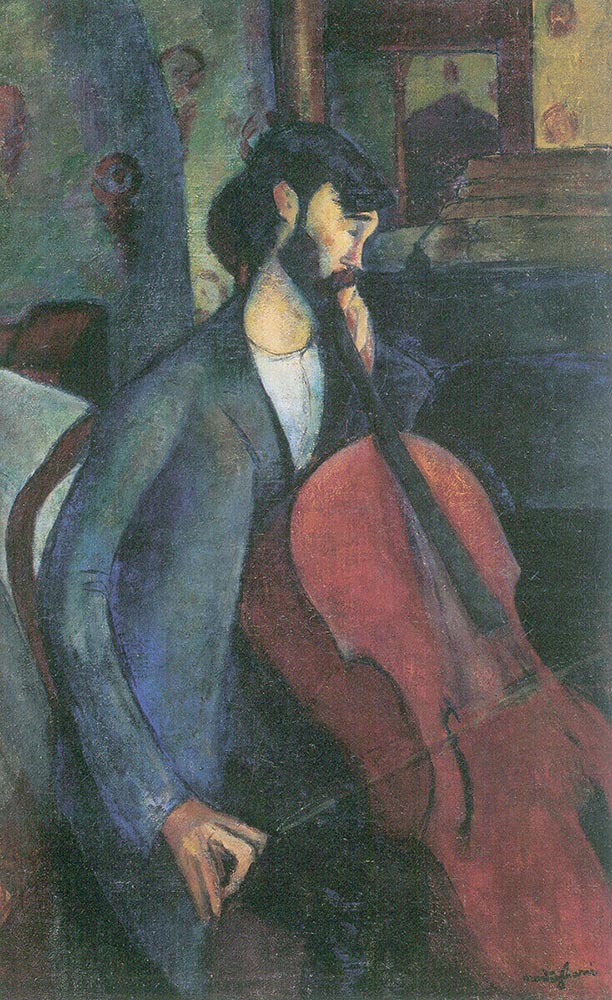
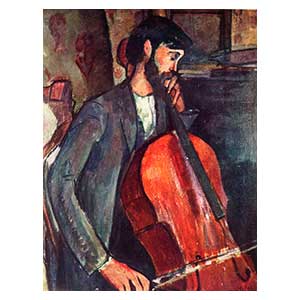
A young bearded man sits with his eyes closed and his head bent towards the neck of his cello. His long body is wrapped in a blue-grey jacket that falls open over a white shirt. His left hand is raised to the fingerboard below his chin, and his right hand, at the bottom left of the canvas, holds the bow, a thin line that crosses the strings. The instrument, a deep, muted red, fills the lower right. Behind him are a patterned green-brown wall, the back of a red chair, a white form at the left edge and, at the top right, a framed rectangle and a strip of yellow above a dark horizontal ledge.
This is Le Violoncelliste, Ceroni no. 23, the culmination of Modigliani's first Paris years and the most ambitious painting he had yet made. It was shown at the Salon des Indépendants in 1910 as Le joueur de violoncelle, and Christie's reported that Paul Alexandre called it "better than Cézanne". It is preceded by an oil study, Ceroni no. 22a, which survives on the front of a two-sided canvas in the Abelló collection, Madrid. This essay considers the finished picture, compares it closely with the study, and sets out what is known and not known about its history.
Composition and format
At 131 × 81 cm (or 130 × 81 cm), the canvas is exceptionally large for Modigliani at this date, and exceptionally narrow. Its proportions match a standard no. 60 marine canvas used upright (my identification). King, Ireson, Fraquelli and Townsend noted in 2018 that Modigliani often used landscape and marine formats in a vertical orientation, and this canvas appears to be an example, though their study does not discuss it.
The format determines the composition. In the study (73 × 60 cm, a squarer field), the figure is compact and the cello's body takes up nearly half the canvas. Here the figure is stretched to fill the height. The head is near the top, the right hand near the bottom, and between them runs a long, uninterrupted sweep of jacket. The cello is cut by the right edge, as in the study, but its body is narrower and its neck longer. The chair and the white form at the left are pushed into a thin vertical strip.
The background is organised, as in the study, as a grid of rectangles behind the curved figure. A patterned wall fills the upper left. A vertical band rises behind the head. At the top right there is a framed rectangle with a dark shape inside it, which may be a picture or a mirror, and beside it a yellow patch with red motifs. Below these a dark horizontal ledge crosses the right half of the canvas. These verticals and horizontals give the composition its stability and set off the long diagonal of the figure.
Line and drawing
Line in the finished picture is more controlled than in the study. The contour of the jacket is a long, continuous dark line that runs from the shoulder down to the cuff. The profile is drawn with a single fine line from the forehead to the nose, and the closed eye is a narrow arc. Christie's 1999 picked out the most striking passage: "The smooth-curved and seemingly boneless right arm of the cellist, which loops through the left of the picture and leads to the figure's stick-like fingers". The arm is indeed one long curve, without an elbow, and the hand at the bottom is a cluster of thin, angular fingers.
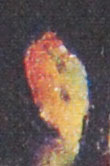
The Secret Modigliani page reproduces a detail of the ear, "where the drawing is clearly visible and is painted over the color (on top of the color)". In other words, at least some of the drawing was done last, as a dark line on top of the paint, not as an underdrawing. In the study, the 2023 technical study found a graphite underdrawing that does not match the final forms. In the finished picture, the evidence offered (a surface observation from a photograph) concerns the final linear accents. The two observations are compatible. Modigliani seems to have drawn at the beginning and redrawn at the end.
Colour
The colour is lower in key and more unified than in the study. The cello is a deep, slightly brownish red, with paler highlights on the upper bout and darker shadows below. The jacket is a blue-grey modelled with green and violet. The wall is a dark green-brown with dull red motifs. The face and throat are pale, almost luminous, with yellow light on the throat and cheek against the near-black of the hair and beard.
Some caution is needed. The Secret Modigliani image is a reproduction from a printed source, and the colour of a reproduction is never reliable. The study, too, looked brown in photographs of about 1950 and about 1980 and became much greener after cleaning, as the page on the study shows. I have found no information on the condition or cleaning history of the finished picture, so it is impossible to say how far its sombre colour reflects Modigliani's intention and how far an old varnish.
Allowing for this, the finished picture is quieter in colour than the study. The red of the cello is deeper, the green of the wall darker, and the face paler. The white of the shirt and of the form at the left gives two points of high value. Christie's 1999 noted "the delicate colouring of the work throughout". Compared with the study, the effect is quieter, closer to the tonal harmonies of Cézanne than to the bright contrasts of the study.
Facture
The surface, as far as a reproduction shows, is more evenly worked than in the study. The jacket is built of long, overlapping strokes that follow its folds. The cello is painted in smooth vertical strokes, with the f-hole and the strings drawn in dark paint on top. The wall is brushed more loosely, and its motifs are blotted on. The face is the most refined passage: the planes of the forehead, cheek and nose are blended, and the dark accents of brow, eye and nostril are placed with precision.
Christie's 1999 described the forms as "smooth rounded and somewhat exaggerated", and spoke of "the smoothing of the cellist's features to the point of almost linear clarity". That smoothness distinguishes the finished picture from the study, where the face is built of separate touches of "unique density", in the words of the 2023 technical study of the study.
Figure, space and expression
The cellist is an image of absorption. His eyes are closed, his head bowed and his body wrapped around the instrument. The elongation that Modigliani introduced between study and final version strengthens the effect. The long neck rises from the open collar like a stem, and the head bends forward at its top. The long arm curves down to the bow. The figure becomes a single line of attention running from the head to the hand.
Christie's 1999 related this elongation to Brancusi, whose influence, it argued, "can be most clearly witnessed in the smooth rounded and somewhat exaggerated forms of the cellist's features and in the carefully orchestrated spatial depth of the composition". It wrote that the painting shows "the first signs of Modigliani's elegant elongation as a means of conveying spatial and pictorial harmony", and that "the elongation of the cellist's head" resembles "that of his later stone sculptures". These are interpretations, but they fit what can be seen.
The space is shallow but more articulated than in most of Modigliani's portraits of 1909. The figure sits close to the picture plane; the chair and the white form are just behind and to the left; the wall, the frame and the ledge are a little further back. The cramped interior seen in the study, which the 2023 article described through a quoted account as a room barely large enough for "the bed, fireplace and the cello", survives here in a more ordered form.
The sitter
The cellist is not named in any source consulted. Ceroni's note on the study says he "probably lived at the Cité Falguière, not far from Modigliani's studio". Christie's 1999 reported, and rejected, the suggestion that he might be Brancusi, who was "a keen violinist and played regularly with ... Henri 'Le Douanier' Rousseau". "The grounds for this identification is, however, insubstantial," Christie's concluded. "Despite the facial resemblance, the slender body and elongated forms of the figure in the painting are inconsistent with Brancusi's more robust figure." I see no reason to disagree. The elongated figure here is, if anything, further from Brancusi's build than the figure in the study.
Comparison with the study (Ceroni no. 22a)
The study and the final painting share the main elements of the composition: the profile to the right, the closed eyes, the left hand at the fingerboard, the right hand with the bow at the bottom, the chair and the white form at the left, the patterned wall, the framed rectangle and the ledge at the right. Modigliani clearly worked from the study, or from the same arrangement of the room, when he painted the final version.
The differences are of three kinds.
- Proportion. Every part of the figure is lengthened in the final version: the neck, the face, the torso, the arm and the fingers. The cello is narrower. The format itself is taller in relation to its width.
- Colour. The study, in its cleaned state, is bright, with a hot orange-red cello and a vivid green wall. The final version is darker and more muted.
- Handling. The study is rough and quick. The final version is smoother, with more blended modelling and more deliberate line.
The Secret Modigliani page notes that "There are 2 versions and multiple drawings". The 2023 technical study reproduces two drawings in the Paul Alexandre collection, in grease pencil and watercolour, as preparatory to The Cellist. The painting was therefore prepared in several stages, which is unusual for Modigliani's portraits and shows how much importance he attached to it.
Comparisons with Cézanne and with the paintings of 1909
Christie's 1999 called the picture "the culmination of a period in Modigliani's art that was characterised by the influence of Cézanne", in which Modigliani "incorporates the lessons that he has learned from Cézanne and ultimately transcends them". Paul Alexandre's verdict, "better than Cézanne", is quoted by Christie's without a source, and I have not checked it against the published Alexandre memoirs. The Tate's 2017 guide made the Cézanne connection for The Beggar of Livorno, painted the same summer, noting that "A Paul Cézanne exhibition that Modigliani had seen in 1907 left a lasting impression".
In the Cellist, the Cézannian element is clearest in the structure: the stable grid of the background, the constructive strokes of the jacket and the use of blue for contour and shadow. A seated figure absorbed in an activity, seen from the side and set in a corner of a room, is a Cézannian type. But no source consulted names a particular Cézanne as a model, and I do not propose one.
Among the paintings of 1909, the Cellist stands apart in its scale, its interior setting and its subject. Pedro, Maurice Drouard, The Beggar of Livorno and the Brancusi study are heads or busts against coloured grounds. The Amazone (Ceroni no. 21) is a three-quarter figure against a dark field. Only the Cellist places a full figure, engaged in an activity, in a described room.
Provenance, exhibitions and discrepancies
Christie's 1999 gives the provenance in full: "Dr. Paul Alexandre, Paris, and thence by descent to his children, Paris; Acquired from the above circa 1980 by Galerie Jean-Francois Gobbi, Paris; Acquired from the above by Galerie Jan Krugier, Geneva; Acquired from the above by the father of the present owners in 1985". The picture was then offered at Christie's, London, on 30 June 1999 (sale 6146, lot 506), with an estimate of £1,200,000–1,800,000, and realised £826,500. Its present owner is not known to me.
The Christie's exhibition history begins with the Salon des Indépendants of 1910, no. 3686, and the Salon des Indépendants' retrospective Trente ans d'Art Indépendant of 1926, no. 3098. It continues with Tokyo, 1985, no. 10; London, Royal Academy, Italian Art in the 20th Century, 1989, no. 60; and Düsseldorf and Zurich, 1991, no. 6. The Secret Modigliani page adds Czechoslovakia, 1969; Liège, 1980; Paris, Musée du Luxembourg, 2002, no. 10; and Milan, 2003, no. 9.
Discrepancies to flag:
- Dimensions. 131 × 81 cm (Christie's; Secret Modigliani) or 130 × 81 cm (Ceroni, Parisot, Patani and "R"); the D'Atri papers give 130 × 80 cm.
- The 1910 Salon. The identification of this painting with no. 3686, Le joueur de violoncelle, is secure on the title. Ceroni's note says that "L'opera, così come la precedente opera, venne esposta al Salon des Indépendants di Parigi nel 1910" ("The work, like the preceding work, was exhibited at the Salon des Indépendants in Paris in 1910"). That implies that the study was shown too, which is the basis of the uncertain identification of the study with no. 3688, "Etude".
- Literature. Christie's dates Pfannstiel's catalogue to 1929, with "the preparatory study illustrated in colour p. 17", and gives Ceroni 1958, no. 19, and Ceroni & Cachin 1972, no. 23. The Secret Modigliani page agrees on the Ceroni numbers.
Technical analysis
I have found no published technical study of the finished Violoncelliste: no radiograph, infrared image, pigment analysis or condition report. The Christie's 1999 page, as opened, includes no condition information. What can be said is therefore limited and largely comparative.
Surface evidence. The Secret Modigliani page's detail of the ear shows dark drawing lying on top of the colour. This is a visual observation from a photograph, not a laboratory finding, but it is consistent with what technical studies have found in other works: a final reinforcement of contours in dark paint.
Comparative evidence from the study. The oil study for this picture (Ceroni no. 22a) was examined in 2016, and the results were published by Garcia, Juanes and Romero in 2023. They found a graphite underdrawing that does not coincide with the painted forms. They identified zinc white, cobalt blue, a chromium-oxide green, emerald (Paris) green, red earth, an organic red lake and a purple lake used for the wallpaper flowers. They also described a light green base layer left visible in many areas, "using the verdaccio technique". These findings concern the study, not this picture. It is reasonable to expect that the final version, painted soon after with a similar palette, shares some of these materials. But that is an expectation, not evidence, and it should not be cited as a finding about this canvas.
Comparative evidence from the Tate programme. King, Ireson, Fraquelli and Townsend (2018) reported that the canvases they studied "seem to have been commercially prepared with an oil-based priming". Tate Papers no. 35 (Genty-Vincent et al.) documents Modigliani's frequent reuse of canvases. Neither discusses this painting. Whether the Violoncelliste was painted on a new canvas or a reused one is unknown. The large and unusual format would make a technical examination particularly informative.
Conclusion
Le Violoncelliste is the most ambitious painting of Modigliani's first Paris years and the clearest statement of his Cézannian phase. It is also the first picture in which the elongation that would define his mature style is used deliberately as a means of composition. Comparing it with the surviving oil study shows how that happened. Between study and final picture, Modigliani stretched the figure, lowered the key of the colour and smoothed the handling, so that the cellist's absorption in his music is carried by a single long line from the bowed head to the hand on the bow.
The documentation is better than for most early works. Christie's 1999 gives an unbroken provenance from Paul Alexandre to 1985, the 1910 Salon showing is secure, and the literature begins in the 1920s. The picture has never been the subject of a published technical study, and its present location is unknown to me. Until it is examined, the remarkable findings made on the study cannot be extended to it except as comparison.
Sale literature
- Christie's, London, 20th Century Art (sale 6146), 30 June 1999, lot 506, Modigliani, Le violoncelliste: details, provenance, literature, exhibitions, lot essay, estimate and price realised, https://www.christies.com/en/lot/lot-1478448
Technical literature
- Greta Garcia, David Juanes and Rafael Romero, "Image Study and Material Characterization of the Two-Sided Painting The Cellist and Portrait of Brancusi by Amedeo Modigliani", International Journal of Conservation Science, vol. 14, no. 3 (2023), pp. 1233–48 (on the study, Ceroni no. 22a; comparative here), https://doi.org/10.36868/ijcs.2023.03.30
- Anaïs Genty-Vincent et al., "Works by Modigliani that have Paintings beneath the Visible Surface", Tate Papers, no. 35 (comparative), https://www.tate.org.uk/research/tate-papers/35/works-by-modigliani-that-have-paintings-beneath-the-visible-surface
- Annette King, Nancy Ireson, Simonetta Fraquelli and Joyce H. Townsend, "The Modigliani Technical Research Study: An introduction to Modigliani's materials and techniques", The Burlington Magazine, vol. 160, no. 1380 (March 2018), pp. 182–88 (comparative), https://www.burlington.org.uk/archive/article/the-modigliani-technical-research-study-an-introduction-to-modiglianis-materials-and-techniques
Museum documentation
- Tate Modern, Modigliani (23 November 2017–2 April 2018), large-print guide, rooms 1–11 (label for The Beggar of Livorno, comparative), https://docslib.org/doc/1601730/modigliani-large-print-guide-room-1-11
Cited but not independently consulted
Waldemar George, "Trente ans d'art indépendant", L'Amour de l'art, March 1926, p. 91; Pfannstiel, Modigliani (1929), p. 3 and p. 17, and Modigliani et son oeuvre (1956), no. 15; Scheiwiller (ed.), Amedeo Modigliani: Selbstzeugnisse, 1958, p. 24; Jeanne Modigliani 1958 and Modigliani sans légende, 1961, no. 23; Claude Roy, Modigliani, 1958, p. 28, and 1985, p. 24; Ceroni 1958, no. 19; Ceroni 1970, no. 23; Lanthemann 1970, no. 36; Ceroni and Cachin 1972, no. 23; Liège 1980; Jeanne Modigliani, Racconta Modigliani, 1984; Tokyo 1985; Castieau-Barrielle 1987, p. 49; Royal Academy 1989, p. 136; Schmalenbach 1990, p. 62, no. 14; Parisot 1991, no. 9/1909; Patani, no. 32; Noël Alexandre, Modigliani inconnu, 1993, p. 64; Musée du Luxembourg, L'Ange au visage grave, 2002, pp. 124–25, no. 10; Milan 2003; the catalogue of the 1910 Salon des Indépendants; the D'Atri papers (no. 261); Paul Alexandre's remark "better than Cézanne" as quoted by Christie's. All are cited from Christie's or the Secret Modigliani page on the work.
Footnotes
- Arthur Pfannstiel, Modigliani. L’Art et la Vie, preface by Louis Latourette, Paris, Seheur, 1929 (presumed catalogue).
- Jeanne Modigliani, Modigliani: Man and Myth, New York, Orion Press, 1958.
- Arthur Pfannstiel, Modigliani et son œuvre, étude critique et catalogue raisonné, Paris, Bibliothèque des Arts, 1956.
- Ambrogio Ceroni, Amedeo Modigliani: Peintre; suivi des souvenirs de Lunia Czechowska, Milan, Edizioni del Milione, 1958.
- Jeanne Modigliani, Modigliani sans légende, Paris, Gründ, 1961.
- Joseph Lanthemann, Modigliani, catalogue raisonné: sa vie, son œuvre, son art, Barcelona, G. Condal, 1970.
- Ambrogio Ceroni and Leone Piccioni, I dipinti di Modigliani, Milan, Rizzoli, 1970.
- Thérèse Castieau-Barrielle, La vie et l’œuvre de Amedeo Modigliani, Paris, ACR, 1987.
- Christian Parisot, Catalogue raisonné Modigliani, Livorno, Graphis Arte, 1991.
- Osvaldo Patani, Amedeo Modigliani: catalogo generale, Milan, Leonardo, 1991–94.
- Werner Schmalenbach, Amedeo Modigliani, Munich, Prestel, 1990.
- MR (cited here as MR), Modigliani: l’ange au visage grave, Paris, Musée du Luxembourg, 2002. Cited from the published exhibition catalogue only.
- Victoria Soto Caba, Modigliani: The Timeless Face, Madrid, Libsa, 2007.