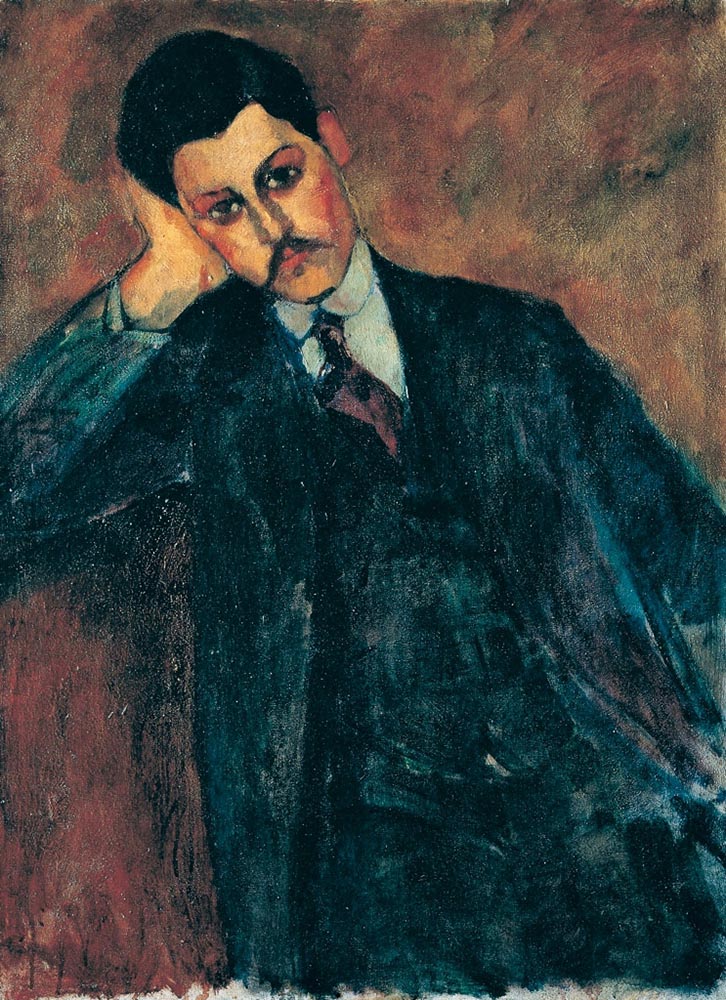
Jean Alexandre Portrait (verso Nu Assis)
Oil on canvas, painted on both sides — 1909 (recto)
Identification
- Title
- English: Jean Alexandre portrait (verso Seated Nude / Nu Assis- Ceroni and Pfannstiel never included the verso painting).
Also as: Jean Alexandre (recto), Nu assis (verso; "see note") (Christie's 2015);Portrait du frère du Dr. Alexandre (Lanthemann 1970, as cited by Christie's); Jean Alexandre (front) / Seated Nude (back) (Tate 2017) - Date
- 1909 (recto) -(Pfannstiel dates in 1908)
- Medium
- Oil on canvas, painted on both sides
- Dimensions
- 81 × 60 cm (Parisot: 74× 60 cm)
- Signature
- Unsigned
- Present location
- Private collection?
Catalogue numbers
| Compiler | Number |
|---|---|
| Arthur Pfannstiel | no. 8 |
| Joseph Lanthemann | no. 29 |
| Ambrogio Ceroni | no. 16 |
| Jeanne Modigliani | YES |
| Christian Parisot | 12 /1909 |
| Osvaldo Patani | no. 20A /20B |
| Modigliani Project | YES |
| MR | YES |
| Modigliani Initiative/ AMDC | ? |
Legal note on MR: This investigation has not had access to MR’s catalogue raisonné; all research here is based on open sources, publications and exhibitions. By no means has that catalogue been copied at any point. Modigliani Project and Modigliani Research Project are marked YES when the work is published or otherwise recorded by those projects, even if no catalogue number is assigned; otherwise the field is marked ?.
Provenance
- Jean Alexandre Collection, Paris.
- Dr. Paul Alexandre Collection, Paris (1913)
- Jeanne Bréfort, Paris (1966)
- John C. Whitehead Collection, NY (2015)
- Sold Christie's NY - Sale 3736 - Impressionist and Modern Evening Sale - 14-May-2015 Lot 3 - Sold: 7.557.000 USD
- Private collection?
The sequence follows the published museum, sale, and catalogue record in this investigation. Gaps and uncertain transfers are marked as such.
Selected bibliography
Book-length publications are marked with a footnote giving a full citation. Exhibition catalogues appear in both this list and the exhibition list when this investigation recorded them in both places.
- Pfannstiel, "catalogue présumé" Modigliani. L'Art et la Vie. Preface de Louis Latourrettes, Seheur, Paris, 1929, p. 31
- Pfannstiel, Modigliani et son oeuvre, étude critique et catalogue raisonne, Bibliothèque des Arts, Paris, 1956 - no. 82
- Ceroni, Amedeo Modigliani: Peintre; Suivi des Souvenirs de Lunia Czechowska, Edizioni del Milione, 1958 - no. 143
- Werner, Amedeo Modigliani, Garzanti, Milano 1967, p. 62
- Werner, Amedeo Modigliani, 1968, pp. 70- 71
- Lanthemann, Modigliani, catalogue raisonné: sa vie, son oeuvre, son art, G. Condal, Barcelona, 1970 - no. 294
- Ceroni & Piccioni, Il dipinti di Modigliani, Rizzoli, Milano, 1970 - no. 165
- Mann, Modigliani, Thames and Hudson, London, 1980, p. 516
- Catalogue exposition Musée de Art Moderne de la Ville de Paris, 1981, p. 102
- C. Roy Modigliani, Paris, 1985, p. 32
- Castieau-Barrielle,La vie et l'oeuvre de Amedeo Modigliani. Editions ACR Paris, 1987, page 457
- Whitehead, Montclair Art Museum,
- Late XIX and Early XX Century French Masters: the John C. Whitehead Collection, 1989
- Catalogue Exp. F. Pierre Gianadda, Martigny, 1990, page 85 - no. 9
- Parisot, Catalogue Raisonné Modigliani, Graphis Arte, 1991 - no. 12/19098
- Patani, Catalogo Generale, Leonardo ed. Milano 1991-94 - no. 20a (verso 20b)9
- Tokyo, Tobu Museum, Exposition Amedeo Modigliani au Japon, 1992-1993, no. 6 and 7 pp. 64 and 66,(recto and verso ill. in color, pp. 65 and 67)
- Osaka, Daimaru Museum, Exposition Amedeo Modigliani au Japon, 1992-1993, no. 6 and 7 pp. 64 and 66,(recto and verso ill.in color, pp. 65 and 67)
- Ibaraki, Mito, Museum Art, Exposition Amedeo Modigliani au Japon, 1992-1993, no. 6 and 7 pp. 64 and 66,(recto and verso ill. in color, pp. 65 and 67)
- Alexandre, The Unknown Modigliani: Drawings from the Collection of Paul Alexandre, 1993, p. 82-83
- Bruges, Stichting Sint-Jan, Der unbekannte Modigliani: Zeichnungen aus Sammlung Paul Alexandre, 1994, p. 82 (recto illustrated in color, p. 83)
- Geneva, Petit Palais, Musée d'art moderne, Montmartre vivant de Toulouse-Lautrec à Utrillo, 1996, p. 22
- Mexico, Museo Olmedo, Montparnasse: los contemporáneos de Diego Rivera, 1998, no. 35a and 35b pp. 105-106 and 145, (recto and verso illustrated in color, pp. 104-105 and 107)
- Monti a cura de R. Chiappini, Catalogue Amedeo Modigliani, Lugano, Skira, 1999, pp. 30-31, no. 4 (verso ill. in color, p. 30; recto illu. in color, p. 31)
- Venice, Fondazione Giorgio Cini, Modigliani e i suoi, October-December 2000, pp. 212-213, no. 140 (recto and verso illustrated in color)
- MR, L'Ange au visage grave, Musée du Luxembourg, Paris, 2002, p.114-115, no. 6 (recto illustrated in color, pp. 115-116; verso ill. in color, p. 117)10
- Rome, C. del Vittoriano, Modigliani, February-June 2006, p. 130, no. 4 (recto illustrated in color. pp. 131-132; verso in illustrated in color, p. 133)
- Meyers, Modigliani: a life, Orlando, 2006 p. 51-51
- Soto Caba, Modigliani, the timeless face, Libsa, 200711
- Pushkin Museum, Moscow, Modigliani, March-May 2007, pp. 36-37, no. 6 (recto and verso illustrated in color)
- Madrid, Museo Thyssen-Bornemisza, Modigliani y su tiempo, February-March 2008, pp. 59-50, nos. 11a and 11b (recto and verso illustrated in color)
- Nagoya City Art Museum; Himeji City Museum of Art and Iwate Museum of Art, Modigliani. A Retrospective, April-October 2008, pp. 43 and 44 (recto and verso illustrated illustrated in color, pp. 43 and 45)
- Evian, Palais Lumière, La Ruche, February-May 2009, p. 69 (recto and verso illustrated in color)
- Gallarate, Museo Arte, Il mistico profano: Omaggio a Modigliani, March-June 2010, p.128, no. 5 (recto and verso illustrated in color, pp. 30-31)
- Saint-Tropez, Musée de l'Annonciade, Amedeo Modigliani, July-October 2010, pp. 18-19 (recto and verso illustrated in color)
- Secrest, Modigliani: A life, New York, 2011 p. 125-125
- Martigny, Fondation Pierre Gianadda, Modigliani et l'Ecole de Paris, June-November 2013, p. 26 (recto and verso illustrated in color, pp. 24-25)
- Ireson, Fraquelli, Modigliani, London, Tate Modern, Skira Rizzoli, London, 2017, pp. 32-3312
Exhibitions
- Roma, Modigliani, Galleria Nazionale d'Arte Moderna, 1959 - no. 6
- Paris, Modigliani, Musée de Art Moderne de la Ville de Paris, 1981 - no. 3/3bis
- New Jersey, Montclair Art Museum,
- Late XIX and Early XX Century French Masters: the John C. Whitehead Collection, 1989
- Martigny, Modigliani, Fondation Pierre Gianadda, 1990 - no. 9
- Düsseldorf, Amedeo Modigliani: Malerei, Skulpturen, Zeichnungen, Kunstsammlung Nordrhein-Westfalen, 1991
- Zurich, Amedeo Modigliani: Malerei, Skulpturen, Zeichnungen, Kunsthaus, 1991
- Geneva, Palexpo, Modigliani, 1992
- Tokyo, Tobu Museum, Exposition Amedeo Modigliani au Japon, 1992-1993 - no. 6 and 7
- Osaka, Daimaru Museum, Exposition Amedeo Modigliani au Japon, 1992-1993 - no. 6 and 7
- Ibaraki, Mito, Museum Art, Exposition Amedeo Modigliani au Japon, 1992-1993 - no. 6 and 7
- Bruges, Stichting Sint-Jan, Der unbekannte Modigliani: Zeichnungen aus Sammlung Paul Alexandre, 1994, p. 82
- Tokyo, Fujisankei Communications Group, Modigliani, 1994
- Madrid, Museo Nacional, Centre de Arte Reina Sofia, Modigliani, 1995-1996
- Geneva, Petit Palais, Musée d'art moderne, Montmartre vivant de Toulouse-Lautrec à Utrillo, 1996, p. 22
- Rouen, Musée des Beaux-Arts, Modigliani, dessins et peintures, 1996
- Mexico, Museo Olmedo, Montparnasse: los contemporáneos de Diego Rivera, 1998 - no. 35a and 35b
- Cairo, Mohamed Mahmoud Khalil Museum, 1998
- Museo d'Arte Moderna della Città di Lugano, Amedeo Modigliani, 1999 - no. 4
- Lugano, 1999, no. 4
- Venice, Fondazione Giorgio Cini, Modigliani e i suoi, 2000 - no. 140
- Paris, Modigliani: l'Ange au visage grave, Musée du Luxembourg, 2002 - no. 6
- Milano, Modigliani: l'ange au visage grave, Palazzo Reale, 2003 - no. 5
- Rome, Complesso del Vittoriano, Modigliani, 2006 - no. 4
- Moscow, Meeting Modigliani, Pushkin State Museum of Fine Arts, 2007 - no. 6
- Madrid, Museo Thyssen-Bornemisza, Modigliani y su tiempo, 2008 - no. 11a and 11b
- Nagoya City Art Museum, Modigliani. A Retrospective, 2008, pp. 43, 44
- Himeji City Museum of Art, Modigliani. A Retrospective,2008, pp. 43, 44
- Iwate Museum of Art, Modigliani. A Retrospective, 2008, pp. 43, 44
- Evian, Palais Lumière, La Ruche, 2009, p. 69 (recto and verso illustrated in color)
- Gallarate, Museo Arte, Il mistico profano: O...(truncated in source)... He wears a dark blue-green suit, a white collar and a wine-red tie; behind him the wall glows in mottled rust and ochre. This is Jean Alexandre, Paul Alexandre's younger brother, a pharmacy student two years younger than Modigliani who, in Christie's words, became the artist's close friend and looked after him while Paul was in Vienna in 1909. Jean contracted tuberculosis in 1911 and died in June 1913, aged twenty-six (Christie's).
The canvas is painted on both sides; the D'Atri papers (no. 257), as reported by the Secret Modigliani page, already mention the nude on the back. On the reverse is a seated nude girl against a blue ground, which Christie's relates to the model of La Mendiante (Ceroni no. 20). Ceroni catalogued only the portrait. This essay concentrates on the recto, which is Ceroni no. 16, and discusses the verso as an associated but differently documented image. Unusually, the making of the portrait is documented by a series of letters from Jean to Paul, quoted in Christie's 2015 essay from Noël Alexandre's The Unknown Modigliani.Composition and format
The canvas is upright, 81 × 60 cm. This corresponds to a standard no. 25 paysage (landscape) canvas, used vertically (my identification). The Burlington Magazine's introduction to the Modigliani Technical Research Study notes that Modigliani "often" turned paysage and marine strainers on their shorter edges to use them for portraits; this painting appears to be an early example.
The figure is seen at half-length, slightly left of centre, and fills almost the whole width. The composition is organised on a strong diagonal: from the raised elbow and hand at the upper left, through the tilted head, to the sitter's left shoulder and arm at the right. The bent arm forms a triangle with the head and the support. The torso fills the lower half in a broad mass of dark blue-green. The wall behind is a warm, undifferentiated field; there is no curtain, no framed picture and no attribute other than the support for the elbow.
The narrower format and the closer framing make this the most intimate of the Alexandre portraits. Where Paul stands at three-quarter length in his own interior and the father sits formally beneath a crucifix, Jean leans towards us at close range.Line and contour
The drawing is fluid and economical. The head is a compact oval, slightly tilted, with black hair painted as a solid mass. The eyebrows are thick, the eyes dark and heavy-lidded and ringed with brown, the nose straight and the moustache a thin dark line. The hand supporting the head is drawn with a few curving strokes, the fingers bunched against the temple.
As in no. 14, the Secret Modigliani page on the work points out that at the ear the drawing "is painted over the color". The contour is a dark brushstroke laid over the flesh tone. The suit is contoured with dark blue lines along the shoulders and the bent arm, but within it the drawing dissolves into loose strokes.Colour
The palette is built on a contrast between the cool blue-green of the suit and the warm rust, ochre and red-brown of the background and the support. The face is painted in pale ochre and pink, with green-grey shadows, and the hand in warmer orange. The white collar and the burgundy tie are the only sharp accents. The blue-green of the suit is not a uniform dark: it varies from deep navy to turquoise, with lighter strokes on the raised sleeve.
The warm background is close in tone to the brown wall of no. 14, but more broken and more luminous. It surrounds the head like a halo of warm colour. Christie's calls the portrait "Cézannesque", and the construction of the jacket in patches of blue and green, and the integration of figure and ground through shared tones, recall Cézanne's portraits. This is a stylistic comparison, not a documented source; the Tate large-print guide notes the impression made on Modigliani by the 1907 Cézanne exhibition.Facture
The brushwork is loose and open. The background is laid in with short, mottled strokes of rust and ochre, through which a darker layer shows. The suit is painted in long, dragged strokes, leaving areas of thinner paint. The face is the most finished part, though even there the planes of colour remain distinct.
The letters quoted by Christie's illuminate this surface. On 26 March 1909 Jean wrote that Modigliani had nearly thrown the portrait on the fire: "I had great difficulty preventing him from chucking it on the fire. For the time being we left it as it is." On 23 April he wrote: "For the tenth time he did a sketch of me. He seems to be pleased with this one. If only he could finish it!" Finally, in late May: "I have my portrait at last, and he came to varnish it yesterday at home... I told him I was coming to pose for the last time." The visible brushwork is therefore not that of a quick sketch, but the result of a long and troubled process of repeated sittings and revisions.Figure and space
The pose, the head resting on the hand, is the traditional posture of melancholy and contemplation, from Dürer's Melencolia I to countless nineteenth-century portraits of poets and intellectuals. Whether Modigliani intended this meaning, or simply adopted a relaxed posture for a long sitting, cannot be known; the letters suggest a friend posing patiently rather than an allegory. But the effect is one of introspection and fatigue: the shadowed eyes, the tilt of the head and the slumped weight on the elbow give the portrait an emotional register quite different from the composure of the father or the assurance of Paul. Knowing that Jean died four years later of tuberculosis inevitably colours our reading, but this is retrospective; nothing in the documents suggests that the illness was apparent in 1909.
Space is almost eliminated. The figure is pressed against the picture plane, the elbow support is close to the left edge, and the background is a flat field of colour with no indication of depth.The verso: Nu assis
The reverse shows a thin, seated girl, nude, against a blue ground. She sits on a pale drapery, her head tilted, long dark hair falling behind her shoulders, her hands between her knees. The body is outlined in dark blue, and the flesh is painted in pinks and warm ochre. Christie's suggests she is "probably the same pre-pubescent girl the artist depicted in La Mendiante, 1909 (Ceroni, no. 20)", and relates the figure to Picasso's Blue Period.
Christie's also states that the nude "was perhaps likewise unknown or overlooked until it was first exhibited and illustrated in the Paris retrospective catalogue of 1981", and that "since it was never included in Ceroni's catalogue it cannot be said with certainty to be by the hand of the artist". The lot title marks it "verso; see note". The journalist Judd Tully, reporting the sale, made the same point. The verso is not part of Ceroni no. 16, and its attribution must be regarded as open.Comparisons
Within the Alexandre series, the portrait of Jean is the most informal. Comparison with nos. 12, 14 and 15 shows the same dark costume against a coloured wall, the same constructed face and the same drawing over colour at the ear, but a more intimate format and pose. Christie's places the portrait alongside L'Amazone (Ceroni no. 21), on which Modigliani was working at the same time, and Le Mendiant de Livourne and La Mendiante, both owned by Jean.
The closest comparison for the double-sided canvas is the Étude pour Le Violoncelliste (Ceroni no. 22a), which carries on its reverse a portrait of Constantin Brancusi (no. 22b). Christie's makes this comparison, and the Tate large-print guide observes of that canvas that painting on both sides "suggests he had limited funds for art supplies".Provenance, exhibitions and discrepancies
Provenance is Dr Paul Alexandre, Paris (by descent, 1913); Jeanne Bréfort, Paris (by descent, by 1966); acquired from her by the present owner (John C. Whitehead) in 1990.
The work was sold at Christie's in 2015 for $7,557,000. The Tate large-print guide of 2017 lists it as a private collection.
The discrepancies are:- The verso in the early catalogues."Ceroni never included the verso painting". Christie's agrees that Ceroni did not include it.
- Sequence. The Ceroni notes, as transcribed, place Jean's portrait after those of Paul. Christie's letters show Jean's portrait in progress by March 1909 and completed by late May, while Paul was in Vienna. The portraits of Paul must then precede his departure or follow his return, and the sequence cannot be confirmed from these sources.
- *Who commissioned L'Amazone. The Tate guide says Jean commissioned it; Christie's says Paul persuaded the Baroness; the Ceroni notes call it the first portrait commissioned by Paul
Technical analysis
No technical study of this painting has been published, as far as I have been able to establish. The following points are documentary, not scientific:
- Christie's suggests that Modigliani removed the canvas with the nude from its stretcher, turned it around and painted the portrait on the unpainted side. This is an inference, not a reported examination.
- Jean's letter of late May 1909 states that Modigliani "came to varnish it yesterday at home". This is a rare piece of direct testimony that the artist varnished a portrait himself, soon after finishing it.
- The Secret Modigliani page reproduces a stamp on the verso. It attributes one stamp to the French export authorities of the 1930s, "probably" for an exhibition in Japan in 1933, and dates a second configuration to the late 1950s, for the Rome exhibition of 1959. No Japanese exhibition of 1933 appears in Christie's exhibition list, so the first association is unconfirmed. The other sources do not mention the stamps.
- The drawing at the ear lies on top of the colour.
Comparative evidence. In the portrait of the father (no. 12, 1909), Tate Papers found a reused canvas with two earlier compositions, a hand-applied lead white ground, and uneven varnish. The portrait of Jean is also on a reused support, but differently: the second painting is on the back, not underneath. Whether the recto conceals further changes, for instance the ten sketches mentioned by Jean, could be tested by X-radiography.
Conclusion
The portrait of Jean Alexandre is the most intimate and the most melancholy of Modigliani's 1909 portraits of the Alexandre family. Painted on a landscape canvas turned upright, with a seated nude of uncertain attribution on the reverse, it is documented by letters that show how hard-won its apparent ease was: the portrait nearly thrown on the fire, the ten sketches, the final sitting and the varnishing at home. Its documentation is comparatively full, thanks to Christie's 2015 catalogue.
Sale literature
- Christie's, New York, 14 May 2015, sale 3736, lot 3, Modigliani, Jean Alexandre (recto) / Nu assis (verso; see note): details, provenance, literature, exhibitions, sale room notice and lot essay, https://www.christies.com/en/lot/lot-5893247
- Christie's, press release, "Results – Impressionist & Modern Art Evening Sale including Property from the John C. Whitehead Collection", New York, 14 May 2015, https://press.christies.com/results-impressionist-modern-art-evening-sale-including-property-from-the-john-c-whitehead-collection/
- Judd Tully, "Christie's Imp/Mod Sale Brings In More Than $200 Million", https://juddtully.net/auctions/christies-impmod-sale-brings-in-more-than-200-million/
Museum documentation
- Tate Modern, Modigliani (23 November 2017–2 April 2018), large-print guide, rooms 1–11 (copy at docslib), https://docslib.org/doc/1601730/modigliani-large-print-guide-room-1-11
- LaM, Villeneuve-d'Ascq, Amedeo Modigliani: l'œil intérieur, dossier pédagogique (2016), https://www.musee-lam.fr/sites/default/files/2019-01/Dossier-pedago-Modigliani-l-oeil-interieur.pdf
Technical literature (comparative)
- Anaïs Genty-Vincent et al., "Works by Modigliani that have Paintings beneath the Visible Surface", Tate Papers, no. 35, https://www.tate.org.uk/research/tate-papers/35/works-by-modigliani-that-have-paintings-beneath-the-visible-surface
- Annette King, Nancy Ireson, Simonetta Fraquelli and Joyce H. Townsend, "The Modigliani Technical Research Study: An introduction to Modigliani's materials and techniques", The Burlington Magazine, vol. 160, no. 1380 (March 2018), pp. 182–88, https://www.burlington.org.uk/archive/article/the-modigliani-technical-research-study-an-introduction-to-modiglianis-materials-and-techniques
Cited but not independently consulted
Noël Alexandre, The Unknown Modigliani: Drawings from the Collection of Paul Alexandre, New York, 1993, pp. 54–83 (source of the letters, as quoted by Christie's); Pfannstiel 1929, p. 3, and 1956, pp. 58–59, no. 8; Ceroni 1958, p. 42, no. 14; Werner 1966, p. 70; Ceroni and Piccioni, I dipinti di Modigliani, 1970, p. 89, no. 16; Lanthemann 1970, p. 109, no. 29; Mann 1980, p. 51; Roy 1985, p. 32; Castieau-Barrielle 1987, p. 45; Parisot 1991, 12/1909, and 2012, vol. V; Patani 1991, nos. 20a–20b; Meyers, Modigliani: A Life, 2006, pp. 51–52; Meryle Secrest, Modigliani: A Life, 2011, pp. 125–126 and 168; the exhibition catalogues listed by Christie's (Rome 1959 to Pisa 2014–15). All are cited from Christie's or the Secret Modigliani page on the work.
Footnotes
- Arthur Pfannstiel, Modigliani. L’Art et la Vie, preface by Louis Latourette, Paris, Seheur, 1929 (presumed catalogue).
- Arthur Pfannstiel, Modigliani et son œuvre, étude critique et catalogue raisonné, Paris, Bibliothèque des Arts, 1956.
- Ambrogio Ceroni, Amedeo Modigliani: Peintre; suivi des souvenirs de Lunia Czechowska, Milan, Edizioni del Milione, 1958.
- Joseph Lanthemann, Modigliani, catalogue raisonné: sa vie, son œuvre, son art, Barcelona, G. Condal, 1970.
- Ambrogio Ceroni and Leone Piccioni, I dipinti di Modigliani, Milan, Rizzoli, 1970.
- Carol Mann, Modigliani, London, Thames and Hudson, 1980.
- Thérèse Castieau-Barrielle, La vie et l’œuvre de Amedeo Modigliani, Paris, ACR, 1987.
- Christian Parisot, Catalogue raisonné Modigliani, Livorno, Graphis Arte, 1991.
- Osvaldo Patani, Amedeo Modigliani: catalogo generale, Milan, Leonardo, 1991–94.
- MR (cited here as MR), Modigliani: l’ange au visage grave, Paris, Musée du Luxembourg, 2002. Cited from the published exhibition catalogue only.
- Victoria Soto Caba, Modigliani: The Timeless Face, Madrid, Libsa, 2007.
- Nancy Ireson and Simonetta Fraquelli, Modigliani, London, Tate Modern / Skira Rizzoli, 2017.