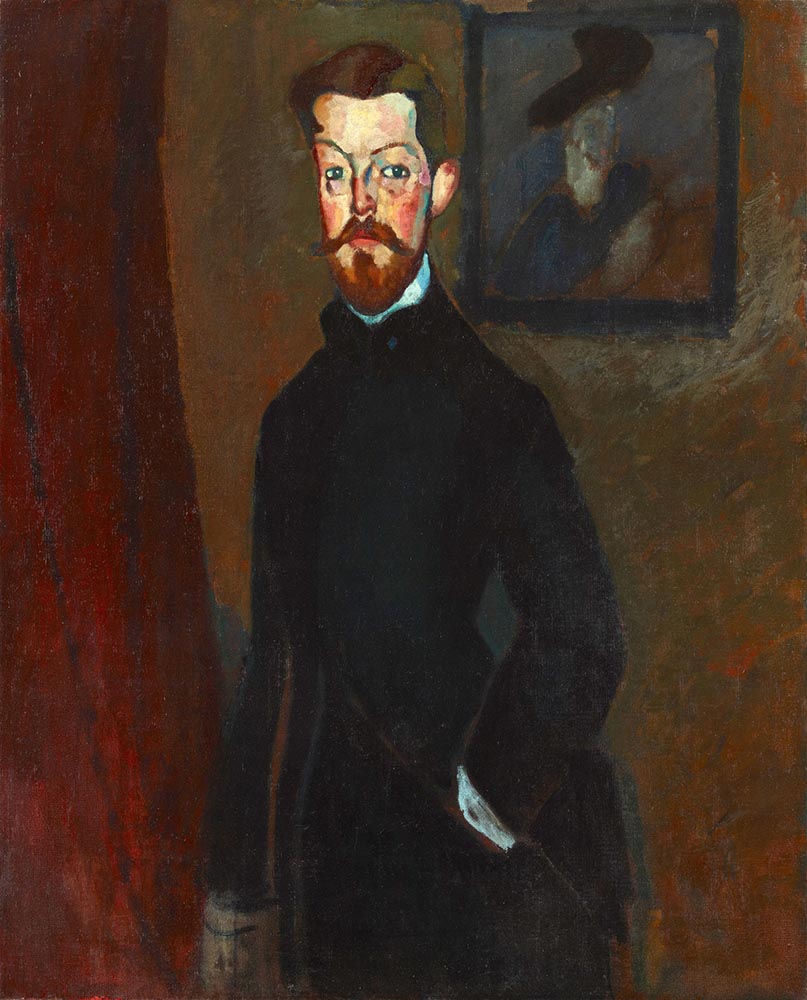
Paul Alexandre on a brown background (Unfinished?)
Oil on canvas? — 1909
Identification
- Title
- English: Paul Alexandre on brown background | (unfinished portrait).
Notes: Portrait of Dr. Paul Alexandre (Yamazaki Mazak Museum title); Portrait de Paul Alexandre (Christie's 2015); Paul Alexandre sur fond brun (D'Atri papers). - Date
- 1909
Notes: 1909 (Christie's 2015); 1908 (Pfannstiel dated the painting 1908 in his 1956 publication; Ceroni and later authors give 1909. Since Paul Alexandre met Modigliani only at the end of 1907 (Tate Papers), 1908 is not impossible, but the Ceroni sequence places the Paul portraits after the father's portrait, which is dated 1909.) - Medium
- Oil on canvas
- Dimensions
- 100 × 81 cm ?
- Signature
- Unsigned
- Present location
- Yamazaki Mazak Museum, Nagoya, Japan | (Inv. no. | FO-M0401)
Catalogue numbers
| Compiler | Number |
|---|---|
| Arthur Pfannstiel | no. 7 |
| Joseph Lanthemann | no. 24 |
| Ambrogio Ceroni | no. 14 |
| Jeanne Modigliani | YES |
| Christian Parisot | 3/1909 |
| Osvaldo Patani | no. 18 |
| Modigliani Project | YES |
| MR | YES |
| Modigliani Initiative/ AMDC | ? |
Legal note on MR: This investigation has not had access to MR’s catalogue raisonné; all research here is based on open sources, publications and exhibitions. By no means has that catalogue been copied at any point. Modigliani Project and Modigliani Research Project are marked YES when the work is published or otherwise recorded by those projects, even if no catalogue number is assigned; otherwise the field is marked ?.
Provenance
- Paul Alexandre Coll.
- Blaise Alexandre Coll. Paris (by 1963)
- Private Coll, ?
- Art Pont, Inc. Tokyo (1991)
- Yamazaki Mazak Museum (Inv. no. FO-M0401)
The sequence follows the published museum, sale, and catalogue record in this investigation. Gaps and uncertain transfers are marked as such.
Selected bibliography
Book-length publications are marked with a footnote giving a full citation. Exhibition catalogues appear in both this list and the exhibition list when this investigation recorded them in both places.
- Pfannstiel, "catalogue présumé" Modigliani. L'Art et la Vie. Preface de Louis Latourrettes, Seheur, Paris, 1929, p. 31
- Pfannstiel, Modigliani et son oeuvre, étude critique et catalogue raisonne, Bibliothèque des Arts, Paris, 1956 - no. 72
- Ceroni, Amedeo Modigliani: Peintre; Suivi des Souvenirs de Lunia Czechowska, Edizioni del Milione, 1958 - no. 123
- Scheiwiller, Arche 1958, pl. 29
- Werner, Amedeo Modigliani, New York, Abrams, 1966, p.72
- Werner, Amedeo Modigliani, New York, Abrams, 1967, p. 64
- Lanthemann, Modigliani, catalogue raisonné: sa vie, son oeuvre, son art, G. Condal, Barcelona, 1970 - no. 244
- Ceroni & Piccioni, Il dipinti di Modigliani, Rizzoli, Milano, 1970 - no. 145
- Mann, Modigliani, Thames and Hudson, London, 1980, p. 496
- Catalogue Musée Saint-Georges, 1980
- Amedeo Modigliani, Musee d’art Moderne de la Ville de Paris, Paris, 1981, p.103
- Werner, Amedeo Modigliani, Ed. Harry N. Abrams NY, 1985, p. 52-53
- Parisot, Catalogue Raisonné Modigliani, Graphis Arte, 1991 - no. 3/19097
- Patani, Catalogo Generale, Leonardo ed. Milano 1991-94 - no. 188
- R, Modigliani, 1992-93, Mainichi Shimbun, p.64
- "Corporate Art Collection Exhibition - From Monet, Renoir to Picasso" , 1997 Shinano Art Museum, Nagano Prefecture, etc.
- "15th anniversary commemorative exhibition centered on Goko Pakin of Ecole de Paris", 1998-1999 Inagawa-shi Ogusu Memorial Art Museum
- Monti a cura de R. Chiappini, Catalogue Amedeo Modigliani, Lugano, Skira, 1999, p.32 - p.183
- “Modigliani L’ange au visage grave” connaissance des ARTS 2002, p.99
- MR, L'Ange au visage grave, Musée du Luxembourg, Paris, 2002, p.92 - p.118-1199
- MR, " Un angelo di volto severo", Milano, Palazzo Reale 2003, p. 92
- Soto Caba, Modigliani, the timeless face, Libsa, 200710
- Katsunori Fukaya "Amedeo Modigliani" Exhibition 2008, Nagoya City Art Museum pp.38 - 39
Exhibitions
- Brussels, Modigliani, Palais de Beaux-Arts, 1933.
- London, Modigliani, Tate Gallery, 1963 - no. .4
- Edinbourgh, Modigliani, Arts council, 1963 - no. 4.
- Liege, Musée Sain Georges, 1980.
- Paris, Amedeo Modigliani, Musee d’art Moderne de la Ville de Paris, 1981 - no. 5.
- Tokyo, "Modigliani" Exhibition, Tobu Art Museum, 1993.
- Kyoto, "Modigliani" Exhibition, Daimaru Museum, 1993.
- Umeda, "Modigliani" Exhibition, Daimaru Museum, 1993.
- Ibaraki,"Modigliani" Exhibition, Ibaraki Prefectural Museum of Modern Art, 1993.
- Nagano, "Corporate Art Collection Exhibition - From Monet, Renoir to Picasso", Shinano Art Museum, 1997.
- Inagawa, "15th anniversary commemorative exhibition centered on Goko Pakin of Ecole de Paris", Inagawa-shi Ogusuku Memorial Art Museum, 1998.
- Lugano, "Amedeo Modegliani", Museo d'Arte Moderna, 1999 - no. 5.
- Paris, Modigliani: l'Ange au visage grave, Musée du Luxembourg, 2002.
- Milano, "Modigliani un angelo di volto severoe", Palazzo Reale Palazzo Reale, 2003.
- Tokyo, "Prestigious Art Collection Exhibition", Hotel Okura, 2007.
- Nogoya, "Amedeo Modigliani", Nagoya City Art Museum, 2008.
- Himeji, "Amedeo Modigliani", Himeji City Art Museum, 2008.
Notes
Museum record (verified): Yamazaki Mazak Museum of Art, Nagoya (inv. FO-M0401). Oil on canvas, c. 100 × 81 cm, 1909. Title: Portrait of Dr. Paul Alexandre (unfinished / brown background).
no. 255 in D'Atri papers as Paul Alexandre sur fond brun - 100 × 81 - dated 1909 - Alexandre Collection
In the back the painting "The Jewess" is visible. This is probably an unfinished painting.
Where sources disagree, both readings are given. This is a working research page, not a catalogue raisonné.

Introduction
A young man with a red-brown beard and upturned moustache stands before a brown wall, his body sheathed in a black, high-collared coat. A deep red curtain hangs at the left; at the upper right a framed picture shows a pale face beneath a broad dark hat. This is the first of the two surviving 1909 portraits of Dr Paul Alexandre, the dermatologist who, as the Tokyo Fuji Art Museum puts it, "was the first person who got interested in the work of Modigliani". Ceroni's notes, as transcribed online, describe the sequence: after the portrait of the father, Modigliani painted a study (no. 13, now lost) and two portraits of Paul, "il presente e il n°15", all three "eseguiti in casa dello stesso Paul" and all with "l'abbozzo de L'Ebrea" in the background.
No technical study has been published. This essay analyses what can be seen, compares the painting with the green-background portrait (no. 15) and the portrait of the father (no. 12), and sets out the discrepancies.
Composition and format
The canvas is upright, about 100 × 81 cm, which corresponds to a standard no. 40 figure canvas (my identification). No. 15 is the same size, as is the lost no. 13 if the dimensions on the Secret Modigliani page are right. The three portraits of Paul were therefore planned on the same format, larger than the no. 30 canvas of the father's portrait.
The sitter stands, cut at mid-thigh by the lower edge, slightly right of centre. The composition is built on a strong diagonal descent from his head, at upper centre, to his left hand in the lower right, where a white cuff marks the end of the movement. A second line runs down his right arm, hanging straight at the left, to a hand that is barely sketched at the lower edge. The coat makes a long dark column, narrower at the shoulders than at the hips, which gives the figure an elegant, slightly elongated silhouette.
The background has three elements. The red curtain fills about a quarter of the width at the left, in long vertical strokes. The brown wall fills the rest. The framed picture, at the upper right, is cut by the top edge and stops just above the sitter's shoulder line. The picture and the curtain frame the head between them, a device that recalls, in reverse, the arrangement of curtain and crucifix in the father's portrait.
Line and contour
The drawing is precise in the head and loose elsewhere. The face is a long oval, framed by the parted hair and by the pointed beard. The nose is long and straight, the eyebrows high and arched, the eyes almond-shaped with blue-grey irises. The moustache is drawn as two brisk upward curls. A dark line runs down the left side of the face, separating it from the ear and hair.
The coat is defined by a few long contours. The edges of the high collar and the line of buttoning are drawn in black over black, distinguished only by a slight change of sheen. The hands are summary: the left is tucked into the coat, with only the cuff and a few fingers visible; the right, at the lower left, is a grey-blue form outlined in a few strokes, perhaps a gloved hand, perhaps simply unfinished.
Colour
The colour is warm and restricted. The curtain is a deep crimson-red, darker in the folds and brightened by vermilion strokes. The wall is a mid-brown, warm and slightly greenish in places, applied in visible strokes over a darker layer, with lighter, almost ochre patches at the right. Against these, the black coat is the strongest value in the painting, and the face, in cream, pink and touches of green, the lightest. The red beard links the face to the curtain.
The framed picture introduces the only cool colours: a dark blue garment, a black hat, a pale face. It acts as a counterweight to the red curtain. The restriction of the palette to red, brown and black, with a single blue accent, gives the painting a sombre, almost Spanish character, comparable to the dark-toned portraits of the 1909 group.
Facture
The handling is uneven, which is why the Secret Modigliani page calls the work probably unfinished. The face is the most worked area, with distinct planes of colour; the coat is painted in broad, flat strokes; the wall and curtain are brushed loosely, with the ground visible at the edges of strokes. In the lower right, the paint is thin and the strokes are scattered, and the right hand at the lower left is hardly more than an outline.
Whether this means that the painting is unfinished or that Modigliani deliberately left the periphery sketchy cannot be decided from the image. Ceroni does not describe it as unfinished; he distinguishes it from no. 13, which he calls a study, by calling it a portrait. The Tokyo Fuji Art Museum describes its own painting (no. 15) as the one, of the three 1909 portraits, that "attained the highest degree of perfection", which implies that no. 14 was seen as less complete.
Figure and space
The sitter's pose is formal and self-aware: weight on one leg, left hand in the coat, head held high, gaze turned to the viewer. The impression is one of reserve and elegance, close to the conventions of the society portrait. Space is shallow, as in all the Alexandre portraits; the wall is immediately behind the sitter, and the curtain at the left occupies the same plane. There is no floor and no furniture.
The Ceroni notes place the portrait in Paul's own home. The framed picture would then be part of his collection, and the curtain part of his interior. The portrait would show not only the man but also his world, the young doctor among the works he bought.
Iconography: the picture within the picture
Both Ceroni and the Secret Modigliani page identify the framed picture as La Juive (Ceroni no. 9), the portrait of Maud Abrantès that, according to Christie's 2015 essay, was Modigliani's first sale in Paris, acquired by Paul Alexandre around the time of the 1908 Salon des Indépendants. The figure in the frame wears a broad dark hat and a blue garment, as in La Juive. But at the scale of the reproduction a pale passage below the face could be read as a beard or a white collar, and I cannot confirm the identification by eye. Ceroni's word "abbozzo", sketch, suggests that Modigliani only roughed in the picture.
If the identification is correct, the painting makes an emblematic statement. The patron is shown with the first work he bought from the artist, the artist's own painting hanging on the patron's wall. The Tokyo Fuji Art Museum relates the Alexandre portraits to the Renaissance tradition of patrons having their portraits painted in return for their support. In that tradition, the inclusion of the artist's own work in the portrait is a declaration of the relationship between them.
Comparisons
The obvious comparison is no. 15, in Tokyo. The two paintings share the format, the red curtain at the left, the framed picture at the upper right and the black coat. They differ in the background colour (brown against green), in the pose (left hand in the coat in no. 14, on the hip in no. 15), and in the degree of finish. In no. 15 the framed picture is reduced to a blue rectangle; in no. 14 a figure is legible. No. 14 therefore seems closer to the lost study (no. 13), in which, according to the photograph, the framed picture is a clear dark rectangle above the shoulder.
Compared with the portrait of the father (no. 12), the son's portrait is more elongated, more elegant and less frontal. The father sits; the son stands. The father's portrait has a crucifix, the son's a modern painting, a contrast between generations that may or may not be deliberate.
The face, built in planes of cream and green with strong drawing, belongs with the Cézannian experiments of 1909. The Tate large-print guide of 2017 records the impression made on Modigliani by the 1907 Cézanne exhibition, apropos The Beggar of Livorno. That comparison concerns method, not a specific source.
Provenance, exhibitions and discrepancies
Provenance as Paul Alexandre; Blaise Alexandre, Paris (by 1963); a private collection (queried); Art Pont Inc., Tokyo (1991); Yamazaki Mazak Museum. The museum's present ownership is confirmed by a figure caption in Christie's 2015 essay ("Portrait de Paul Alexandre, 1909. Formerly in the collection of Dr. Paul Alexandre, Paris; Yamazaki Mazak Museum of Art, Nagoya, Japan"). The intermediate private collection between 1963 and 1991 is not identified. Tate Papers lists C14 among the portraits that "remained in the family's collection", which accords with the provenance up to the 1960s.
Technical analysis
No technical study of this painting has been published, as far as I have been able to establish. Neither the Tate Papers study nor the Burlington Magazine's introduction to the Modigliani Technical Research Study discusses it. The only direct observation is that on the Secret Modigliani page: at the ear, the drawn contour lies on top of the colour.
The following is comparative evidence only. In the father's portrait (no. 12), Tate Papers found lead and zinc whites used for different effects in the face, vermilion skin tones, red lake with vermilion in the red curtain and upholstery, cobalt blue and chromium green over red layers in the background, and a black coat made of bone black, Prussian blue, cobalt blue, chromium green and small amounts of red lake and vermilion. It also found two earlier compositions beneath the portrait. The visual similarities of no. 14 to that painting, especially the curtain and the black coat, make similar materials plausible but do not establish them. Whether no. 14 also conceals an earlier image is unknown; X-radiography would answer the question.
Conclusion
The brown-background portrait of Paul Alexandre is a dark, restrained and elegant painting, in which the patron stands between a red curtain and a picture that Ceroni and the Secret Modigliani page identify as La Juive. It is the intermediate stage between the lost study and the more finished green-background portrait, and it shows Modigliani adapting the conventions of the society portrait to a friend and patron. Its uneven finish, its contested date, its gap in provenance and two exhibition numbers that conflict with other works remind us how insecure the documentation of these early paintings still is.
Museum documentation
- Tokyo Fuji Art Museum, "Portrait of Dr. Paul Alexandre", collection page, https://www.fujibi.or.jp/en/collection/artwork/01212/ (accessed 25 October 2026)
- Ministère de la Culture, POP, Joconde, "Jean-Baptiste Alexandre au crucifix", Rouen, inv. 1988.11.1, https://pop.culture.gouv.fr/notice/joconde/07290005830 (for the Lugano 1999 date)
- Tate Modern, Modigliani (2017–18), large-print guide, rooms 1–11 (copy at docslib), https://docslib.org/doc/1601730/modigliani-large-print-guide-room-1-11
Sale literature
- Christie's, New York, 14 May 2015, sale 3736, lot 3, Modigliani, Jean Alexandre (recto) / Nu assis (verso): lot essay, exhibitions and figure captions, https://www.christies.com/en/lot/lot-5893247
Technical literature (comparative)
- Anaïs Genty-Vincent et al., "Works by Modigliani that have Paintings beneath the Visible Surface", Tate Papers, no. 35, https://www.tate.org.uk/research/tate-papers/35/works-by-modigliani-that-have-paintings-beneath-the-visible-surface
- Annette King, Nancy Ireson, Simonetta Fraquelli and Joyce H. Townsend, "The Modigliani Technical Research Study: An introduction to Modigliani's materials and techniques", The Burlington Magazine, vol. 160, no. 1380 (March 2018), pp. 182–88, https://www.burlington.org.uk/archive/article/the-modigliani-technical-research-study-an-introduction-to-modiglianis-materials-and-techniques
Cited but not independently consulted
Pfannstiel 1929, p. 3, and 1956, no. 7; Ceroni 1958, no. 12; Scheiwiller 1958, pl. 29; Werner 1966, p. 72, 1967, p. 64, and 1985, pp. 52–53; Lanthemann 1970, no. 24; Ceroni and Piccioni, I dipinti di Modigliani, 1970, no. 14; Mann 1980, p. 49; Liège, Musée Saint-Georges, 1980; Paris, Musée d'Art Moderne de la Ville de Paris, 1981, p. 103, no. 5; Parisot 1991, 3/1909; Patani 1991, no. 18; Lugano 1999, p. 32; L'Ange au visage grave, Paris, 2002, pp. 92, 118–119; Milan, Palazzo Reale, 2003, p. 92; Soto Caba 2007; Fukaya, Nagoya 2008, pp. 38–39; D'Atri papers, no. 255; Yamazaki Mazak Museum of Art collection database (not accessible).
Footnotes
- Arthur Pfannstiel, Modigliani. L’Art et la Vie, preface by Louis Latourette, Paris, Seheur, 1929 (presumed catalogue).
- Arthur Pfannstiel, Modigliani et son œuvre, étude critique et catalogue raisonné, Paris, Bibliothèque des Arts, 1956.
- Ambrogio Ceroni, Amedeo Modigliani: Peintre; suivi des souvenirs de Lunia Czechowska, Milan, Edizioni del Milione, 1958.
- Joseph Lanthemann, Modigliani, catalogue raisonné: sa vie, son œuvre, son art, Barcelona, G. Condal, 1970.
- Ambrogio Ceroni and Leone Piccioni, I dipinti di Modigliani, Milan, Rizzoli, 1970.
- Carol Mann, Modigliani, London, Thames and Hudson, 1980.
- Christian Parisot, Catalogue raisonné Modigliani, Livorno, Graphis Arte, 1991.
- Osvaldo Patani, Amedeo Modigliani: catalogo generale, Milan, Leonardo, 1991–94.
- MR (cited here as MR), Modigliani: l’ange au visage grave, Paris, Musée du Luxembourg, 2002. Cited from the published exhibition catalogue only.
- Victoria Soto Caba, Modigliani: The Timeless Face, Madrid, Libsa, 2007.