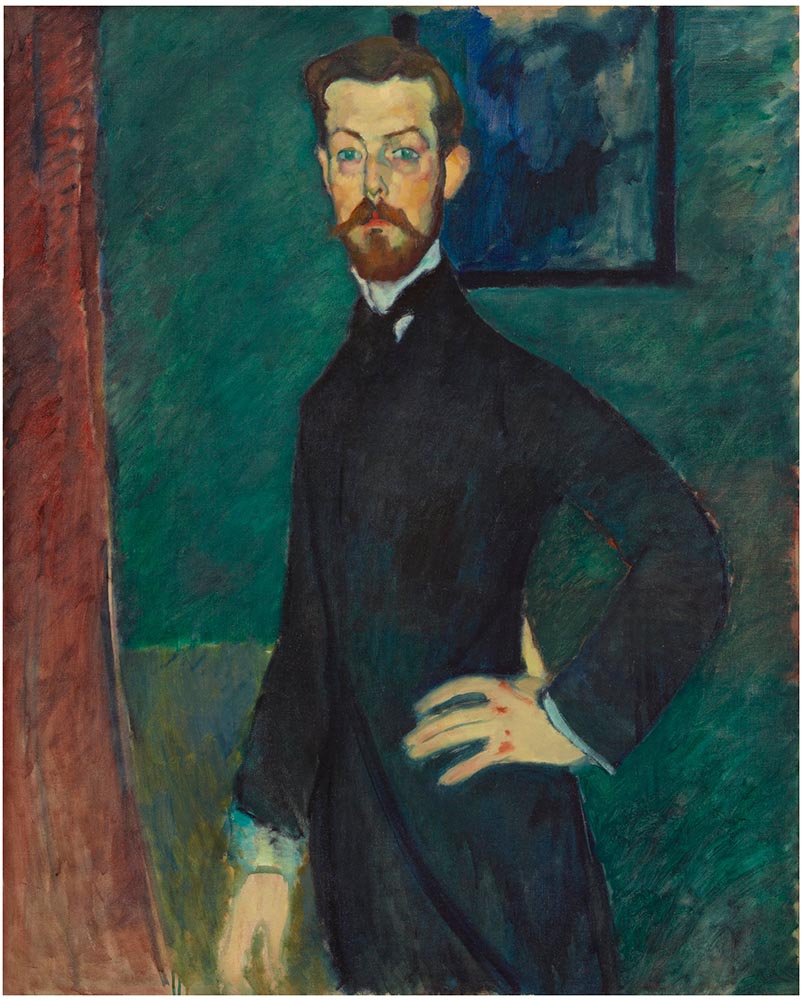
Paul Alexandre on green background (Unfinished?)
Oil on canvas — 1909
Identification
- Title
- English: Paul Alexandre on green background - Portrait unfinished.
Also as: Portrait of Dr. Paul Alexandre (Tokyo Fuji Art Museum); Paul Alexandre su fondo verde (Ceroni); Portrait inachevé (Galerie Charpentier) - Date
- 1909
- Medium
- Oil on canvas
- Dimensions
- 100.5 × 81.5 cm (Tokyo Fuji Art Museum)
Notes: Pfannstiel, Ceroni, Patani &Parisot say 100 × 81 cm) - Signature
- Unsigned
- Present location
- Tokyo Fuji Art Museum, Japan
Notes: Tokyo, Tokyo Fuji Art Museum (Hachiōji); on loan to the Nakanoshima Kosetsu Museum of Art, Osaka, October–December 2026 (museum website)
Catalogue numbers
| Compiler | Number |
|---|---|
| Arthur Pfannstiel | no. 13 |
| Joseph Lanthemann | no. 25 |
| Ambrogio Ceroni | no. 15 |
| Jeanne Modigliani | YES |
| Christian Parisot | 4/1909 |
| Osvaldo Patani | no. 19 |
| Modigliani Project | YES |
| MR | YES |
| Modigliani Initiative/ AMDC | ? |
Legal note on MR: This investigation has not had access to MR’s catalogue raisonné; all research here is based on open sources, publications and exhibitions. By no means has that catalogue been copied at any point. Modigliani Project and Modigliani Research Project are marked YES when the work is published or otherwise recorded by those projects, even if no catalogue number is assigned; otherwise the field is marked ?.
Provenance
- Paul Alexandre Coll.
- Private Coll. Paris
- Nahmad Collection, London (1991)
- Tokyo Fuji Art Museum
The sequence follows the published museum, sale, and catalogue record in this investigation. Gaps and uncertain transfers are marked as such.
Selected bibliography
Book-length publications are marked with a footnote giving a full citation. Exhibition catalogues appear in both this list and the exhibition list when this investigation recorded them in both places.
- Pfannstiel, "catalogue présumé" Modigliani. L'Art et la Vie. Preface de Louis Latourrettes, Seheur, Paris, 1929, p. 31
- Pfannstiel, Modigliani et son oeuvre, étude critique et catalogue raisonne, Bibliothèque des Arts, Paris, 1956 - no. 132
- Roy , Modigliani, Skira, Lausanne, 1958, p. 32
- Ceroni, Amedeo Modigliani: Peintre; Suivi des Souvenirs de Lunia Czechowska, Edizioni del Milione, 1958 - no. 133
- Catalogue Cent Tableau× de Modigliani, Galerie Charpentier, Paris, 1958. no. 5 Unfinished portrait
- Lanthemann, Modigliani, catalogue raisonné: sa vie, son oeuvre, son art, G. Condal, Barcelona, 1970 - no. 254
- Ceroni & Piccioni, Il dipinti di Modigliani, Rizzoli, Milano, 1970 - no. 155
- Mann, Modigliani, London, 1980, - . 506
- Lassaigne, Tout Modigliani, la peinture, Paris, 1982
- C. Roy Modigliani, Paris, 1985, p. 33?
- Parisot, Modigliani, Ed. G. Arte, Livorno, 1988 p. 39
- Castieau-Barrielle, La vie et l'oeuvre de Amedeo Modigliani, Editions ACR Paris, 1987, p. 387
- Parisot, Catalogue Raisonné Modigliani, Graphis Arte, 1991 - no. 4/19098
- Patani, Catalogo Generale, Leonardo, Milano, 1991-94 - no. 199
- Parisot, Modigliani, Pierre Terrail, Paris, 1992, p. 2410
- Alexandre, The Unknown Modigliani: Drawings from the Collection of Paul Alexandre, 1993, p. 19
- D. Krystof, Amedeo Modigliani: The Poetry of Seeing, Taschen Cologne, 2000, p. 14
- Soto Caba, Modigliani, the timeless face, Libsa, 200711
Exhibitions
- Paris, Salon des Indépendants, 1909 (mentioned by Several experts, uncertain)
- Bruxelles, Palais des Baux-Arts de Bruselles- no. 90 (uncertain)
- Paris, Galerie Charpentier, Cent Tableau× de Modigliani, 1958. no. 5 as unfinished portrait
- Seoul, South Korea, Ho-Am Gallery, Masterpieces of European Oil Painting, 1990
- Yongin-gun, Kyunggi-do, Ho-Am Art Museum, Masterpieces of European Oil Painting, 1990
- Beijing, China Art Gallery, Masterpieces of European Oil Painting: The Paintings in 20th Century from the Renaissance to Impressionism, 1992
- Taipei, National Dr. Sun Yat-sen Memorial Hall, Masterpieces of Western Paintings from the Renaissance to the 20th Century, 2000
- Kumamoto, Kumamoto Prefectural Museum of Art, Four Centuries of Occidental Paintings from the Tokyo Fuji Art Museum Collection, 2002
- Gifu, Hida Takayama Museum of Art, The Great Masters of Art, 2002
- Kanagawa, SOGO Museum of Art, Four Centuries of Occidental Paintings from the Tokyo Fuji Art Museum Collection, 2002
- Hokkaido, Abashiri Museum of Art, Invitation to Occidental Painting Arts: from Barbizon School to Contemporary Art, 2002
- Fukuoka, Fukuoka Art Museum, The Great Masters of Art, 2003
- Kanazawa, 21st Century Museum of Contemporary Art, Paris est une fête: les années 1920, 2007
- Aichi, Nagoya City Art Museum, Amedeo Modigliani: Retrospective, 2008
- Iwate, Iwate Museum of Art, Amedeo Modigliani, 2008
- Seoul, Amadeo Modigliani: Legend of Montparnasse, Hangaram Museum of Seoul Art Center, 2015
- Ehime, Nihama City Museum of ArtTokyo Fuji Art Museum: East and West Encounters, 2017
- Beijing, 500 Years of Western Paintings Collection of Tokyo Fuji Art Museum, Tsinghua University Art Museum, 2018
Notes
Museum record (verified): Tokyo Fuji Art Museum. Oil on canvas, 100.5 × 81.5 cm, 1909. Title: Portrait of Dr. Paul Alexandre.
In the back the painting "The Jewess" is visible. / There is a large number of sketches for this painting.
Where sources disagree, both readings are given. This is a working research page, not a catalogue raisonné.
Introduction
Dr Paul Alexandre stands before a green wall, one hand on his hip, the other hanging at his side. He wears a black, high-buttoned coat; his red beard and moustache frame a pale, angular face; a narrow red curtain hangs at the left edge and a blue picture at the upper right. Of the three portraits of Paul painted in 1909, the Tokyo Fuji Art Museum describes this one as the most "exquisitely painted", the one which "attained the highest degree of perfection". It is Ceroni no. 15, the last of the series that, according to the online transcription of his notes, began with a lost study (no. 13) and continued with the brown-background portrait (no. 14).
This essay analyses the painting and its relation to the other two. It also has to deal with a notable documentary problem: another painting on the Secret Modigliani site, the 1911–12 Portrait of Paul Alexandre (works/59), is labelled "Ceroni no. 15" in its summary table, though its own bibliography gives a different number. That duplicate is discussed below.
Composition and format
The canvas is upright, about 100 × 81 cm: the same no. 40 figure format as no. 14 (my identification from the standard French sizes; the museum gives 100.5 × 81.5 cm). The sitter is set slightly right of centre and cut at mid-thigh. His head is in the upper quarter, and the black mass of his body fills most of the lower half.
The composition is more open and more dynamic than no. 14. The left arm, bent with the hand on the hip, creates a large triangle at the right, through which the green wall shows. The right arm hangs straight at the left, and the pale hand reaches almost to the lower edge. The figure thus forms a broad, asymmetrical silhouette, closed at the left and open at the right. The Tokyo Fuji Art Museum compares the pose, with "his left hand placed on his hip", to that of L'Amazone (The Riding Habit, Ceroni no. 21), painted the same year.
The background is divided into four zones: the red curtain at the far left, narrower than in no. 14; the green wall; a lower zone of olive and yellow-green at the left, separated from the wall by a horizontal line at about one-third of the height, which may be a table, a dado or the floor; and the framed picture at the upper right, whose lower edge makes a strong horizontal behind the sitter's head.
Line and contour
Line plays a more active role than in no. 14. The contours of the coat are reinforced with blue lines, especially along the sleeve of the bent arm and the lower edge of the coat. These lines separate the black figure from the green ground and give the silhouette its clarity. The face is drawn with the same features as in no. 14: high, arched eyebrows, almond eyes with blue-grey irises, a long straight nose and the upturned moustache. The head is a little more turned, and the gaze is directed at the viewer with greater intensity.
The hands are more fully realised. The left hand on the hip is drawn in pale flesh with red strokes over the knuckles, and its spread fingers are separately articulated. The right hand is a long, pale shape, its fingers barely indicated. The cuffs are touched with pale blue.
Colour
The colour is the most striking difference from no. 14. The brown wall has become a strong green, a blue-green or teal applied in dense, diagonal strokes. Against it, the red beard and the red curtain are complementary contrasts. The lower zone at the left, in olive and yellow-green, introduces a warmer note. The framed picture is painted in deep blues, with a black frame.
The coat is painted in black with blue undertones and blue contour lines, so that it seems to absorb the green of the background. The face is cream and pink with green shadows, and the hands are pale with red accents. The overall effect is cooler and brighter than no. 14, and more decorative. The juxtaposition of red and green recalls the colour experiments of the Fauves, though the restraint of the palette and the dark figure keep the painting closer to the conventions of the portrait.
Facture
The surface is more uniformly worked than in no. 14, though the brushwork remains visible everywhere. The green wall is built up in short, dense diagonal strokes, almost hatched, that give it vibration and texture. The curtain is painted in vertical strokes of red and brown. The coat is brushed in broad, smooth strokes, the face in small planes.
The 1958 Galerie Charpentier exhibition, according to the Tokyo Fuji Art Museum's documentation, showed the painting as Portrait inachevé, an unfinished portrait. The Secret Modigliani page on the work also notes "many sketches". Yet the Fuji museum considers it the most accomplished of the three, and the reproduction shows a painting resolved in all its main areas. The 1958 title may reflect the loosely brushed lower zone and the summary right hand rather than any substantial incompleteness. The contrast between the two characterisations is itself instructive: in Modigliani's early portraits, the line between finished and unfinished is difficult to draw.
Figure and space
The sitter's pose combines elegance and authority. The hand on the hip is a traditional gesture of assurance in male portraiture, familiar from the Renaissance and Baroque, and here it gives the young doctor a certain swagger. The Tokyo Fuji Art Museum places the series in the Italian tradition of "patrons having their portraits painted in return for their financial support".
The space is shallow but slightly deeper than in no. 14. The horizontal division at the lower left suggests a ledge or floor behind the sitter, and the bent arm opens a pocket of space at the right. Nonetheless, wall, curtain and picture all lie in a plane close behind the figure, and the green wall pushes forward visually.
Iconography: the picture within the picture
The framed picture at the upper right is, according to Ceroni's notes as transcribed, the sketch of La Juive, as in nos. 13 and 14. The Secret Modigliani page on the work also identifies it as La Juive. In this painting, however, the picture is reduced to an area of dark blue with lighter strokes, and no figure is legible in the reproduction. If the identification is correct, Modigliani has turned the picture into an abstract colour field, a blue note that balances the red curtain.
The iconography is that of the patron. The doctor is shown standing, confident, in his own interior and with the artist's work behind him. Christie's 2015 essay on the portrait of Jean Alexandre reports that Paul bought La Juive from Modigliani in 1908, his first purchase, and that he arranged the artist's first commissions. The painting records that relationship as clearly as any document.
Comparisons
The comparison with no. 14 is essential. The two paintings share the format, the sitter, the costume, the curtain, the picture and the general arrangement. No. 15 differs in its green background, its hand-on-hip pose, its more open silhouette, its blue contour lines and its more even finish. Ceroni's sequence (study, brown background, green background) suggests a progression from a closed, dark composition to a brighter and more assertive one.
The pose links the painting to L'Amazone, as the Fuji museum notes. Christie's 2015 describes L'Amazone (Ceroni no. 21) as painted for Jean Alexandre's girlfriend in 1909, with the red coat famously repainted yellow. A comparison with the later portraits of Paul (Ceroni nos. 31 and 40, 1911–13) shows how far Modigliani travelled: in Paul Alexandre in Front of a Window (1913, Rouen) the head is elongated and the colour subdued. The 1909 portraits remain within the tradition of the society portrait, while showing an interest in constructed colour that the Tate large-print guide associates with Cézanne.
Provenance, exhibitions and discrepancies
Provenance in Paul Alexandre; a private collection, Paris; the Nahmad collection, London (1991); and the Tokyo Fuji Art Museum. The museum's collection page gives no provenance. Tate Papers lists C15 among the portraits that "remained in the family's collection". The intermediate stages are not documented in the sources I consulted.
The discrepancies are:
- "Salon des Indépendants, 1909." Both the Tokyo Fuji Art Museum and the Secret Modigliani page list this as the first exhibition. But the Secret Modigliani exhibition chronology records no works by Modigliani at the 25th Salon des Indépendants of 1909. He showed six paintings at the 1910 Salon, including two works simply titled Étude (nos. 3688 and 3689, according to the Secret Modigliani page on that Salon), and none of them can be identified with this portrait from the information available. The 1909 exhibition should be treated as unverified.
Technical analysis
No technical study of this painting has been published, as far as I have been able to establish. The Tokyo Fuji Art Museum's page gives no technical information, and neither the Tate Papers study nor the Burlington Magazine's introduction to the Modigliani Technical Research Study discusses it.
The following is comparative evidence only. In the portrait of Jean-Baptiste Alexandre (no. 12, 1909), Tate Papers identified chromium-based greens and cobalt blue in the background layers, vermilion in the skin and red areas, and a black built up from several pigments, as well as two earlier compositions beneath. In Paul Alexandre in Front of a Window (1913), it identified lead white, zinc white, barite, emerald green and chromium greens, Prussian blue and vermilion. The strong green of no. 15 makes the use of a chromium or emerald green plausible, but without analysis this remains conjecture. Whether the canvas, like those of nos. 12 and the 1913 portrait, was reused is also unknown.
Conclusion
The green-background portrait is the most accomplished of Modigliani's 1909 portraits of Paul Alexandre: brighter, more assured in pose and more consistent in finish than the brown-background version. The red-green contrast, the blue contour lines and the reduction of the picture within the picture to a field of blue show Modigliani handling colour with a new freedom within a traditional portrait format. Its documentation needs care: the 1909 Indépendants is unverified, the 1958 Charpentier number is claimed by another work, and the site's "no. 15" label on a 1911–12 portrait is an error. Ceroni no. 15 is this painting, in Tokyo.
Museum documentation
- Tokyo Fuji Art Museum, "Portrait of Dr. Paul Alexandre", collection page (summary, exhibitions, literature), https://www.fujibi.or.jp/en/collection/artwork/01212/ (accessed 25 October 2026)
- Tate Modern, Modigliani (2017–18), large-print guide, rooms 1–11 (copy at docslib), https://docslib.org/doc/1601730/modigliani-large-print-guide-room-1-11
Sale literature
- Christie's, New York, 14 May 2015, sale 3736, lot 3, Modigliani, Jean Alexandre (recto) / Nu assis (verso): lot essay, https://www.christies.com/en/lot/lot-5893247
Technical literature (comparative)
- Anaïs Genty-Vincent et al., "Works by Modigliani that have Paintings beneath the Visible Surface", Tate Papers, no. 35, https://www.tate.org.uk/research/tate-papers/35/works-by-modigliani-that-have-paintings-beneath-the-visible-surface
- Annette King, Nancy Ireson, Simonetta Fraquelli and Joyce H. Townsend, "The Modigliani Technical Research Study: An introduction to Modigliani's materials and techniques", The Burlington Magazine, vol. 160, no. 1380 (March 2018), pp. 182–88, https://www.burlington.org.uk/archive/article/the-modigliani-technical-research-study-an-introduction-to-modiglianis-materials-and-techniques
Cited but not independently consulted
Pfannstiel 1929, p. 3, and 1956, p. 60, no. 13; Ceroni 1958, no. 13; Claude Roy, Modigliani, 1958, p. 32, and 1985, p. 33; Galerie Charpentier, Cent tableaux de Modigliani, 1958, no. 5; Lanthemann 1970, p. 166, no. 25; Ceroni and Piccioni, I dipinti di Modigliani, 1970, p. 89, no. 15; Cachin and Ceroni, Tout l'œuvre peint de Modigliani, 1972, p. 88, pl. II; Mann 1980, p. 50; Lassaigne 1982; Castieau-Barrielle 1987, p. 38; Parisot 1988, p. 39, 1991, 4/1909, and 1992, p. 24; Patani 1991, no. 19; Noël Alexandre, The Unknown Modigliani, 1993, p. 19; Doris Krystof, Modigliani, 2000, p. 14; Soto Caba 2007; Brussels, Palais des Beaux-Arts, no. 90. All are cited from the Tokyo Fuji Art Museum.Footnotes
- Arthur Pfannstiel, Modigliani. L’Art et la Vie, preface by Louis Latourette, Paris, Seheur, 1929 (presumed catalogue).
- Arthur Pfannstiel, Modigliani et son œuvre, étude critique et catalogue raisonné, Paris, Bibliothèque des Arts, 1956.
- Ambrogio Ceroni, Amedeo Modigliani: Peintre; suivi des souvenirs de Lunia Czechowska, Milan, Edizioni del Milione, 1958.
- Joseph Lanthemann, Modigliani, catalogue raisonné: sa vie, son œuvre, son art, Barcelona, G. Condal, 1970.
- Ambrogio Ceroni and Leone Piccioni, I dipinti di Modigliani, Milan, Rizzoli, 1970.
- Carol Mann, Modigliani, London, Thames and Hudson, 1980.
- Thérèse Castieau-Barrielle, La vie et l’œuvre de Amedeo Modigliani, Paris, ACR, 1987.
- Christian Parisot, Catalogue raisonné Modigliani, Livorno, Graphis Arte, 1991.
- Osvaldo Patani, Amedeo Modigliani: catalogo generale, Milan, Leonardo, 1991–94.
- Christian Parisot, Modigliani, Paris, Pierre Terrail, 1992.
- Victoria Soto Caba, Modigliani: The Timeless Face, Madrid, Libsa, 2007.