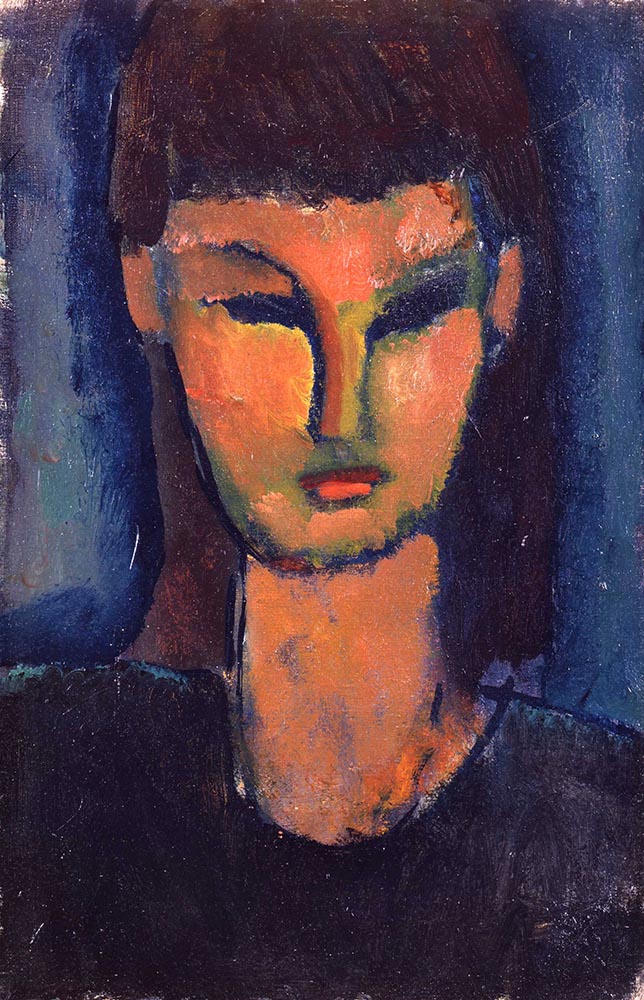
Young Woman Head
Oil on canvas — 1910
Identification
- Title
- English: Young woman head.
Notes: Testa di giovane donna (Ceroni); Head of young woman (R); Young woman head (Others) - Date
- 1910?
Notes: J. Modigliani; Lanthemann (1911) - Medium
- Oil on canvas
- Dimensions
- 41.3 × 25.4 cm?
Notes: 41 × 27 cm (Pfannstiel, Ceroni, Parisot); 40.5 × 27 cm (Galerie Charpentier 1958) - Signature
- Unsigned
- Present location
- Private Collection ?
Catalogue numbers
| Compiler | Number |
|---|---|
| Arthur Pfannstiel | no. 20 |
| Joseph Lanthemann | no. 42 |
| Ambrogio Ceroni | no. 29 |
| Jeanne Modigliani | YES |
| Christian Parisot | 1/1910 |
| Osvaldo Patani | no. 33 |
| Modigliani Project | ? |
| MR | YES |
| Modigliani Initiative/ AMDC | ? |
Legal note on MR: This investigation has not had access to MR’s catalogue raisonné; all research here is based on open sources, publications and exhibitions. By no means has that catalogue been copied at any point. Modigliani Project and Modigliani Initiative are marked YES when the work is published or otherwise recorded by those projects, even if no catalogue number is assigned; otherwise the field is marked ?.
Provenance
- Paul Alexandre Coll. Paris
- Sale Hotel Drouot 25-11-1990
- Guy Loudmer sale
- Perls Galleries, New York (1985)
- Collection Alain Delon, Paris (1991)
- 2017 for sale at Richard Nathanson, London.
- Private Collection?
The sequence follows the published museum, sale, and catalogue record in this investigation. Gaps and uncertain transfers are marked as such.
Selected bibliography
Book-length publications are marked with a footnote giving a full citation. Exhibition catalogues appear in both this list and the exhibition list when this investigation recorded them in both places.
- Pfannstiel, "catalogue présumé" Modigliani. L'Art et la Vie. Preface de Louis Latourrettes, Seheur, Paris, 1929, p. 51
- Pfannstiel, Modigliani et son oeuvre, étude critique et catalogue raisonne, Bibliothèque des Arts, Paris, 1956 - no. 202
- Jeanne Modigliani, Modigliani: Man and Myth, Orion Press, New York, 1958, pl. 2 (dated 1911 and located at the Paul Alexandre Coll. Paris in 1958)3
- Ceroni, Amedeo Modigliani: Peintre; Suivi des Souvenirs de Lunia Czechowska, Edizioni del Milione, 1958 - no. 214
- Catalogue Cent Tableaux de Modigliani, Galerie Charpentier, Paris, 1958. no. 12 (size in catalogue: 40.5 × 27 cm)
- Diehl, Modigliani, Ed. Flamarion, Paris, 1969, p. 125
- Ponente, Modigliani, Ed. Toray, Barcelona, 1969 - no. 2
- Lanthemann, Modigliani, catalogue raisonné: sa vie, son oeuvre, son art, G. Condal, Barcelona, 1970 - no. 42, dated in 19116
- Ceroni & Piccioni, Il dipinti di Modigliani, Rizzoli, Milano, 1970 - no. 297
- Diehl, Ed. Flammarion 1977, p. 125
- Jeanne Modigliani, Gli anni della scultura, Mondadori, Milan 1984, p. 72
- Aichi Prefectural art gallery, Catalogue Modigliani, 1985, p. 44, no. 17
- Castieau-Barrielle, La vie et l'oeuvre de Amedeo Modigliani, Editions ACR Paris, 1987, p. 518
- Parisot, Catalogue Raisonné Modigliani, Graphis Arte, 1991 - no. 1/19109
- Patani, Catalogo Generale, Leonardo ed. Milano 1991-94 - no. 3310
- Soto Caba, Modigliani, the timeless face, Libsa, 200711
Exhibitions
- Paris, Gallerie Charpentier, Cent Tableaux de Modigliani, 1958 - no. 12
- Livorno, Gli anni della scultura, Villa Maria 1984 - no. 5
- Tokyo, Modigliani exhibition, National Museum, 1985 - no. 17
- Nagoya, Modigliani exhibition, Aichi Prefectural Art Gallery, 1985
- Paris, 20 ans de passion, Didier Imbert Fine Art, 1990, rep - no. 29
Notes
Not in d'Atri papers?
No further documentary note is recorded in this investigation beyond the fields above. Where sources disagree, both readings are given.
Introduction
A young woman's head rises from a dark garment on a long neck, set against a field of vigorous blue. Her face is frontal and oval. Her eyes are lowered, reduced to two dark, heavy lids or slits. The nose is long and narrow, with a green shadow down one side. The mouth is small and red. A fringe of dark brown hair crosses her forehead, and the rest falls straight to the sides of the face. Her skin is an orange-salmon colour, shaded with yellow-green. There is no setting, no hands, no attribute and no expression beyond withdrawal.
This small canvas, Ceroni no. 29, comes from Paul Alexandre's collection and belongs to the moment, around 1910, when Modigliani turned increasingly to sculpture. The Jewish Museum's guide to Modigliani Unmasked notes that the drawings Alexandre preserved belong to a period "when the artist largely ceased to paint in order to develop his conceptual and pictorial ideas through drawing and sculpture". The present work is one of the few paintings from that time, and it is plainly the painting of a sculptor. Ceroni's note, as transcribed by modigliani1909.com, is short: "Because of the evident rapidity of the execution it must be considered as a sketch" ("Per l'evidente rapidità dell'esecuzione si deve considerare come un abbozzo"). This essay examines what that rapidity produced, and why the sketch matters.
Composition and format
The canvas is narrow and upright. The Secret Modigliani page on the work gives 41.3 × 25.4 centimetres, while Pfannstiel, Ceroni and Parisot give 41 × 27 centimetres. The figures of 41 × 27 match the French standard size 6 paysage, used upright, and 41.3 × 25.4 is close to size 6 marine, 41 × 24. It is also worth noting that 41.3 × 25.4 centimetres is exactly 16¼ × 10 inches, which may mean that the figure was converted from an American measurement, perhaps during the work's time with a New York dealer, and not taken from the canvas in centimetres. This is a hypothesis only. Either way, the canvas is a landscape or seascape format turned on its short edge, a practice that the 2018 Burlington Magazine study found in Modigliani's work "as early as 1908".
The narrow format determines the composition. The head is on the vertical axis and fills almost the full width of the canvas at the level of the hair. The neck continues the axis downward. The shoulders and garment are cut by the lower edge and the sides. Above the head there is only a narrow band of blue. Everything is centred and symmetrical. The head is a vertical oval set on a vertical cylinder, within a vertical rectangle. It is the simplest possible arrangement, and it is close to the arrangement of a carved head on a pedestal.
Line
There is very little line in the sense of drawn contour. The forms are defined by the meeting of colours: the orange face against the dark hair, the dark hair against the blue ground, the pale neck against the dark garment. Line appears in the features. The eyelids are drawn in dark strokes, the nose in a long line with a shadow, the mouth in a short red stroke. The brows are barely suggested. The lowered eyes, with no visible pupils, are the most striking feature. They give the face the closed, inward look of the sculpted heads.
Colour
The colour is simple and strong. The background is a deep, saturated blue, varied with lighter and darker strokes. The face is orange-salmon, warm and almost flat, with yellow-green shadows on the cheeks, along the nose and under the jaw. The hair is dark brown. The garment is blue-black with a greenish edge. The lips are red.
The contrast of orange and blue is the basis of the image. These are complementary colours, and placing an orange face against a blue ground makes the head advance and the ground recede. The yellow-green shadows sit between the two and connect them. The same blue appears, darkened, in the garment, so that the head is framed by blue above and below. The effect is decorative rather than descriptive. The skin is not a natural colour, and the shadows are not natural shadows. This is a painter's head, built from contrasts, not a likeness.
Facture
Ceroni's word, abbozzo, is accurate. The paint is applied quickly, in broad strokes, and with little reworking. The blue background is brushed in vigorous, multidirectional strokes, and at the left the canvas weave seems to show through the thin paint in the reproduction. The face is laid in with a few broad strokes of orange, and the shadows are added in a second, quick layer of green. The hair is a single dark mass with some brushed texture. The garment is painted thinly.
The speed of execution does not mean carelessness. The decisions are clear and the forms are placed with confidence. What is missing is finish: the transitions are abrupt and the surface is uneven. In this, the work is close to the oil sketches that painters made as notes for larger works, though there is no evidence that it was a study for a particular painting.
Figure and space
There is no space in the usual sense. The blue ground is flat and undefined; it is not a wall, a sky or a curtain. The head, neck and shoulders are flattened against it. Modelling is minimal: a few green shadows give the face some volume, but the general effect is of a flat, coloured shape. The figure is presented frontally and in isolation, like an object.
The sitter and the sculptural context
The sitter is not identified, and the titles give no name. The work belongs to Paul Alexandre's collection, and the Secret Modigliani page notes that Jeanne Modigliani's 1958 book reproduced it, dated 1911, as in the Alexandre collection at that date.
The connection with sculpture is the key to the painting. The features of this head—the long oval face, the long narrow nose, the small mouth, the lowered eyes and the long neck—are the features of Modigliani's limestone heads of 1910–14. The Jewish Museum's Modigliani Unmasked exhibition showed four such heads on pedestals in its central gallery, including a Head of a Woman of 1910–11 from the Chester Dale Collection at the National Gallery of Art, Washington. I have not opened the National Gallery's own page on that head, and I do not compare it with this painting in detail. The general resemblance is, however, clear, and it is not surprising. The Jewish Museum's guide stresses that around this time Modigliani "largely ceased to paint", and that he developed his "visual vocabulary of features—heads, noses, mouths, eyes" from "both life and the study of African, Egyptian, and Asian art".
The guide also speaks of the "emphasis on the nose" that "recurs throughout Modigliani's work and is a focal point of his sculpture". In the present painting, the nose is the longest and most clearly defined feature, and its green shadow is the most visible stroke on the face. It is not too much to say that this head is a sculptural idea worked out in paint.
Comparisons
The closest comparison is with the next work in Ceroni's sequence, the Busto di donna (no. 30), also from Alexandre's collection and also dated 1910. Both show a young woman frontally, with long neck, long nose and small mouth, painted quickly. In no. 30 the eyes are black almonds without pupils, and the neck is even longer. Together, the two works mark the passage from the more naturalistic portraits of 1909, such as Donna con cappello (no. 26), to the stylised heads that would dominate Modigliani's painting from 1915.
Another comparison is with the Lady with a Blue Scarf (no. 5) and the Woman Bust of 1907 (no. 4). Those early heads also present the sitter close to the picture plane, but they are modelled in a more conventional way, and the gaze of the Lady with a Blue Scarf is direct rather than lowered. The change between 1907 and 1910 is a change from portraiture to the construction of a type.
Provenance and exhibitions
The provenance as Paul Alexandre, Paris; sale, Hôtel Drouot, Paris, 25 November 1990 (Guy Loudmer); Perls Galleries, New York (1985); Alain Delon, Paris (1991); and "2017 for sale at Richard Nathanson, London". The Ceroni caption, reads "Francia, proprietà privata".
The exhibitions listed by the page are: Paris, Galerie Charpentier, Cent tableaux de Modigliani, 1958, no. 12; Livorno, Villa Maria, Gli anni della scultura, 1984, no. 5; Tokyo, National Museum of Modern Art, 1985, no. 17; Nagoya, Aichi Prefectural Art Gallery, 1985 (catalogue p. 44, no. 17); and Paris, Didier Imbert Fine Art, 20 ans de passion, 1990, no. 29.
The Secret Modigliani site's list of the 1990 Martigny exhibition includes, as no. 12, a "Tête de femme 1911-1912" lent by the Perls Galleries, New York. The word "Pierre" in that line most probably gives the medium, stone, so the loan was a carved head and not this painting. It is worth noting only because it shows the Perls Galleries handling Modigliani's sculpted heads and his painted heads of the same type.
Discrepancies.
- Dimensions. The page gives 41.3 × 25.4 cm, the older catalogues 41 × 27 cm and the Charpentier catalogue 40.5 × 27 cm. The difference in width, 25.4 against 27 cm, is too large to be a rounding error.
- Date. Ceroni gives 1910. Jeanne Modigliani (1958) and Lanthemann (1970) give 1911.
- Provenance order. The page places the Perls Galleries in 1985 after the Drouot sale of 1990. If the dates are right, the Perls ownership came before the sale. The 1985 Japanese exhibitions would fit a Perls ownership in the mid-1980s, but the page does not name the lender. The sequence of owners on the page should be read as a list, not a chronology.
- Alexandre provenance. The page lists Paul Alexandre as the first owner, and Jeanne Modigliani placed the work in his collection in 1958. Ceroni's 1970 caption names only "France, private property". These two are compatible, but the date at which the work left the Alexandre family is not documented in any source.
Technical analysis
No technical study of this work has been published, as far as I can find. The painting is not among the works discussed in the Tate Papers article on paintings beneath the visible surface, the 2018 Burlington Magazine introduction, or the 2023 IJCS study. What follows is visual observation and comparative evidence.
Visual observations. The thin paint at the left, through which the canvas texture seems to show, suggests a single, fast campaign of work over a prepared canvas. There are no visible signs of an earlier composition, but such signs often appear only in X-radiographs. The Tate Papers authors note that in some reused canvases "the texture of the paintings indicated the presence of something painted below the surface", but in others "the hidden images were discovered only after technical examination".
Comparative evidence. The Tate Papers study shows that Modigliani frequently reused canvases in these years, often turning them by 180 degrees. In Jean-Baptiste Alexandre with a Crucifix (1909), a thick lead white ground was applied, perhaps by the artist himself; the head was painted "using an iron-based pigment, vermilion and emerald green". The IJCS study of The Cellist (1909) found emerald green and vermilion as well. The green shadows and orange flesh of the present work could reflect the same palette, but that is a hypothesis to be tested, not a finding.
What an examination could settle. Given the hesitation about the dimensions, simple measurement of the canvas and stretcher, and identification of any supplier's stamp, would be the most useful first step. X-radiography would show whether the canvas was reused, and X-ray fluorescence would identify the blues and greens. Since the work is close to the sculptures, a comparison with the drawings of heads in the Alexandre collection would also be valuable.
Conclusion
Ceroni no. 29 is a small, quickly painted head, built from a few strong colour contrasts: orange against blue, with yellow-green shadows connecting them. Its frontal oval face, long nose, lowered eyes and long neck are those of Modigliani's sculpted heads of 1910–14, and the painting is best understood as a sculptor's idea tried out in paint, at a time when, according to the Jewish Museum's guide, he had largely stopped painting. Ceroni was right to call it an abbozzo. But the speed of execution gives it a directness that the more finished heads of later years sometimes lack. The work's documentation is not consistent on its dimensions, its date or the order of its owners, and the Secret Modigliani site itself gives two different "correct" sizes. These questions could be settled by measurement and a basic technical examination.
Museum and exhibition sources
- The Jewish Museum, New York, Modigliani Unmasked, large-print exhibition guide, https://thejewishmuseum.org/wp-content/uploads/2025/06/Modigliani_Large_Print_FINAL.pdf
Technical literature (comparative)
- Anaïs Genty-Vincent et al., "Works by Modigliani that have Paintings beneath the Visible Surface", Tate Papers, no. 35, https://www.tate.org.uk/research/tate-papers/35/works-by-modigliani-that-have-paintings-beneath-the-visible-surface
- Annette King, Nancy Ireson, Simonetta Fraquelli and Joyce H. Townsend, "The Modigliani Technical Research Study: An introduction to Modigliani's materials and techniques", The Burlington Magazine, vol. 160, no. 1380 (March 2018), pp. 182–88, https://www.burlington.org.uk/archive/article/the-modigliani-technical-research-study-an-introduction-to-modiglianis-materials-and-techniques
- Greta Garcia, David Juanes and Rafael Romero, "Image Study and Material Characterization of the Two-Sided Painting The Cellist and Portrait of Brancusi by Amedeo Modigliani", International Journal of Conservation Science, vol. 14, no. 3 (2023), pp. 1233–48, https://doi.org/10.36868/ijcs.2023.03.30
Sources that could not be opened
Richard Nathanson, London, website (returned no usable content); National Gallery of Art, Washington, page on the limestone Head of a Woman (not opened).
Cited but not independently consulted
Pfannstiel, 1929, p. 5, and 1956, no. 20; Jeanne Modigliani, Modigliani: Man and Myth, 1958, pl. 2, and Gli anni della scultura, 1984, p. 72; Ceroni, Amedeo Modigliani peintre, 1958, no. 21; Galerie Charpentier, Cent tableaux de Modigliani, 1958, no. 12; Diehl, Modigliani, 1969 and 1977, p. 12; Ponente, 1969, no. 2; Lanthemann, 1970, no. 42; Ceroni and Piccioni, 1970, no. 29; Aichi Prefectural Art Gallery catalogue, 1985, p. 44, no. 17; Castieau-Barrielle, 1987, p. 51; Parisot, 1991, no. 1/1910; Patani, 1991–94, no. 33; Soto Caba, 2007; the catalogues of Livorno, 1984, Tokyo, 1985, and Didier Imbert, 1990; the Hôtel Drouot sale catalogue of 25 November 1990. All are cited from the Secret Modigliani page on the work.
Footnotes
- Arthur Pfannstiel, Modigliani. L’Art et la Vie, preface by Louis Latourette, Paris, Seheur, 1929 (presumed catalogue).
- Arthur Pfannstiel, Modigliani et son œuvre, étude critique et catalogue raisonné, Paris, Bibliothèque des Arts, 1956.
- Jeanne Modigliani, Modigliani: Man and Myth, New York, Orion Press, 1958.
- Ambrogio Ceroni, Amedeo Modigliani: Peintre; suivi des souvenirs de Lunia Czechowska, Milan, Edizioni del Milione, 1958.
- Gaston Diehl, Modigliani, Paris, Flammarion, 1969.
- Joseph Lanthemann, Modigliani, catalogue raisonné: sa vie, son œuvre, son art, Barcelona, G. Condal, 1970.
- Ambrogio Ceroni and Leone Piccioni, I dipinti di Modigliani, Milan, Rizzoli, 1970.
- Thérèse Castieau-Barrielle, La vie et l’œuvre de Amedeo Modigliani, Paris, ACR, 1987.
- Christian Parisot, Catalogue raisonné Modigliani, Livorno, Graphis Arte, 1991.
- Osvaldo Patani, Amedeo Modigliani: catalogo generale, Milan, Leonardo, 1991–94.
- Victoria Soto Caba, Modigliani: The Timeless Face, Madrid, Libsa, 2007.