Caryatid - standing caryatid
Oil on canvas — 1913 ?
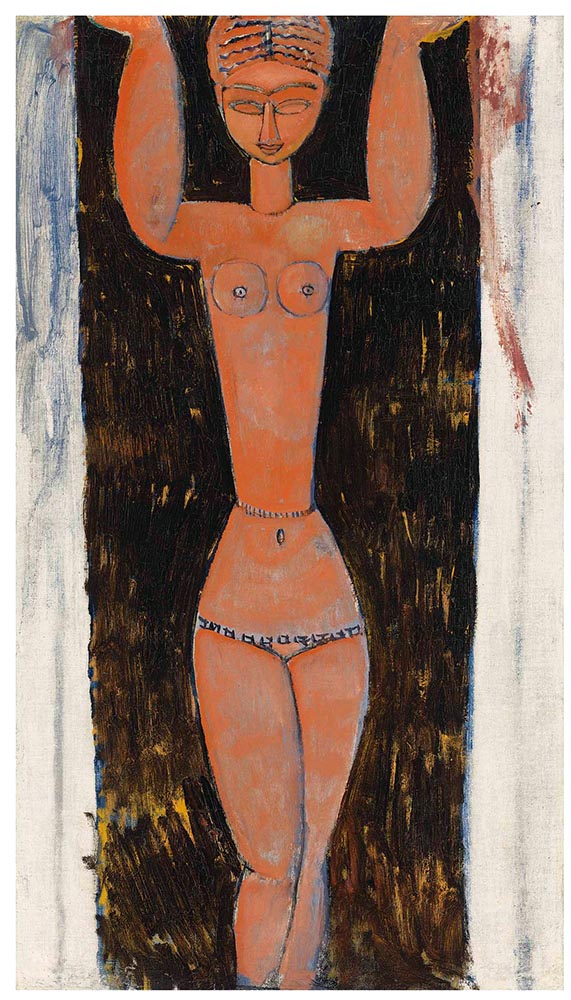
Identification
- Title
- English: Caryatid - standing caryatid - Caryatid frontal view.
Note: Cariatide in piedi (Ceroni); Cariatide (Christie's 2017); Standing Caryatid (Tate Papers). - Date
- 1913 ?
Note: 1913 (Christie's 2017; Burlington Magazine 2018; Ceroni); circa 1912 (Hirschl & Adler 1973, according to Christie's); 1910 (Tate Papers) - Medium
- Oil on canvas
- Dimensions
- 80 × 45.8 cm
Note: 80 × 45.8 cm (Christie's 2017); 81 × 45 cm (Ceroni, Patani, MR, and the Royal Academy 2006); 82 × 46 cm (Pfannstiel); 81 × 46 cm (Parisot); 81.5 × 45 cm (MR in another publication). - Signature
- Unsigned
- Present location
- Private Collection ?
Catalogue numbers
| Compiler | Number |
|---|---|
| Arthur Pfannstiel | NO |
| Joseph Lanthemann | NO |
| Ambrogio Ceroni | no. 37 |
| Jeanne Modigliani | NO |
| Christian Parisot | 3/1913 |
| Osvaldo Patani | no. 40 |
| Modigliani Project | ? |
| MR | YES |
| Modigliani Initiative/ AMDC | ? |
Legal note on MR: This investigation has not had access to MR’s catalogue raisonné; all research here is based on open sources, publications and exhibitions. By no means has that catalogue been copied at any point. Modigliani Project and Modigliani Initiative are marked YES when the work is published or otherwise recorded by those projects, even if no catalogue number is assigned; otherwise the field is marked ?.
Provenance
- Paul Alexandre, Paris
- Léopold Zborowski, Paris
- André Level, Paris
- Sale: Level Collection Hotel Drouot, 3 mars 1927, no. 110, Paris
- André Lefèvre, Paris
- Sale: Palais Galliéra, Paris, 29 November 1966, lot 108
- The Brook Street Gallery, London, by whom acquired in 1968.
- Robin D. Judah, London, by whom acquired in 1970.
- Perls Galleries, New York (no. 7027).
- Private coll. United States; sale, Sotheby’s, New York, 22 October 1980, lot 64.
- Private coll. United States, by whom acquired at the above sale.
- Private coll. United Kingdom, by whom acquired in December 1980.
- ( Parisot mentions the property of Samir Traboulsi, in France in the 1991)
- Acquired from the above by the owner in 2007?
- Sale Christies's 27-June-2017 - London Art Impressionist and Modern art evening sale
- Sale 14239- Lot 21
- Estimate:
- 6.000.000 - 9.000.000 GBP - Sold at: 6.885.000 GBP
- Private Collection
The sequence follows the published museum, sale, and catalogue record in this investigation. Gaps and uncertain transfers are marked as such.
Selected bibliography
Book-length publications are marked with a footnote giving a full citation. Exhibition catalogues appear in both this list and the exhibition list when this investigation recorded them in both places.
- (Decrooq in p. 184 on Monti a cura de R. Chiappini, Catalogue Amedeo Modigliani, Lugano, Skira, 1999 by error say is no. 27 in Pfannstiel and is NOT)1
- Werner, Amedeo Modigliani, Cercle d'art, Paris,1968, p. 802
- Ceroni & Piccioni, Il dipinti di Modigliani, Rizzoli, Milano, 1970 - no. 373
- Castieau-Barrielle, La vie et l'oeuvre de Amedeo Modigliani, Editions ACR Paris, 1987, p.644
- Parisot, Catalogue Raisonné Modigliani, Graphis Arte, 1991 - no. 3/1913 (incorrect provenance and exhibitions/bibliography mixed with previous number)5
- Patani, Catalogo Generale, Leonardo ed. Milano 1991-94 - no. 40 (incorrect provenance)6
- Schmalenbach, Amedeo Modigliani, Prestel, Munich, 1990, p. 64 - no. 167
- Monti a cura de R. Chiappini, Catalogue Amedeo Modigliani, Lugano, Skira, 1999
- MR, L'Ange au visage grave, Musée du Luxembourg, Paris, 2002, p.142-143, no. 121
- Exh. cat. Royal Academy of Arts, Modigliani and His Models, 2006, no. 2, p.78 (incorrect size: 81 × 45 cm)
- Soto Caba, Modigliani, the timeless face, Libsa, 20078
- R, Le silence éternel, Pinacotheque de Paris, 2008, p. 329
- New York, The Jewish Museum, Modigliani unmasked, 2018
- Ireson, Fraquelli, Modigliani, London, Tate Modern, Skira Rizzoli, London, 2017, p. 5710
Exhibitions
- (Decrooq in p. 184 on Monti a cura de R. Chiappini, Catalogue Amedeo Modigliani, Lugano, Skira, 1999 by error say -Milano,
- Associazione fra gli amatori e i cultori delle arti figurative contemporanee, 1946 - no. 1 but is not same work in the catalogue)
- Paris, Musée National d'Art Moderne, Collection André Lefèvre, 1964 - no. 205
- New York, Hirschl & Adler Galleries, Modigliani Retrospective, 1973 - no. 67 (dated 1912)
- Basel, Galerie Beyeler, Nudes, Nus, Nackte, June - October 1984 - no. 51 (illustrated; dated 'circa 1912')
- Martigny, Fondation Pierre Gianadda, Modigliani, 1990 - no. 29
- Dusseldorf, Kunstsammlung Nordrhein-Westfalen, Amedeo Modigliani: Malerei, Skulpturen, 1991 - no. 11
- Zürich, Kunsthaus, Amedeo Modigliani: Malerei, Skulpturen, 1991 - no. 11
- Tokyo, Musée Tobu, Exposition Amedeo Modigliani au Japon, 1992 - no. 9, p. 70 (with incorrect provenance)
- Kyoto, Musée Daimaru,Exposition Amedeo Modigliani au Japon, 1992 - 1993 - no. 9, p. 70 (with incorrect provenance)
- Osaka, Musée Daimaru d'Umeda, Exposition Amedeo Modigliani au Japon,1993 - no. 9, p. 70 (with incorrect provenance)
- Ibaraki, Musée d'Art Moderne, Exposition Amedeo Modigliani au Japon,1993 - no. 9, p. 70 (with incorrect provenance)
- Lugano, Amedeo Modigliani, Museo d'Arte Moderna, 1999 - no. 9
- Paris, Musée d'Art Moderne de la Ville de Paris, L'École de Paris 1904-1929, la Part de l'Autre, 2000 - 2001, p. 173
- Paris, Modigliani: l'Ange au visage grave, Musée du Luxembourg, 2002 - no. 12
- Milan, Palazzo Reale,Modigliani: The Melancholy Angel, 2003 - no. 11
- London, Royal Academy of Arts, Modigliani and His Models, 2006 - no. 2
- Moscow, Meeting Modigliani, Pushkin State Museum of Fine Arts, 2007 - no. 16
- Bonn, Amedeo Modigliani: Ein Mythos der Moderne, Bundesrepublik, 2009 - no. 25
- New York, The Jewish Museum, Modigliani unmasked, 2018
- London, Tate Modern, Modigliani, 2017-2018
Notes
Not in D'Atri papers ?
Where sources disagree, both readings are given. This is a working research page, not a catalogue raisonné.
Introduction
A standing woman, naked, raises her arms above her head and bends them at the elbows, so that her hands touch the top edge of the picture. Her head is tilted slightly. Her hair is drawn with wavy lines from a central parting. Her eyes are closed almonds, her nose is long and straight, and her mouth is small. A long neck rises from sloping shoulders. The round breasts are marked with dots for nipples. A beaded belt crosses the waist and a girdle with a geometric pattern crosses the hips. One knee is bent, so that one leg is drawn in front of the other. The figure is painted in warm apricot and coral tones, with a few touches of blue at the edges. She stands in front of a dark brown-black panel. To the left and right, the canvas is bare or thinly washed, with streaks of blue on the left and drips of red-brown on the right.
Ceroni numbered the painting 37 and called it Cariatide in piedi, dated 1913, in the collection of R. D. Judah, London. It was sold at Christie's in London on 27 June 2017. The lot essay calls it "One of only a handful of oil paintings which explore the form of a sculpted caryatid". The Burlington Magazine's 2018 introduction to Modigliani's materials reports a supplier's stamp on the back of the canvas. A footnote in the Tate Papers gives it a different date and location. This essay describes the painting, places it among Modigliani's caryatids, and sets out the many differences in the published data.
Composition and format
The canvas measures 80 × 45.8 cm, according to Christie's. Its proportions are almost the same as those of C36 (80.5 × 45 cm) and C40 (81 × 45.6 cm, a size the Tate Papers say "do not correspond to any standard format"). The figure occupies the central third of the width. The dark panel behind her is a little wider than her body and stops short of the edges. On either side is a band of pale canvas. The hands touch the top edge and the legs run off the bottom edge below the knees, so that the figure is bigger than the frame. This cropping is typical of Modigliani's caryatids, and the Aichi museum's phrase for C36 applies here too: the pose fills the canvas.
Facture
Christie's speaks of "vigorous, visceral brushstrokes". The figure is painted more smoothly than in C36, with modelled tones that give it volume. The dark panel is brushed more freely, and the strokes are visible. The edges of the canvas appear unfinished, with the ground showing through and streaks of colour that look like trials or wiping of the brush. The drips at the upper right show that the paint was thin enough to run.
Figure and space
The space is shallow: the dark panel works as a niche or a wall immediately behind the figure. The pale side bands do not suggest a depth but rather the edges of a support. The figure is set close to the picture plane. The modelling of the flesh, with the blue at the edges, gives it a rounded body in front of the flat panel. The overall effect is that of a relief: a sculpted figure in front of a stone ground, which is what a caryatid is.
Iconography and models
In Ceroni's catalogue, no. 37 carries a cross-reference to no. 35: "si veda la n°35". The note near no. 35 proposes that the painted caryatids were executed after the period of sculpture, "che termina con un'unica cariatide in pietra evidentemente allo stadio di abbozzo" (which ends with a single stone caryatid, evidently at the rough-out stage), and that they are its "proseguo creativo" (creative continuation).
The Christie's essay sets the painting in the context of Modigliani's sculpture. It quotes the critic Curt Stoermer, who said that Modigliani "felt destined to be a sculptor. There were certain periods when the urge started and thrusting all painting tools aside, he snatched up the hammer". It recalls Modigliani's project for "a Temple of Beauty", with caryatids standing "en-masse" as "colonnes de tendresse (columns of tenderness)". It notes that "only two stone caryatids carved by the artist have survived, Nu debout (1912) now in the National Museum of Australia, and Cariatide (1914) at the Museum of Modern Art". (Christie's itself cites a 1992 catalogue of the sculpture collection of the "Australian National Gallery, Canberra", so "National Museum of Australia" appears to be a slip for the national gallery in Canberra.)
Christie's also connects the caryatid with Egypt, through the poet Anna Akhmatova's memory of the Louvre: "[Modigliani] used to rave about Egypt. At the Louvre he showed me the Egyptian collection and told me there was no point in seeing anything else". And it cites Picasso: Modigliani visited the Bateau-Lavoir while Picasso was painting Les Demoiselles d'Avignon, and Picasso posed one of the figures of the Demoiselles "in a similar stance, with both arms raised above her head". Flavio Fergonzi is quoted as saying that the world of Modigliani's caryatid drawings is "archaic and hieratic, proudly anti-modern", but conscious that "every Primitivist synthesis, or every archaeological allusion, had to be translated into stylised elegance, very pleasing to modern tastes".
The belt and girdle are an important detail. Christie's says that "The regular geometric patterning of the thin belt that encircles her hips, meanwhile, appears almost like a mysterious tattoo, its patterns inked into her skin, ornamenting the body whilst also providing a clear dividing line between her upper and lower bodies". The Jewish Museum's 2017–18 exhibition text says that Modigliani added to his caryatids "elements derived from ancient South and Southeast Asian sources: facial features, postures, tattoos, and other ornamental details".
Comparisons
C36, Caryatid, Aichi Prefectural Museum of Art. The pose and format are the same. The Aichi painting is hotter in colour, with orange-red walls on either side of the black panel, and its figure is rougher and more expressive. The present picture is cooler and calmer: the figure is smoother, the side bands are bare canvas, and the ornament is more precise. If both are of 1913, the present picture may be a more finished version; if Tate's date of 1910 for C37 is correct, the relationship would be reversed. Neither hypothesis can be tested without technical evidence
C35, Caryatid, Düsseldorf. The kneeling caryatid carries a painted slab on her raised arms. The present figure stands, and her load is suggested only by the top edge of the picture
The reclining nudes of 1917–19. Christie's argues that the raised arms of the 1917–18 Nu couché repeat this pose, "casting the sleeping nude in the role of a horizontal caryatid". The Tate Papers study of the nudes similarly speaks of "a series of nude caryatid-like figures inspired by Egyptian, Greek and Cambodian art (C32–39)".
Provenance and exhibitions
The Secret Modigliani page gives the following provenance: Paul Alexandre; Léopold Zborowski; André Level; Level sale, Hôtel Drouot, Paris, 3 March 1927, no. 110; André Lefèvre; sale, Palais Galliéra, Paris, 29 November 1966, lot 108; Brook Street Gallery, London, 1968; Robin D. Judah, London, 1970; Perls Galleries, New York (no. 7027); sale, Sotheby's New York, 22 October 1980, lot 64; private collection, United States; private collection, United Kingdom, December 1980; "Parisot mentions the property of Samir Traboulsi, in France in the 1991"; owner in 2007; sale, Christie's London, 27 June 2017, lot 21, estimate £6–9 million, sold £6,885,000.
Christie's 2017 provenance begins with Zborowski and continues with Lefèvre, the 1966 Galliéra sale, Brook Street Gallery, Judah, Perls, the 1980 Sotheby's sale, a private American collection, a private British collection from December 1980, and "the present owner" from 2007. It does not mention Paul Alexandre or André Level.
The list of works in the Martigny exhibition of 1990, reproduced on the Secret Modigliani site, includes as no. 29: "Cariatide 1913 Huile sur toile Samir Traboulsi, France". Christie's cites Martigny 1990 no. 29 for the present picture. So the work was lent to Martigny in 1990 by Samir Traboulsi. This makes Traboulsi probably the private owner after December 1980, although Christie's describes that owner as being in the United Kingdom.
Exhibitions in Christie's list include: Paris, Musée National d'Art Moderne, Collection André Lefèvre, 1964, no. 205; New York, Hirschl & Adler, 1973, no. 67 (dated circa 1912); Basel, Beyeler, 1984, no. 51; Martigny, 1990, no. 29; Düsseldorf, 1991, no. 16; Japan, 1992–93, no. 9; Lugano, 1999, no. 9; Paris, Musée d'Art Moderne, 2000–01; Luxembourg and Milan, 2002–03, no. 12; London, Royal Academy, 2006, no. 2; Moscow, 2007, no. 16. A sale-room notice adds that the work had been requested for the Jewish Museum's Modigliani Unmasked (2017–18) and for Tate Modern's Modigliani (2017–18).
Discrepancies
- Date. Christie's, the Burlington introduction and Ceroni give 1913. Hirschl & Adler, according to Christie's, dated it circa 1912. The Tate Papers footnote calls it "Standing Caryatid 1910 (location unknown; C37)".
- Dimensions. Christie's and the Secret Modigliani page give 80 × 45.8 cm. Other catalogues give 81 × 45, 82 × 46, 81 × 46 or 81.5 × 45 cm. The Royal Academy 2006 catalogue gave an "incorrect size: 81 × 45".
- Provenance. Secret Modigliani page begins the provenance with Paul Alexandre and adds André Level and the 1927 Level sale. Christie's begins with Zborowski. Christie's says that Patani's catalogue (no. 40) and the 1964 Lefèvre exhibition give an "incorrect provenance". The Secret Modigliani page says Parisot's 3/1913 mixes the provenance, exhibitions and bibliography with the previous number.
- Düsseldorf exhibition number. The Secret Modigliani page gives Düsseldorf and Zurich 1991 no. 11; Christie's gives Düsseldorf 1991 no. 16.
- Pfannstiel. The Secret Modigliani page says the work is not in Pfannstiel, and that the Lugano 1999 catalogue wrongly gives it Pfannstiel no. 27 (which belongs to C36). It also gives Pfannstiel dimensions of 82 × 46 cm, which are also the Pfannstiel dimensions given for C36. The confusion probably goes back to the Pfannstiel no. 27 entry.
Technical analysis
No full technical study of this painting has been published. The only technical information comes from The Burlington Magazine (2018). In a passage on artists' suppliers, the authors write that "'A. Moreaux, 106 Bd Montparnasse', was found on the reverse of the canvas of a caryatid painting from 1913 (private collection; C37), an address near Cité Falguière, where Modigliani was known to have had a studio from 1909 to 1912". The same article reports that "The canvases examined in the study seem to have been commercially prepared with an oil-based priming".
The stamp is useful in two ways. First, it confirms that the canvas is a commercial artists' canvas bought from a Montparnasse supplier. Second, the location of the supplier near Cité Falguière, where Modigliani worked until 1912, suggests that the canvas may have been bought before 1913. That would not date the painting, since an artist can keep a canvas for some time, but it is consistent with a date of 1911–12. It may also explain the date of 1910 in the Tate Papers, though I have no evidence for this.
Comparative: the canvas of C40 (81 × 45.6 cm), examined by the C2RMF and published in the Tate Papers, "was cut on at least one side" from a larger canvas. Its height "corresponds to a no.25 format". The present canvas, at 80 × 45.8 cm, has almost exactly the same size. It is possible that it was also cut down, which would show in the tacking margins and in any stamp position. That is a hypothesis to test, not a finding.
The bare margins on the left and right, with blue streaks and red-brown drips, show the ground. If it is commercial, it is probably the "oil-based priming" described in the Burlington article. The blue might be cobalt or Prussian blue, both of which are found in C40, but that is only a comparison.
Conclusion
The standing caryatid of 1913 is one of the most finished of Modigliani's few painted caryatids. Its smooth apricot figure, its wavy hair with a central parting, its patterned girdle and its closed eyes make it more classical than the rougher C36. Christie's reads it as a combination of Greek contrapposto and Egyptian frontality, a modern translation of archaic sources.
The painting has also accumulated contradictions. It has been dated 1910, circa 1912 and 1913. Its first owner is given as Paul Alexandre or Zborowski. Its exhibition number at Düsseldorf is 11 or 16. Its location is "unknown" in a study published after its public sale. The supplier's stamp on the back, from a shop near Modigliani's studio of 1909–12, is the only hard physical evidence, and it raises the question of whether the canvas was bought, and perhaps painted, earlier than 1913.
Museum, auction and exhibition sources
- Christie's, London, Impressionist and Modern Art Evening Sale, 27 June 2017, sale 14239, lot 21, Cariatide, https://www.christies.com/en/lot/lot-6089492
- Aichi Prefectural Museum of Art, collection database, Caryatid (C36), https://jmapps.ne.jp/apmoa2/det.html?data_id=10012
- The Jewish Museum, New York, Modigliani Unmasked, exhibition checklist, https://thejewishmuseum.org/wp-content/uploads/2025/07/Modigliani_Unmasked_checklist.pdf
- The Jewish Museum, New York, Modigliani Unmasked, large-print exhibition guide, https://thejewishmuseum.org/wp-content/uploads/2025/06/Modigliani_Large_Print_FINAL.pdf
- Tate Modern, Modigliani (2017–18), large-print guide, rooms 1–11 (copy at docslib), https://docslib.org/doc/1601730/modigliani-large-print-guide-room-1-11
Technical literature (comparative)
- Annette King, Nancy Ireson, Simonetta Fraquelli and Joyce H. Townsend, "The Modigliani Technical Research Study: An introduction to Modigliani's materials and techniques", The Burlington Magazine, vol. 160, no. 1380 (March 2018), https://www.burlington.org.uk/archive/article/the-modigliani-technical-research-study-an-introduction-to-modiglianis-materials-and-techniques
- Anaïs Genty-Vincent et al., "Works by Modigliani that have Paintings beneath the Visible Surface", Tate Papers, no. 35, https://www.tate.org.uk/research/tate-papers/35/works-by-modigliani-that-have-paintings-beneath-the-visible-surface
- Barbara Buckley et al., "Modigliani's Painted Nudes: A Technical Study", Tate Papers, no. 35, https://www.tate.org.uk/research/tate-papers/35/modiglianis-painted-nudes-technical-study
Sources that could not be opened
The Sotheby's New York catalogue of 22 October 1980 and the Palais Galliéra catalogue of 29 November 1966 were not found online. No exhibition catalogue listed above could be consulted. I found no confirmation that the work was shown at the Jewish Museum or Tate in 2017–18.
Cited but not independently consulted
Werner, 1968, p. 80; Ceroni and Piccioni, I dipinti di Modigliani, 1970, no. 37; Castieau-Barrielle, La vie et l'œuvre d'Amedeo Modigliani, 1987, p. 64; Schmalenbach, 1990, p. 64, no. 16; Parisot, 1991, no. 3/1913; Patani, 1991, no. 40; Chiappini (ed.), Lugano catalogue, 1999, p. 184; Modigliani: l'ange au visage grave, Musée du Luxembourg, 2002, pp. 142–43, no. 12; Modigliani and His Models, Royal Academy of Arts, London, 2006, no. 2, p. 78; Soto Caba, 2007; Pinacothèque de Paris catalogue, 2008, p. 32; the Jewish Museum and Tate catalogues of 2017–18 (p. 57); the catalogues of the exhibitions listed above.
Footnotes
- MR (cited here as MR), Modigliani: l’ange au visage grave, Paris, Musée du Luxembourg, 2002. Cited from the published exhibition catalogue only.
- Alfred Werner, Amedeo Modigliani, New York, Harry N. Abrams, 1966–85.
- Ambrogio Ceroni and Leone Piccioni, I dipinti di Modigliani, Milan, Rizzoli, 1970.
- Thérèse Castieau-Barrielle, La vie et l’œuvre de Amedeo Modigliani, Paris, ACR, 1987.
- Christian Parisot, Catalogue raisonné Modigliani, Livorno, Graphis Arte, 1991.
- Osvaldo Patani, Amedeo Modigliani: catalogo generale, Milan, Leonardo, 1991–94.
- Werner Schmalenbach, Amedeo Modigliani, Munich, Prestel, 1990.
- Victoria Soto Caba, Modigliani: The Timeless Face, Madrid, Libsa, 2007.
- MR (cited here as MR), Le silence éternel, Paris, Pinacothèque de Paris, 2008. Cited from the published exhibition catalogue only.
- Nancy Ireson and Simonetta Fraquelli, Modigliani, London, Tate Modern / Skira Rizzoli, 2017.