Le Buste Rouge
Oil on cardboard — 1913
Identification
- Title
- English: Le Buste Rouge - the red bust - red caryatid - egyptian bust.
Notes: Busto rosso (Ceroni); Le buste rouge (Cariatide) (Christie's 2006); The Red Bust (Tate Papers); Le Buste Rouge – the red bust – red caryatid – egyptian bust (Others); The Egyptian Bust, dated 1909 (Jeanne Modigliani 1958). - Date
- 1913 (Christie's 2006; Tate Papers; Ceroni)
Note: 1909 (Jeanne Modigliani 1958) - Medium
- Oil on cardboard (Others)
Oil on canvas (Christie's 2006) - Dimensions
- 81.2 x 53.3 cm (Ceroni 81 x 40 - Patani, Klein 81 x 46)
- Signature
- Unsigned
- Present location
- Former in Mme. Lilly Safra Coll. London? (Inheritance)
Catalogue numbers
| Compiler | Number |
|---|---|
| Arthur Pfannstiel | NO |
| Joseph Lanthemann | no. 515 |
| Ambrogio Ceroni | no. 38 |
| Jeanne Modigliani | YES |
| Christian Parisot | ? |
| Osvaldo Patani | no. 42 |
| Modigliani Project | ? |
| MR | YES |
| Modigliani Initiative/ AMDC | ? |
Legal note on MR: This investigation has not had access to MR’s catalogue raisonné; all research here is based on open sources, publications and exhibitions. By no means has that catalogue been copied at any point. Modigliani Project and Modigliani Initiative are marked YES when the work is published or otherwise recorded by those projects, even if no catalogue number is assigned; otherwise the field is marked ?.
Provenance
- Léopold Zborowski, Paris
- Jonas Netter, Paris and thence by descent
- Sale: Christie's, London (20 June, 2006) - Sale 7243 - Lot 132 - Lot Sold: $ 6,413,640 USD
- Mme. Lilly Safra Coll. London
- Inheritance Mme. Safra?
The sequence follows the published museum, sale, and catalogue record in this investigation. Gaps and uncertain transfers are marked as such.
Selected bibliography
Book-length publications are marked with a footnote giving a full citation. Exhibition catalogues appear in both this list and the exhibition list when this investigation recorded them in both places.
- Modigliani Jeanne, Modigliani: Man and Myth, Orion Press, New York, 1958, pl. 24 (titled: the egyptian bust and dated 1909)1
- Ceroni & Piccioni, Il dipinti di Modigliani, Rizzoli, Milano, 1970 - no. 382
- Lanthemann, Modigliani, catalogue raisonné: sa vie, son œuvre, son art, G. Condal, Barcelona, 1970 - no. 5153
- Castieau Barrielle, La vie et l'œuvre de Amedeo Modigliani, Paris, 1987 p. 654
- Patani, Amedeo Modigliani. Catalogo generale. Dipinti, Milan, 1991 - no. 425
- Krystof, Amedeo Modigliani: The Poetry of Seeing, Taschen Cologne, 2000, p. 366
- MR, L'Ange au visage grave, Musée du Luxembourg, Paris, 2002, p. 26, pl. 277
- Klein, Modigliani: Beyond the Myth, The Jewish Museum, 2004-2005, p.104, pl. 198
- Soto Caba, Modigliani, the timeless face, Libsa, 20079
Exhibitions
- Chiba, Kawamura Memorial Museum of Art, Modigliani et son époque Paris 1910-20, 1997 - no. 1
- Osaka, Kintetsu Museum of Art, Modigliani et son époque Paris 1910-20, 1997 - no. 1
- Yamagata, Yamagata Museum of Art, Modigliani et son époque Paris 1910-20, 1997 - no. 1
- Niigata, Niigata Museum of Art, Modigliani et son époque Paris 1910-20, 1997 - no. 1
- Miyazaki, Miyazaki Museum of Art, Modigliani et son époque Paris 1910-20, 1997 - no. 1
- Kitakuyushu, Municipal Museum of Kitakyushu, Modigliani et son époque Paris 1910-20, 1997-98 - no. 1
- Tokyo, Daîmaru, Modigliani et son époque Paris 1910-20, 1998 - no. 1
- New York, Modigliani: Beyond the Myth, The Jewish Museum, 2004
- Toronto, Modigliani: Beyond the Myth, The Art Gallery of Ontario, 2004 - 2005
- Washington D.C., Modigliani: Beyond the Myth, The Phillips Collection, 2005
Notes
No further documentary note is recorded in this investigation beyond the fields above. Where sources disagree, both readings are given.
Introduction
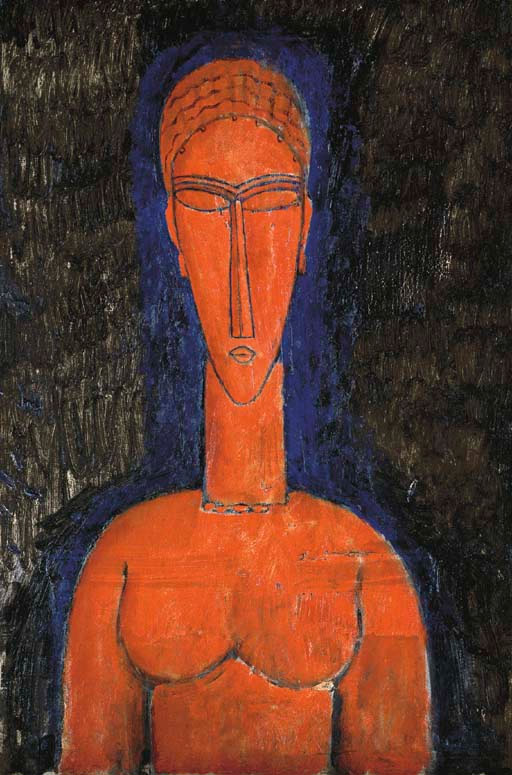
A bust of a woman, painted in orange-red, stands out against a dark brown-black ground and is surrounded by a deep blue aura. The head is a long oval. The hair is a cap of scalloped waves, with a line of dots above the forehead. The brows are two arcs drawn in double lines, which meet above a long, straight nose shaped like a narrow rectangle. The eyes are closed almonds with no pupils. The mouth is tiny. A long cylindrical neck rises from a necklace of dots. The shoulders are broad and square, and the bust is cut off just below two broad curves that mark the breasts. The flesh is a single hot orange-red, with a few paler touches on the forehead, the neck and the chest.
Ceroni catalogued the work as no. 38, Busto rosso, dated 1913 and in a private collection in Paris. It belonged to Jonas Netter and stayed in his family until it was sold at Christie's in London on 20 June 2006. The Christie's lot essay calls it "one of the most important of the rare 'Cariatide' oils of the period". It also remarks that "the viewer is uncertain as to whether this is a painting of a model or of one of the sculptures". It is the painting among Ceroni's 1913 works that is closest to the stone heads, and its title on the Secret Modigliani page, "egyptian bust", points to one of its sources.
Composition and format
The proportions of the picture are about two to three: 81 × 53.9 cm according to Christie's, 81.2 × 53.3 cm according to the Secret Modigliani page. The reproduction on the Secret Modigliani page has the same proportions. Ceroni's 81 × 40 cm and the 81 × 46 cm of Patani and Klein do not fit the image. Christie's notes "incorrect measurements" in Ceroni, Patani, the Japanese exhibition catalogue of 1997 and the Jewish Museum catalogue of 2004. Christie's dimensions are close to the standard French no. 25 marine canvas (81 × 54 cm), which would make this one of the few paintings of these years on a full-size standard canvas, if it is on canvas. Unlike C36, C37 and C40, which share a narrower format of about 81 × 45.5 cm, this painting is wider.
The figure is set on the vertical axis of the picture. The head occupies the upper third, the neck the middle and the shoulders and breasts the lower third. The width of the shoulders fills the picture almost from edge to edge, so that the bust seems to support the frame. This is why Christie's adds "Cariatide" to the title: the figure has no raised arms, but the shoulders do the work of the caryatid. The blue aura follows the contour of the head and neck, then widens over the shoulders, like a halo or a niche.
The composition is almost perfectly symmetrical, with a small displacement of the head and a slight difference between the two shoulders.
Line
The line is the main means of construction. The contours of the head, the neck and the shoulders are drawn in a dark line. Inside the face, the double arcs of the brows continue into the two parallel lines of the nose, a feature that appears in the stone heads and in the drawings of caryatids. The almond eyes are drawn in a single contour without pupils, and the mouth is a small bow. The necklace is a row of dots. The breasts are two curves that join in the middle.
The line is both firm and loose. In places it is doubled or corrected, for instance along the right shoulder and the edge of the left breast. There are scratched lines in the paint of the chest. The figure is a drawing filled with colour.
Colour
The colour is concentrated in three areas: the orange-red of the figure, the blue of the aura and the dark brown-black of the ground. The orange-red is uniform, with few modulations. Christie's speaks of "the red figure", and the title, Busto rosso, names the main sensation. The blue aura, painted in a deep ultramarine-like blue, is the complement of the orange, and the contrast makes the figure vibrate. The dark ground is made of horizontal strokes of brown, black and grey.
Christie's describes "the magnificent blue aura around the figure's head" and "the dark blue aura/shadow that surrounds the figure". It reads the blue as a light effect: "The manner in which Le buste rouge (Cariatide) looms from the darkness of the background, with the magnificent blue aura around the figure's head, hints at just such a light-source", recalling the candles that visitors saw on the stone heads in Modigliani's studio.
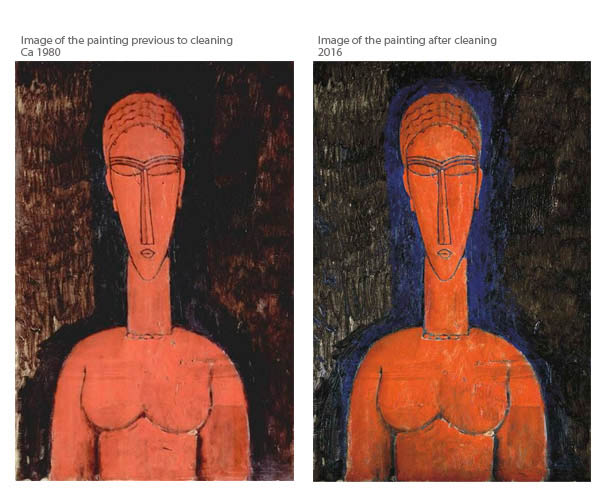
The Secret Modigliani page reproduces two images, captioned "Image of the painting previous to cleaning Ca 1980" and "Image of the painting after cleaning 2016". In the first, the blue aura is almost invisible: the figure stands against a dark background with warm red-brown strokes. In the second, the blue aura is strong and the background is cooler and greyer. The difference may be due to the cleaning, to different photography, or to both. Christie's already described the blue aura in 2006, before the date given for the second image. So either the cleaning took place before 2006, or the first image is a poor reproduction. Either way, the blue aura is an original part of the painting, and old reproductions may give a false idea of its colour.
Facture
The background is painted in thick horizontal strokes of a loaded brush, with visible ridges and a strong texture. The figure is painted more thinly and flatly, with vertical and diagonal strokes on the neck and the chest. The blue aura is applied with short strokes around the figure, overlapping both the figure and the background in places. The surface shows a contrast between the agitated ground and the calm, flat figure. That contrast makes the figure look carved out of the darkness, like a relief.
Figure and space
There is no space in the usual sense: no floor, no wall, no setting. The figure is pressed against the picture plane, the blue aura surrounds it and the dark ground lies behind it. The bust is truncated at the bottom, as a sculpted bust would be, and the long neck gives it the look of a column. Christie's reads it as "a totemic presence, a spirituality heightened by the dark blue aura/shadow that surrounds the figure", and as something that "appears less as a portrait than as an idealised vision of a deity, some strange, timeless modern guardian".
Iconography and models
Christie's essay says that the painting "echoes the reduced, elongated forms of the most elegant and celebrated of Modigliani's sculptures". It notes that Modigliani painted only a handful of works in 1913: "The most attributed to 1913 is half a dozen, of which five appeared to echo, as does Le buste rouge (Cariatide), the forms of the sculptures that he was executing in parallel." It then adds: "Here, the viewer is uncertain as to whether this is a painting of a model or of one of the sculptures."
On the sources, Christie's sees "a clear debt to African sculpture", citing comparisons with the art of "the Baulé and Fang peoples". It also says that "The sheer stillness and inscrutability appears to owe something to the hieratic art of Egypt as much as to that of Africa". It quotes Jacques Lipchitz: "Modigliani, though he admired African Negro and other primitive arts as much as any of us, was never profoundly influenced by them any more than he was by Cubism. He took from them certain stylistic traits, but he was hardly affected by their spirit". And it quotes Augustus John, who bought sculptures from Modigliani in 1913: "The stone heads affected me deeply. For some days afterwards I found myself under the hallucination of meeting people in the street who might have posed for them".
The title "egyptian bust", used by Jeanne Modigliani in 1958 according to the Secret Modigliani page, makes the Egyptian source explicit. The joined brows and nose, the closed eyes and the long neck are close to the stone heads. The necklace of dots recalls the ornament that the Jewish Museum's 2017–18 exhibition texts trace to "ancient South and Southeast Asian sources".
Comparisons
The stone heads. The closest comparisons are the limestone heads of 1911–13. Christie's speaks of "the reduced, elongated forms" of the sculptures. In the painting, the head has the same long oval, the same long nose joined to the brows, the same small mouth and the same long neck as many of the heads. I have not compared it to a specific sculpture, and I do not wish to identify a model without evidence.
C36 and C37, the standing caryatids. The standing caryatids raise their arms to carry a load. The Busto rosso has no arms visible, only shoulders. It is a bust, not a caryatid, but Christie's subtitle Cariatide reflects its function.
C40, Paul Alexandre in Front of a Window. Ceroni's note on C40 says it is "il primo ritratto che ricorda, per l'allungamento, le teste scolpite dall'artista" (the first portrait that recalls, by its elongation, the heads sculpted by the artist). The Busto rosso* shows the same elongation in its extreme form, without a sitter.
The nudes of 1916–19. Christie's says that "both in the red figure and subject matter, Le buste rouge (Cariatide) appears to prefigure the great nude paintings of the following years".
Provenance and exhibitions
Léopold Zborowski, Paris; Jonas Netter, Paris, and by descent; sale, Christie's, London, 20 June 2006, sale 7243, lot 132, sold $ 6,413,640; Acquired Mme Lilly Safra, London (+2022); "Inheritance Mme. Safra?".
Christie's gives: "Léopold Zborowski, Paris (no. 391). Jonas Netter, Paris and thence by descent to the present owner". The lot essay says that the painting "has never been on the open market since its early purchase by Jonas Netter". Christie's press release after the sale gives the estimate in pounds: "Le buste rouge (Cariatide), 1913, (estimate £1,000,000-1,500,000) sold for £3,480,000 ($6,413,640)". The site's dollar estimate is a conversion. Colin Gleadell's report of the sale in ARTnews says the painting "won a double-estimate £3.5 million ($6.4 million) from Gilbert Lloyd of Marlborough Fine Arts". The Tate Papers place the painting in the "Lilly Safra Collection, London". The Marlborough bid was made for Mrs Safra; I had the opportunity to see the painting in his fireplace.
Exhibitions, according to Christie's: Chiba, Kawamura Memorial Museum of Art, Modigliani et son époque, Paris 1910–20, 1997, no. 1, touring to Osaka, Yamagata, Niigata, Miyazaki, Kitakyushu and Tokyo (Daimaru) until 1998; New York, the Jewish Museum, Modigliani: Beyond the Myth, 2004, pl. 19, touring to Toronto (Art Gallery of Ontario) and Washington (the Phillips Collection) in 2004–05.
Discrepancies
- Medium. Christie's gives oil on canvas. The Secret Modigliani page gives oil on cardboard after visual inspection.
- Dimensions. Christie's gives 81 × 53.9 cm, the Secret Modigliani page 81.2 × 53.3 cm. Ceroni (81 × 40 cm) and Patani and Klein (81 × 46 cm).
- Date and title. Jeanne Modigliani published the painting in 1958 as The Egyptian Bust, dated 1909. All later sources give 1913.
- Zborowski stock number. Christie's gives the Zborowski number 391. I can not confirm this data, there are no stock library from Zborowski known to me.
- Location in Ceroni. Ceroni (1970) gives "Parigi, proprietà privata", consistent with the Netter family.
- Cleaning. The Secret Modigliani page dates the image after cleaning to 2016. Christie's described the blue aura in 2006. The date of the cleaning is uncertain.
Technical analysis
No technical study of this painting has been published, as far as I could find. It is listed in a footnote in the Tate Papers study of the nudes, but was not examined in that study or in the Burlington Magazine introduction (2018).
Support. The first question is the support. Christie's, in 2006, gave oil on canvas. The Secret Modigliani page gives oil on cardboard. Comparative: the Tate Papers study of hidden paintings says that "During the early years of his career, Modigliani painted on various kinds of support, from cardboard to canvas". If the support is canvas, the dimensions are close to a standard no. 25 marine. A cardboard of 81 × 54 cm would be large but not impossible.
Cleaning. The two images on the Secret Modigliani page show a large difference in the blue and in the background. If the earlier image reflects the real state of the painting, a discoloured varnish or surface dirt may have hidden the blue. Comparative: the Tate Papers report that the varnish on C40 was "very thin" and applied with a brush. Whether the present painting was varnished by Modigliani or later is unknown.
Pigments (comparative only). The blue may be ultramarine, cobalt or Prussian blue. Comparative: in C40, "The blue highlight that traces the edges of the curtain and window is cobalt blue". The orange-red may contain vermilion, red lead or an iron oxide. These are suggestions for analysis, not findings.
Facture. The thick horizontal strokes of the background and the scratched lines in the figure would repay study under raking light. They might show whether the figure was painted first and the ground added around it, or the reverse.
Conclusion
The Busto rosso is the painting of 1913 that comes closest to the stone heads. It reduces a woman to an oval head, a cylindrical neck and a pair of shoulders, painted in a single red and surrounded by a blue aura that seems to come from a light source. Christie's describes it as "a strange, perfect figure of sublime, elegance and simplicity", and as a "crossover" between sculpture and painting.
The painting raises practical questions as well. Its support is described as canvas by Christie's and as cardboard by the Secret Modigliani page. Its published dimensions vary by 14 cm in width. Its earliest published title and date, The Egyptian Bust of 1909, were later abandoned. And the two images on the Secret Modigliani page show how much a cleaning, or a photograph, can change the appearance of the blue aura on which the expressive force of the painting depends.
Museum, auction and exhibition sources
- Christie's, London, Impressionist and Modern Art Evening Sale, 20 June 2006, sale 7243, lot 132, Le buste rouge (Cariatide), https://www.christies.com/en/lot/lot-4742923
- Christie's, press release on the sale of 20 June 2006, https://www.christies.com/presscenter/pdf/06202006/18312.pdf
- Colin Gleadell, "Schiele's $21.7M Sunflowers Bloom at Christie's Imp/Mod Sale", ARTnews, https://www.artnews.com/art-news/news/schieles-21-7m-sunflowers-bloom-at-christies-impmod-sale-1753/
- The Jewish Museum, New York, Modigliani Unmasked, large-print exhibition guide, https://thejewishmuseum.org/wp-content/uploads/2025/06/Modigliani_Large_Print_FINAL.pdf
Technical literature (comparative)
- Barbara Buckley et al., "Modigliani's Painted Nudes: A Technical Study", Tate Papers, no. 35, https://www.tate.org.uk/research/tate-papers/35/modiglianis-painted-nudes-technical-study
- Anaïs Genty-Vincent et al., "Works by Modigliani that have Paintings beneath the Visible Surface", Tate Papers, no. 35, https://www.tate.org.uk/research/tate-papers/35/works-by-modigliani-that-have-paintings-beneath-the-visible-surface
- Annette King, Nancy Ireson, Simonetta Fraquelli and Joyce H. Townsend, "The Modigliani Technical Research Study: An introduction to Modigliani's materials and techniques", The Burlington Magazine, vol. 160, no. 1380 (March 2018), https://www.burlington.org.uk/archive/article/the-modigliani-technical-research-study-an-introduction-to-modiglianis-materials-and-techniques
Sources that could not be opened
The catalogues of the Japanese exhibition of 1997–98 and of the Jewish Museum exhibition of 2004 were not available online. No technical documentation, condition report or report on the cleaning was found.
Cited but not independently consulted
Jeanne Modigliani, Modigliani: Man and Myth, New York, 1958, pl. 24; Ceroni and Piccioni, I dipinti di Modigliani, 1970, no. 38; Lanthemann, Modigliani, catalogue raisonné, 1970, no. 515; Castieau-Barrielle, La vie et l'œuvre de Amedeo Modigliani, 1987, p. 65; Patani, Amedeo Modigliani: catalogo generale, 1991, no. 42; Krystof, Amedeo Modigliani: The Poetry of Seeing, 2000, p. 36; Modigliani: l'ange au visage grave, Musée du Luxembourg, 2002, p. 26, pl. 27; Klein, Modigliani: Beyond the Myth, 2004, p. 104, pl. 19; Soto Caba, Modigliani: The Timeless Face, 2007; Werner, Modigliani the Sculptor, 1965, pp. xviii and xxiii (cited in the Christie's 2006 lot essay).
Footnotes
- Jeanne Modigliani, Modigliani: Man and Myth, New York, Orion Press, 1958.
- Ambrogio Ceroni and Leone Piccioni, I dipinti di Modigliani, Milan, Rizzoli, 1970.
- Joseph Lanthemann, Modigliani, catalogue raisonné: sa vie, son œuvre, son art, Barcelona, G. Condal, 1970.
- Thérèse Castieau-Barrielle, La vie et l’œuvre de Amedeo Modigliani, Paris, ACR, 1987.
- Osvaldo Patani, Amedeo Modigliani: catalogo generale, Milan, Leonardo, 1991–94.
- Doris Krystof, Amedeo Modigliani: The Poetry of Seeing, Cologne, Taschen, 2000.
- MR (cited here as MR), Modigliani: l’ange au visage grave, Paris, Musée du Luxembourg, 2002. Cited from the published exhibition catalogue only.
- Mason Klein, Modigliani: Beyond the Myth, New York, The Jewish Museum / Yale University Press, 2004.
- Victoria Soto Caba, Modigliani: The Timeless Face, Madrid, Libsa, 2007.